AI Churn Prediction: Turn Attrition into a Weekly Action List
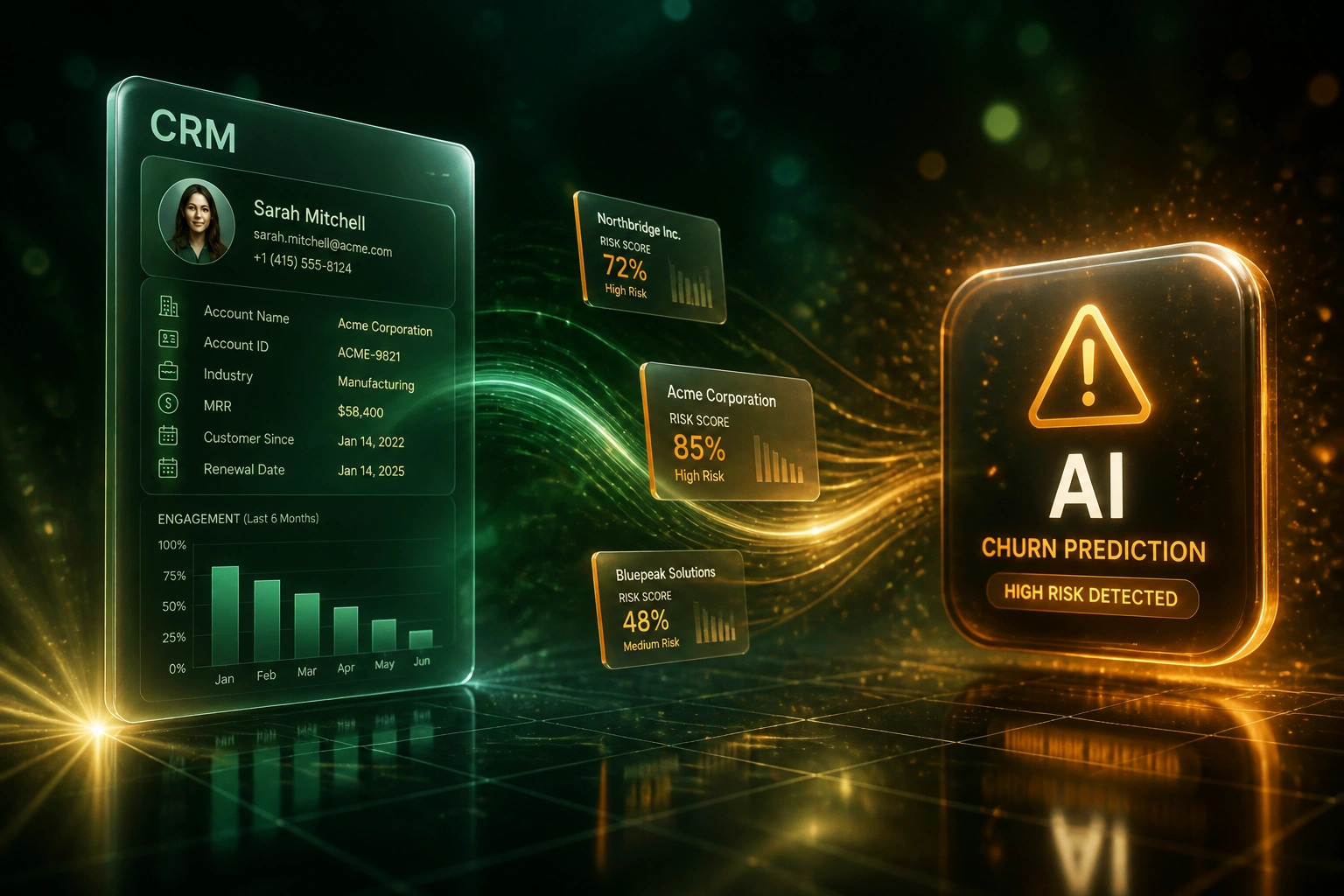
Losing customers is expensive, but prevention needs early warning. Most CEOs and CS directors still see churn as a lagging board report. Customer retention AI scores every account from CRM usage patterns and engagement decline so your team intervenes weeks before revenue walks out the door.
We build the attrition model that ranks at-risk accounts, not last month's exit list.
Sound Familiar?
These are the exact issues our clients faced before churn prediction:
- Churn shows up as a monthly board slide after the customer has already left
- CSMs only notice risk when usage has already collapsed or a cancellation email lands
- Health scores are static traffic lights that nobody trusts or updates weekly
- Save campaigns start after the renewal conversation has already gone cold
- Product, CRM, and billing signals live in separate tools, so attrition modelling never happens
New B2B SaaS sales dropped 3.3% while economic pressure pushes customers to cut tools (Paddle / ProfitWell). True churn cost is roughly 3× lost MRR once wasted CAC and destroyed LTV are included. Competitors adopting predictive retention will keep the accounts you notice too late.
What Churn Prediction Actually Does
Account activity → risk score → at-risk list → save campaign before cancellation.
Signals Update Daily
Usage, CRM activity, tickets, and billing events refresh for every live account
Model Scores Churn Risk
AI compares each account to historical leavers: engagement decline, seat drop, and support heat
Score Writes Back to CRM
Risk field and at-risk views update. Slack or task alerts fire for high bands
CS Runs Save Playbooks
Retention campaigns start weeks earlier, while the account is still saveable
Everything You Need for Reliable Customer Retention AI
Usage & Engagement Models
We train on login frequency, feature adoption, seat utilisation, and engagement decline so churn prediction reflects how customers actually use the product, not a gut-feel traffic light.
At-Risk Account Lists
Every account gets a live risk score inside the CRM. CS directors open Monday with a ranked attrition list instead of a lagging churn report.
CRM + Billing Signals
Support tickets, NPS, unpaid invoices, seat reductions, and stalled renewals feed the model so customer retention AI catches silent churn weeks earlier.
Retention Playbooks
High-risk bands trigger save campaigns: outreach tasks, executive sponsorship, discount or success plan offers, and playbook steps written back to the CRM.
CRM-Native Risk Fields
Scores write back to HubSpot, Salesforce, Pipedrive, or Dynamics. Views, dashboards, and Slack alerts filter on predicted churn risk automatically.
Continuous Retraining
Saved and lost outcomes retrain the model on a schedule. Attrition modelling stays accurate as your ICP, pricing, and product surface change.
CRMs We've Wired for Churn Prediction
From 4.8% Monthly Churn to 3.2%
How a mid-market SaaS CS team replaced lagging churn reports with AI risk scores and started saving accounts 45 days earlier.
The Lagging Churn Report
- CS director saw logo churn only after month-end finance packs closed
- Manual health reviews spotted risk about 7 days before cancellation
- Successful save rate sat at 24% because outreach started too late
- CSMs spent ~4 hours a week aggregating usage and CRM notes by hand
- Reactive saves after cancellation notices burned goodwill and discounts
The Predictive Retention Week
- Every account carries a live AI churn risk score in HubSpot
- At-risk list gives ~45 days of lead time before typical cancellation
- Save rate rose to 61% with playbooks triggered within 48 hours
- Manual aggregation dropped by ~4.2 hours per CSM per week
- Monday CS standup runs the ranked attrition list, not last month's exits
Before vs After Attrition Modelling
How It Works
From first conversation to live churn scores in 3–6 weeks.
Tell Us Your Setup
Which CRM, what usage and billing data you have, and where churn currently surprises the CS team.
Free Scoping Call
30-minute call with your CEO or CS director to define risk bands, save playbooks, and data readiness.
Build & Test
We train the churn model on your history, write scores into the CRM, and shadow live accounts for a week.
Go Live & Monitor
Switch CS workflows to the at-risk list. Dashboards track save rates, lead time, and ARR retained.
Frequently Asked Questions
How is AI churn prediction different from a CRM health score?
Most CRM health scores are static rules: open tickets, last login, or NPS. AI churn prediction scores every account from historical attrition patterns across usage, engagement decline, billing, and CRM signals. The output is a ranked early-warning list CS can act on weekly, not a traffic light nobody trusts.
How is this different from AI lead scoring or deal prediction?
Lead scoring ranks inbound prospects. Deal prediction scores open pipeline. Churn prediction scores existing customers who may leave. Same CRM stack, different decision: who to acquire, who will close, and who to save before revenue walks out the door.
What data do we need for customer retention AI?
We usually start with 12–24 months of logo churn and renewals, plus CRM activity, product usage or seat data, and billing events. Thin usage data still works with CRM and support signals; we expand features as product analytics mature and retrain as volume grows.
Will CSMs trust and act on the risk scores?
Adoption fails when scores feel arbitrary. We ship explainability (top contributing signals), calibrate bands against real churn rates, and wire retention playbooks so an alert becomes a task, not another dashboard to ignore. A shadow week lets the CS director compare model flags to gut feel before go-live.
How long does an AI churn prediction project take?
Most builds take 3–6 weeks from scoping to go-live: data audit, model training, CRM field mapping, playbook wiring, and a parallel shadow week. Cleaner HubSpot or Salesforce datasets with clear cancellation history can be live in about two weeks.
How much does AI churn prediction cost?
Custom attrition models with CRM write-back and retention playbooks typically range from R45,000 to R95,000 depending on data sources and platforms. Most teams with meaningful ARR at risk recover the project cost within 2–4 months from saved accounts and CSM hours alone.
Turn Churn from a Report into a Save List
If your CS team still finds out about attrition after the customer has left, you are paying acquisition costs to replace revenue you could have saved weeks earlier.
Tell us which CRM you run, what usage and billing data you have, and where save campaigns currently start too late. We will show you how AI churn prediction would score your book of business.