Workflow Automation | WebFootprint

Task & Project Automation

Auto-create tasks from emails, forms, or deals and route work to the right people with CRM stage-triggered sequences, territory-based lead assignment by province, postal code, or segment, AI lead routing that matches inbound leads to the best rep by expertise, territory, and capacity instead of round-robin or first-to-claim (distinct from territory rules and from lead scoring alone), behavioural and demographic lead scoring with fit/engagement models, threshold routing of hot leads to sales and nurture parking for low-fit contacts, stale-deal flags and missed-SLA escalations to managers, employee onboarding checklists with owners and SLAs for IT laptop, accounts, desk, manager intro, compliance training, and payroll setup, new-hire digital document collection portals with validation reminders and payroll/HRIS write-back before day one, ongoing HR self-service portals for payslips, leave balances, policy libraries, and personal-detail updates synced to payroll/HRIS (distinct from onboarding checklists and pre-day-one document collection), branded customer self-service portals where clients view invoices, track orders, submit requests, and access documents 24/7 without contacting the team (distinct from HR portals and from CRM order/invoice ticket deflection alone), shift rostering and skills-matched workforce scheduling with BCEA rest and overtime rule checks, full roster management covering published rotas, availability capture, and governed shift-swap request workflows with eligibility rules (distinct from weekly roster draft generation and from schedule-vs-actual variance alone), employee-initiated shift swap / schedule trading with skills, hours, and BCEA rest guardrails so managers only handle exceptions (distinct from roster building alone), scheduled-versus-actual variance closed loops that compare rostered hours to clocked time and flag buddy punching, unplanned overtime, and understaffing before payroll (distinct from roster building and roster-to-payroll write-back alone), roster and timeclock hours write-back into payroll with OT, Sunday, and shift-allowance mapping, approved timesheet → payroll hours push ending CSV re-keying into SimplePay, Sage, and PaySpace (distinct from roster scheduling and timesheet approval workflows), overtime calculation engines applying BCEA 1.5×/2× rates with daily/weekly cap checks and audit-ready OT ledgers (distinct from roster building and hours sync), overtime rules engines that encode company and BCEA thresholds, auto-flag excessive hours for manager review before pay lock, and retain exception audit trails (distinct from OT amount calculation), digital clock-in/out systems with biometric/PIN/app punch capture, buddy-punching prevention, and BCEA Section 31 attendance ledgers (distinct from OT rate engines and roster write-back), full BCEA compliance time-tracking packs covering ordinary-hours caps, Sunday and public-holiday premiums, and three-year Section 31 DoL/CCMA exports (distinct from OT calculation and OT rules engines alone), GPS-verified / geofenced clock-in for field and mobile workers with purpose-limited location stamps at punch events only (distinct from office timeclocks), offline-first mobile time tracking for field crews that queues clock events with no signal and syncs with conflict resolution when connectivity returns (distinct from GPS geofencing and office/desktop timesheets), light-touch team time tracking systems for billable-hour capture, explicit billable vs non-billable separation with weekly utilisation rate tracking by grade, capacity planning, and client profitability without Friday timesheet reconstruction, purpose-built professional services time tracking with matter codes, client/matter allocation, and utilisation/realisation reporting for law firms, consultancies, and accounting practices (distinct from generic billable vs non-billable classification and from T&M invoice assembly), plus dedicated contractor and freelancer time tracking outside internal systems with manager approval before contractor invoices are paid and client re-billing of verified hours (distinct from employee timesheet approval), multi-project time allocation so staff split hours across concurrent projects and delivery leads see which clients consume the most hours and cost before fixed-fee budgets overrun (distinct from T&M invoice assembly and forward capacity planning), recurring regulatory compliance task tracking with owners, due dates, evidence attach, and audit-ready export packs for POPIA/FICA/labour/licence obligations (distinct from HR onboarding checklists), automated payslip generation with secure portal or email distribution so salary PDFs leave shared printers and unprotected inboxes, plus project tools such as Asana, Monday.com, Jira, and ClickUp feeding deliverables into invoice drafts, Closed Won to full project spawn with contacts, scope notes, owners, kickoff briefs, attachments, and success-criteria transfer (distinct from invoice-draft feed-through), living project template libraries that stamp website-build, onboarding, audit, and campaign playbooks with tasks, milestones, roles, and SLAs from CRM wins or form intake, live resource allocation and capacity planning across Float, Resource Guru, Monday Workload, and Asana Workload so utilisation, over-allocation, and bench time are visible without spreadsheet rebuilds, and automated RAG project status reporting packs delivered on schedule from Asana, Jira, and Monday into client or exec digests, executive multi-project portfolio dashboards showing health, budget burn, timeline risk, and resource utilisation across all active projects at a glance (distinct from scheduled status packs), live budget-vs-actual and burn-rate tracking from time and expense data so overruns surface mid-delivery rather than at month-end, time and materials tracking that pushes approved hours and expenses into transparent client invoice breakdowns, project profitability analysis that ranks clients and project types by true margin from combined time, cost, and revenue, real-time project profitability and live margin P&L from time, expenses, and invoicing so delivery directors catch margin erosion mid-job (distinct from retrospective client/project margin rankings and from budget-burn tracking alone), and formal scope change / change-request capture that logs, estimates impact, and gets approval across project and CRM tools before work begins, forward-looking capacity forecasting / resource forecasting that models pipeline demand against available hours weeks ahead so yes/no decisions on new work happen before overcommitment (distinct from live utilisation boards), recurring/scheduled task creation for weekly reports, monthly compliance checks, and quarterly reviews that auto-create, assign, and track on cadence (distinct from one-shot project template stamping and from automated status-report digests), rule-based task assignment by skill, workload, location, and round-robin in Asana, Monday, Jira, ClickUp, and ServiceNow-style tools (distinct from CRM lead/territory routing), and internal department request-queue SLA timers with countdown breach alerts and multi-level escalation chains for IT, finance, HR, and ops handoffs (distinct from sales stale-deal / missed-SLA flags), automated contract renewal reminder workflows with 90/60/30 CRM tasks, calendar events, and manager escalations that protect ARR before silent churn (distinct from sales stale-deal flags), overdue task escalation ladders that climb assignee to manager to director with automatic reassignment when work sits past deadline (distinct from SLA countdown timers alone), task status-change triggers that notify stakeholders, refresh dashboards, spawn follow-up tasks, and fire cross-tool actions when status moves (e.g. In Progress to Done), distinct from recurring schedules and from assignment-on-create rules, and bidirectional task field sync (status, assignee, due date, comments) across Asana, Jira, Monday.com, and CRM so dual-tool teams stop duplicate entry, living rate card management with governed client/project/staff billing rates, effective dates, and stale-rate alerts so invoice amounts stay accurate (distinct from hours-to-invoice assembly), live retainer hour-balance tracking with low-hour alerts at 75–80% and top-up/overage billing triggers so prepaid hour blocks do not run dry mid-month (distinct from recurring retainer invoice generation), and project-tool milestone completion that fires same-day invoices in Xero, Sage, or QuickBooks (distinct from CRM deposit and retainage billing), field service management systems with digital dispatch boards, mobile job cards, completion tracking, and customer ETA/completion updates for HVAC/electrical/plumbing/facilities crews (distinct from GPS clock-in and shift rostering), skills/location/availability job scheduling and dispatch automation that replaces Excel and phone-call assignment (distinct from office shift rostering and appointment booking), field-team route sequence optimisation that cuts fuel and kilometres and lifts jobs-per-day (distinct from GPS geofenced clock-in and appointment scheduling), purpose-built field service mobile apps with digital job cards, on-phone navigation, completion forms, photo/signature capture, and same-day close-out to billing (distinct from GPS clock-in and offline time tracking), offline-first field apps that queue forms, photos, and time logs with no signal and sync with conflict resolution when connectivity returns (distinct from Shopify POS offline catch-up and from GPS-only clock-in), mandatory digital job completion checklists with required fields and photo evidence as a quality gate (distinct from HR onboarding checklists), mandatory before-and-after photo capture with automatic timestamping and close-out gates for dispute and chargeback protection (distinct from optional photo/signature capture on mobile job cards), live GPS dispatch visibility with customer ETA feeds from real movement and lone-worker safety check-ins/SOS (distinct from GPS-verified / geofenced clock-in), and customer-facing online service appointment booking with live technician calendar sync and double-booking prevention (distinct from internal job scheduling/dispatch and from website booking widgets under Email & Communication Workflows), recurring preventive maintenance schedule automation that auto-creates jobs N days before due windows with reminder notifications and PM compliance tracking (distinct from reactive skills/location dispatch and from the full FSM platform overview), emergency priority dispatch with nearest-tech schedule override, acknowledgement escalation on no-ack, and after-hours on-call rotations (distinct from day-planning job scheduling and from SLA compliance measurement), field-service customer-contract SLA tracking with response/resolution clocks, on-site arrival windows, and penalty-clause monitoring (distinct from internal department request-queue SLA timers), South Africa-aware field service stacks with load-shedding-aware scheduling, offline mobile job cards, ZAR/VAT invoice hand-off to Xero or Sage Pastel, and WhatsApp customer ETAs (distinct from generic FSM platform pages), job-completion mobile invoice triggers that raise parts/labour/callout invoices the moment a tech closes a job with optional on-site payment capture (distinct from CRM Closed Won invoice drafts and from project-tool milestone invoicing), and revenue leakage / timesheet-vs-invoice discrepancy detection with unbilled-hours and wrong-rate alerts (distinct from hours-to-invoice assembly and retainer balance tracking). structured RFP and tender response workflows with reusable answer libraries, multi-contributor section ownership, BBBEE/SBD compliance checklists, and deadline clocks for eTender and municipal closes (distinct from tender alert scrapes alone), automated marketing-to-sales lead handoff with SLA timers so MQLs never sit unowned between teams (distinct from territory rules and from lead scoring alone), governed pricing catalogue sync into quoting tools for SKU list prices, customer tiers, volume breaks, and multi-currency so reps stop looking up prices in spreadsheets (distinct from CPQ configuration engines and from narrative proposal packs), Includes Zapier vs Make vs n8n platform selection and iPaaS vs custom / build-vs-buy decision criteria (volume, complexity, SLA, ownership) so teams do not overpay for platforms or over-engineer simple syncs, plus AI workflow optimisation and process mining that ranks bottlenecks, rework loops, and automation candidates from CRM, ERP, and ticket event logs before you wire the next workflow, agentic AI that replaces brittle Zapier-style chains with autonomous multi-step planning, escalation, and cross-system write-back (distinct from process mining alone), deterministic rules-based ticket routing and auto-assign by skills, VIP, priority, language, product line, and round-robin (distinct from AI content classification), and customer-facing helpdesk SLA management with first-response and resolution timers plus breach-before escalation on Zendesk, Freshdesk, Intercom, and HubSpot Service (distinct from internal queue or field-contract SLAs), and proactive SLA breach-alert configuration with 50%/75%/90% warning thresholds so managers intervene before the deadline rather than discovering misses in Monday reports, lead leakage prevention that closes orphan CRM records, form and WhatsApp capture gaps, and first-touch SLA enforcement so paid prospects are never left uncontacted (distinct from MQL-to-SQL handoff scoring), searchable digital SOP libraries with version control and acknowledgement tracking that replace paper binders and stale shared-drive Word docs (distinct from employee onboarding checklists alone), searchable internal knowledge bases and team wikis that capture FAQs, how-tos, and institutional knowledge so staff self-serve without interrupting seniors (distinct from digital SOP libraries and from customer-facing help centres), and month-end finance close checklists with named preparer/reviewer assignment, due-date escalation, completion dashboards, and audit-ready sign-off trails (distinct from recon/accrual/journal automation and from process redesign), outcome-based employee output visibility and productivity dashboards that track deliverables rather than keystroke surveillance (distinct from timesheet and roster tools), multi-branch / multi-location operations platforms with standardised SOPs across sites, centralised branch reporting for regional managers, structured store-walk follow-ups, and new-branch playbooks (distinct from multi-location CRM alone), and franchise operations centralisation with royalty reconciliation, brand playbook distribution, and outlet compliance scoring for franchisee networks (distinct from company-owned multi-branch ops), plus multi-site asset tracking for equipment location, condition, and move history across offices, warehouses, and remote sites so ops stop buying duplicates because Site B cannot find the generator (distinct from warehouse stock sync and from fixed-asset depreciation registers), custom fleet management platforms unifying GPS location, driver assignment, service due, and cost dashboards (distinct from field-service GPS dispatch and route optimisation), own-fleet service schedules with licence renewal and COF compliance clocks (distinct from customer-asset preventive maintenance), and fleet fuel cost tracking with L/100km and anomaly alerts for theft and idle waste (distinct from route fuel savings alone), project margin monitoring with threshold alerts and mid-flight resource reallocation when jobs drift unprofitable (distinct from real-time P&L dashboards alone), and compliance calendar ladders with staged 90/60/30/7 filing reminders, prep-task assignment, and escalation when owners go quiet (distinct from checklist or evidence-attach task trackers alone), service contract expiry registers with renewal value-at-risk dashboards and sales/ops renewal workflows for maintenance SLAs, support retainers, and managed service agreements (distinct from generic 90/60/30 CRM reminder tasks alone), warranty claims processing with digital submission, validation rules, live status tracking, and automated customer updates for aftersales teams (distinct from RMA returns / pick-pack-ship), live tender bid-pipeline tracking with opportunity owners, closing clocks, submission-pack status, and win/loss logging (distinct from eTender discovery scrapes and from RFP answer libraries alone), digital QMS NCR/CAPA workflows with document control and ISO audit packs for manufacturing (distinct from computer-vision QC), and shop-floor quality inspection digitisation with mobile checklist capture, pass/fail alerts, offline floor mode, and live quality dashboards for manufacturing and food plants (distinct from field-service job completion checklists).

Email & Communication Workflows

Drip sequences and live sales cadence automation with CRM-triggered personalised multi-step follow-ups that stop on reply or meeting booked, including post-quote nurture sequences (distinct from cold outbound cadences) so every sent quote gets a disciplined day-1 / day-3 / day-7 chase, behaviour-and-lifecycle nurture workflows that re-engage quiet MQLs and hand warm leads to sales, CRM-stage-mapped lifecycle journeys from prospect to advocate covering welcome, onboarding, retention, and win-back, living audience segments and list hygiene with behaviour, demographic, engagement, and RFM sync into HubSpot, Klaviyo, ActiveCampaign, and Mailchimp, dynamic email content blocks with conditional modules and feed-driven product or offer personalisation per recipient (distinct from trigger timing), behavioural and event-based email triggers for pricing-page visits, content downloads, product views, and browse/cart abandonment, post-purchase cross-sell and upsell product recommendation flows from purchase history, bi-directional Marketo / HubSpot Marketing Hub / ActiveCampaign / Mailchimp ↔ CRM sync with shared lead handoff state and closed-won feedback, multi-touch attribution connecting UTM and ad spend to CRM closed deals and channel ROI, cross-channel campaign orchestration with shared CRM journey state, person-level frequency caps, and collision prevention across email, SMS, WhatsApp, and social, CRM-synced newsletter and promo campaign automation with audience sync and send-time optimisation, AI marketing content automation that turns CRM segments and product launches into on-brand email, social, and product-description kits with human approval before HubSpot, Mailchimp, Meta Ads, and Shopify publish, lead capture forms, campaign landing page form CRM sync from Unbounce, WordPress, Webflow, and custom pages with UTM and source attribution, Meta Lead Ads sync, TikTok Lead Ads Instant Form CRM sync with sales SLA and Events API feedback, LinkedIn Lead Gen Forms Instant Form CRM sync with campaign and creative context, organic Instagram, Facebook, and LinkedIn DM, comment, and inbox lead routing into CRM with owner assignment and first-response SLA, Google Ads lead form extension CRM sync, and Click-to-WhatsApp (CTWA) ads CRM capture with attribution, on-site website chatbot lead capture with mid-conversation qualification and CRM write-back of transcript and score, plus AI support-ops chatbots for Tier-1 deflection and helpdesk escalation with full context, customer-facing RAG support that answers only from synced knowledge bases with citation trails (distinct from deflection-only chatbots), customer-facing AI chatbot deployment and go-live across web and WhatsApp with containment-rate ops (distinct from Tier-1 deflection alone), AI ticket routing that assigns helpdesk tickets to the right queue by content; AI ticket priority scoring that ranks support requests by content urgency, customer value/ARR, and SLA deadline pressure (distinct from AI ticket routing and from sentiment-plus-urgency inbox triage), intent, language, and priority (distinct from chatbot answers), sentiment-plus-urgency scoring on inbound email and WhatsApp that reorders the inbox so angry or at-risk customers are handled first (distinct from AI ticket routing by content/intent and from CRM churn-risk write-back), WhatsApp chatbots, WhatsApp-to-CRM conversation logging onto contact timelines, WhatsApp Business API multi-agent team inbox with assignment, collision prevention, handoffs, and first-response SLA timers on one business number, WhatsApp template creation with Meta approval tracking and versioning, CRM-triggered WhatsApp broadcast campaigns, courier-triggered WhatsApp confirmation, dispatch, out-for-delivery, and delivered templates, conversational WhatsApp appointment booking that writes live slots into calendar and CRM, WhatsApp payment and dunning reminder sequences with gateway Pay Now links, SMS payment reminder sequences with PayFast, Ozow, and Yoco Pay Now links for overdue invoices, multi-channel debtor escalation ladders (email → SMS → CRM call task → final notice) that are rules-based and channel-agnostic (distinct from WhatsApp-only or SMS-only payment reminder sequences), and lightweight SME debtor management systems with live aging dashboards, chase status, and owner-operator workflows (distinct from SMS/WhatsApp dunning alone), live WhatsApp Commerce catalogue sync for in-chat shopping, VoIP click-to-call with automatic CRM call logging and screen-pop, abandoned cart recovery, timed multi-channel appointment reminder sequences (7-day / 48-hour / morning-of SMS and email) that cut no-shows, field-service customer notification journeys covering booking confirmation, day-of reminder, technician en-route ETA, arrival, and job completion summaries that cut where's-my-tech status calls (distinct from reminder-only sequences and generic transactional SMS), SMS-only 24-hour and 1-hour reminder sequences, bulk SMS gateway integrations (Clickatell, SMSPortal, Twilio, Africa's Talking) with CRM-triggered mass SMS, DLR sync, and POPIA opt-out, transactional SMS for OTPs, delivery alerts, and service notifications, two-way SMS with YES/NO/STOP keyword parsers and inbound webhook CRM write-back, SMS marketing campaign automation with CRM segmentation, triggered offers, and A/B testing, Gmail API OAuth logging with labels and thread sync for Google Workspace, Microsoft Graph Outlook-to-CRM email sync with Entra ID consent and shared mailbox capture, automatic email-to-deal association by recipient domain and open opportunity, shared inbox management with ownership assignment, collision and duplicate-reply prevention, and SLA tracking for info@ / sales@ / support@, email parsing of unstructured enquiry and partner-referral emails into structured CRM lead records, transactional email API integration (SendGrid, Postmark, Amazon SES, Resend) for order confirmations, password resets, and receipts with delivery analytics, self-serve scheduling links with availability and buffer rules plus CRM deal creation from bookings, embedded website booking widgets that convert traffic into confirmed appointments and CRM leads 24/7, Google/Outlook calendar sync with meeting auto-logging and follow-up reminders, marketing automation handoff, HubSpot workflow/sequence migration into a destination CRM with enrolment criteria, delays, and if/then branching rebuilt before cutover, and Outreach / Salesloft / Salesforce Sales Engagement cadence rebuild (step timing, templates, enrolment, A/B variants, and mid-cadence handoff) so outbound does not go dark at cutover, plus structured helpdesk system setup on Zendesk, Freshdesk, or HubSpot Service with email-to-ticket, ticket lifecycle and statuses, CSAT dashboards, and CRM write-back as a commercial setup engagement distinct from AI deflection and AI routing, knowledge base and help centre setup strategy with taxonomy, article ownership, templates, review cadence, search tuning, and ticket-deflection metrics (distinct from AI deflection chatbots), branded customer support portals for ticket submission, live status tracking, and help-article self-service (distinct from CRM order or invoice portals), support ticket escalation rules with priority and age thresholds, manager alerts, and auto-reassignment (distinct from SLA dashboards and initial routing), omnichannel unified inbox integrations that pull WhatsApp, email, chat, phone, and social into one agent timeline on Zendesk, Freshdesk, or Intercom (distinct from multi-channel campaign orchestration), omnichannel ticket continuity strategy so email→WhatsApp→phone→chat hops stay on one ticket with a single agent view and fewer repeat contacts (distinct from wiring channels into a unified inbox), end-to-end support workflow automation for status updates, pending follow-ups, and auto-closures across the ticket lifecycle (distinct from routing, escalation rules, and first-response-time optimisation), and first response time optimisation with auto-acknowledgements, priority routing, and ageing-ticket agent alerts so customers hear back in minutes rather than hours. Also covers AI email triage that classifies shared-inbox intent and auto-routes enquiries, complaints, and orders; voice AI phone receptionist for inbound call answering, calendar booking, and warm transfer when a human is needed; and AI translation in email, chat, WhatsApp, and document workflows so every agent can serve multilingual customers without a bilingual seat per language; keyword-matched SA government tender email and SMS alerts to the bid desk when Apify detects a matching eTender or provincial notice (distinct from marketing SMS and from portal-monitoring scrapes alone); and Google Reviews response-workflow triggers with SLA alerts and sentiment trend tracking so multi-location CX teams reply before a 1-star sits public for days (distinct from review aggregation dashboards alone).

Approval Chains

Quote approvals with value and discount threshold routing to the right manager or director before the customer sees the PDF, percentage-threshold discount approval hierarchy (rep to manager to director with SLA escalation) so margin governance does not stall low-discount deals, employee expense claim workflows with mobile receipt capture, policy checks, and ledger or payroll reimbursement posting (distinct from supplier AP invoice OCR), automated expense policy enforcement that flags out-of-policy claims, missing receipts, duplicates, and limit breaches before approval or payment (distinct from reimbursement-speed claim workflows and from full digital expense platforms), purpose-built digital expense management platforms that replace shared Excel/Google Sheets workbooks with policy engines, audit trails, and live ledger sync (distinct from claim-only automation and from AI receipt categorisation), timesheet review, contractor and freelancer hour approval gates before contractor invoices are paid, annual leave and HR leave-balance approvals with accrual sync, calendar blocks, and leave-balance write-back into payroll for unpaid deductions and first-time-right pay runs, multi-type absence request systems covering sick, family responsibility, study, unpaid, and short-notice leave with calendar conflict checks (distinct from payroll leave write-back and maternity UIF packs), maternity and parental leave workflows with BCEA entitlement date tracking, UIF claim document packs (UI-19/UI-2.7), payroll leave-status changes, and return-to-work scheduling, digital employment contract e-signing with ECT Act audit trails and signed-file write-back to the employee record and payroll readiness checklist (distinct from generic contract approvals and e-sign-to-invoice), AP and finance invoice approval with amount thresholds and escalation, intelligent AP coding that routes supplier invoices to the right cost centre and approver, e-sign-to-invoice triggers, multi-level purchase-order approval by value band and category before supplier release, digital procurement request workflows that replace email approval chains with pre-approval budget gates and exportable audit trails (distinct from threshold-only PO routing and from three-way GRN matching), and document approval routing for proposals, contracts, policies, and discount requests, with SLA escalations via Slack, Teams, or email and CRM-linked audit trails, plus AI approval intelligence that risk-scores purchase orders, expenses, leave, and discount requests, auto-approves low-risk items same day, and escalates high-risk exceptions to senior staff with a full audit trail (distinct from threshold-only routing and process-mining optimisation), cross-request electronic approval routing engines with configurable amount, department, and cost-centre rules, leave delegation, SLA escalation, and mobile sign-off (distinct from single-document invoice, quote, or discount pages), and paper-to-digital approval digitisation that retires wet-ink desk packs and couriered sign-offs with POPIA-ready who/when/signed trails (distinct from email document-approval routing alone), and commission statement approval workflows before payroll export (distinct from expense and PO approvals alone)

Scheduled Jobs & Sync

Nightly syncs including close-cycle time-to-accounting cost journal posts for project costing, periodic reports, inventory fan-out across Shopify, WooCommerce, and Takealot, Amazon FBA / Seller Central inventory and settlement fee sync alongside local warehouse stock, live available-to-sell and stock-level visibility across warehouse, POS, and ecommerce, real-time multi-location stock synchronisation that closes warehouse-to-till-to-online lag to prevent overselling and stockouts, Shopify POS ↔ online store sync with BOPIS reservation and offline-mode catch-up, multichannel product listing and catalogue sync (titles, descriptions, images, and attributes from a master PIM to every storefront), marketplace price synchronisation for list, promo, and MAP with margin floors across Shopify, Takealot, Amazon, and WooCommerce, B2B wholesale portals with tiered pricing, credit enforcement, and trade self-service ordering into ERP, ecommerce order-to-ERP capture from online stores and marketplaces with stock reservation and fulfilment status sync-back, wave picking, pack-station print, courier label handoff, and storefront fulfilment status sync, RMA returns automation (self-service return request, approval, courier return label, refund or exchange, and warehouse restock), pre-ship fraud scoring holds with release or reject before pick, multi-carrier label generation, rate shopping, and tracking write-back into Shopify/WooCommerce/ERP (DHL, FedEx, UPS, ShipStation-style), SA multi-courier quote, book, waybill print, and tracking sync for The Courier Guy, Aramex South Africa, Dawn Wing, Pargo, RAM, and Fastway alongside Shopify / WooCommerce / Takealot seller fulfilment, Google Shopping and Meta Commerce Catalogue product feed generation with validation and scheduled refresh (distinct from marketplace price sync and PIM-to-storefront listing sync), reorder-point threshold alerts with draft purchase-order creation and buyer/supplier notifications, multi-channel low-stock threshold alerts with WhatsApp, email, Slack, and Teams escalation for buyers and ops (distinct from purchasing automation), full WMS integration covering receiving, putaway, bin locations, and directed pick/pack/ship as the warehouse system of record synced to Shopify, WooCommerce, and ERP, full purchase-order automation with approval routing and supplier email/EDI send, end-to-end request-to-receipt procurement (requisition → PO → approval → supplier send → goods receipt) distinct from threshold PO generation alone and from AP three-way match alone, live procurement tracking dashboards with order-status and budget-burn visibility from requisition to delivery (distinct from PO creation and approval-matrix workflows), demand forecasting and recommended purchase quantities from sales history (distinct from simple min/max alerts), supplier and vendor master sync with OTIF scorecards and preferred-vendor defaults for ERP PO lines, continuous supplier performance management with live OTIF, quality, and price-drift dashboards plus dated vendor improvement actions (distinct from quarterly ratings alone), and formal weighted supplier scorecards for tenders, renewals, preferred-supplier lists, and BBBEE preferential-procurement evidence packs (distinct from live OTIF dashboards), multi-warehouse location hierarchy with inter-warehouse transfer confirmation, cost- and zone-aware order routing with split-shipment rules and nearest-DC fulfilment, barcode cycle counting and stocktake variance write-back to ERP/WMS, AP three-way match of PO, GRN, and supplier invoice before payment release, SARS filing deadlines, and disaster recovery runbooks. Also production webhook receivers and emitters with signed payloads, HMAC signature verification and secret rotation so forged events never write CRM or payment state, API gateway design patterns as a unified front door for authentication, routing, rate limits, and response aggregation across CRM, mobile, and partner clients, consistency-model selection so inventory stays real-time while invoices and analytics can be eventual, transactional outbox plus a decision framework across outbox, saga, and choreography when 2PC cannot span HubSpot, Xero, and warehouse SaaS, holistic partial-failure recovery with checkpoint replay, compensation, intervention queues, and human escalation across CRM, payments, and accounting (beyond retries or circuit breakers alone), silent-failure monitoring with health checks, lag metrics, meaningful alert thresholds, and on-call routing so sync gaps surface in minutes not days, structured integration logging with correlation IDs across CRM→payment→accounting hops so mean-time-to-diagnose drops from hours to minutes, consumer-driven contract testing (Pact-style) with contract brokers and can-I-deploy release gates that catch undocumented vendor API changes before production, idempotent once-only write paths, ordered delivery, retries with exponential backoff and jitter plus dead-letter queues with poisoned-message quarantine and replay playbooks, circuit breakers that fail fast when a payment gateway, Xero, or warehouse API is already down so cascading failure does not freeze checkout and CRM, request timeout handling with distinct connect vs read budgets, post-timeout verification, and verify-before-retry so ambiguous unknown states do not create duplicate invoices or charges, event-driven domain events and pub-sub fan-out when a deal closes, payment lands, or stock moves (distinct from overnight batches and queue buffering for spikes), API versioning with dual-running adapters and sunset migration windows that keep CRM and accounting syncs alive through vendor upgrades, additive-only / non-breaking API evolution with published deprecation windows and dual-run consumer paths so partner syncs survive vendor changes without emergency weekends, saga orchestration with compensating actions for multi-system order-to-cash flows that must complete fully or cleanly undo, rate-aware token-bucket and sliding-window pacing with priority lanes so HubSpot, Salesforce, and Xero syncs do not stall on 429s, and queue-backed async layers that absorb spikes so a slow ERP does not freeze the CRM Also load-shedding-tolerant sync design with durable queues, offline buffers, and catch-up reconciliation for CRM, ecommerce, and accounting during Stage 4 to 6, plus load-shedding-aware scheduling that consults EskomSePush and municipal calendars and shifts batch jobs, syncs, and campaigns into live power windows (distinct from resilient catch-up queues), and Apify scheduled Actor runs with monitoring alerts and automatic retries so scraper uptime is an ops schedule concern, not a Monday morning surprise, plus Apify webhooks into Slack and Microsoft Teams channels for ACTOR.RUN.FAILED and timed-out run alerts with run summaries and empty-dataset guards, and Apify Actor webhooks into n8n, Make, or Zapier for no-code scraped-data routing to Sheets, CRM, Slack, and warehouses, daily sales-manager pipeline briefs and overnight slippage flags on a morning cadence (distinct from stale-deal flags alone), automated executive board report drafting from live finance and ops feeds so commentary is reviewed not rebuilt, and digital board pack / investor document assembly from live financial extracts plus departmental uploads into one versioned pack, month-end close cycle automation for continuous reconciliations, accrual drafting, and recurring journal workflows that cut close from 8–15 working days toward under 5, and financial close process mapping with bottleneck diagnosis and close-cycle compression from weeks to days (distinct from checklist task tracking and from recon/journal automation alone), digital equipment registers with purchase dates, depreciation schedules, maintenance windows, and assignment history synced into the FAR and ledger (distinct from multi-site location tracking alone), and fixed-asset lifecycle control from procurement through deployment, maintenance, depreciation, and disposal with residual-value checks and ghost-asset write-offs (distinct from equipment register master data alone), plus sales commission calculation engines that apply tiered rates, splits, overrides, accelerators, and clawbacks to CRM closed deals and produce audit-ready payout statements (distinct from pipeline dashboards and team performance scorecards), live quota-band / tier visibility and multi-product SPIF ladders so reps always know which rate band they are in (distinct from end-of-cycle payout statements alone), and commission payout pipelines from closed-won through manager approval to payroll export into SimplePay, Sage, or PaySpace with a full audit trail (distinct from calculation engines alone), pricing-feedback loops that feed actual cost-vs-quoted-revenue into the next quote so underquoting stops repeating, and scheduled regulatory report pack assembly from finance, HR, and ops sources with validation and audit evidence before filing day (distinct from generic periodic reports alone).

Single Sign-On & Identity

SSO with Entra ID, Okta, or Google Workspace, HRIS-driven provisioning and offboarding from Sage 300 People, SimplePay, PaySpace (Deel Local Payroll), and other payroll masters with same-day access revocation across email, CRM, payroll, and SaaS when someone leaves, MFA, RBAC, zero-trust access, API key vault management, and gateway-level authentication policies with single-place partner key rotation so credentials are not scattered across CRM, payment, and partner microservices.

Related Articles

A glass CRM panel showing billable hours connected to an Accounting badge by a lime ribbon carrying timesheets and invoices, illustrating an automated billable-hours pipeline

Time Tracking to CRM to Accounting: Billable Hours Pipeline

A 14-person consultancy cut timesheet-to-invoice admin from 8 hrs/week to 40 minutes, recovered R890K in previously unbilled hours in year one, and closed billing 11 days sooner.

A CRM panel and Accounting badge linked by a copper-gold ribbon carrying escalating reminder, overdue, and final-notice documents, illustrating automated dunning sequences

Dunning Automation: CRM-Triggered Payment Follow-Up Sequences

One client cut DSO by 18 days and lifted overdue recovery from 28% to 74%, pulling R1.9M AR forward. CRM-triggered day-7 to day-30 dunning sequences run without burning goodwill.
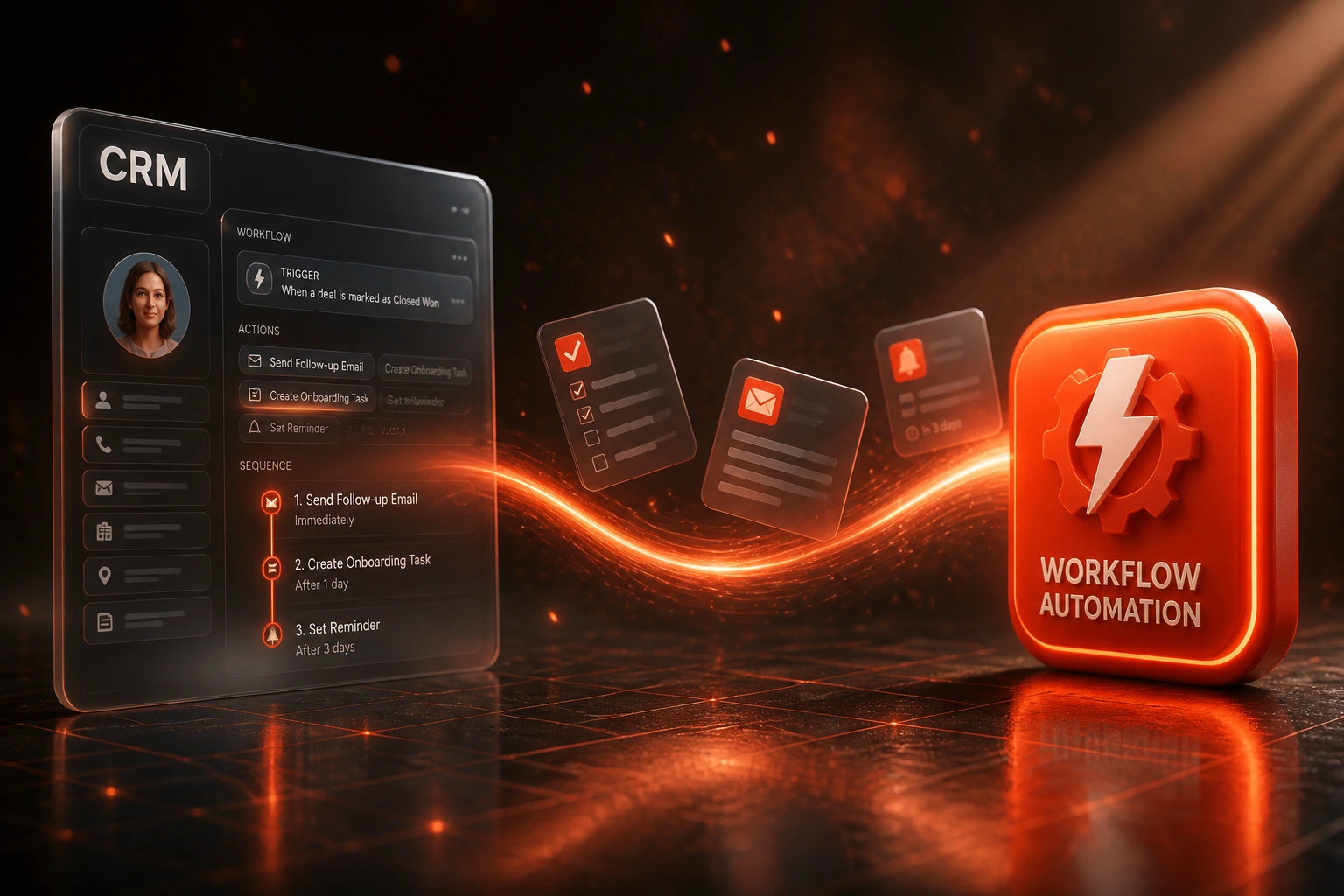
A glass CRM panel with a trigger and sequence UI connected by a coral ribbon of task and email cards to a workflow automation badge

CRM Workflow Automation: Triggers, Actions and Sequences

A 6-rep team cut CRM chores from 5 hrs/week each to 45 minutes, recovered R480K+ in selling time, and answered inbound leads in under five minutes with triggers, sequences, and routing.

A glass CRM panel with Rand amounts and +27 phone numbers connected by a ribbon of POPIA, invoice, and PayFast documents to a South Africa localisation badge

CRM for South African Businesses: Local Requirements

A Joburg wholesaler recovered 14 hours a week and closed a R5m POPIA exposure gap after we localised CRM for ZAR, Sage Pastel, PayFast ITN, and load-shedding sync queues.

A glass CRM panel and the WhatsApp logo linked by a ribbon of chat bubbles, illustrating WhatsApp CRM integration for business messaging

WhatsApp CRM Integration: Business Messaging at Scale

A Cape Town sales team went from 8 hours a week hunting personal WhatsApp chats to sub-5-minute responses, recovering 350+ hours and R140K+ in year one once every chat lived in the CRM.
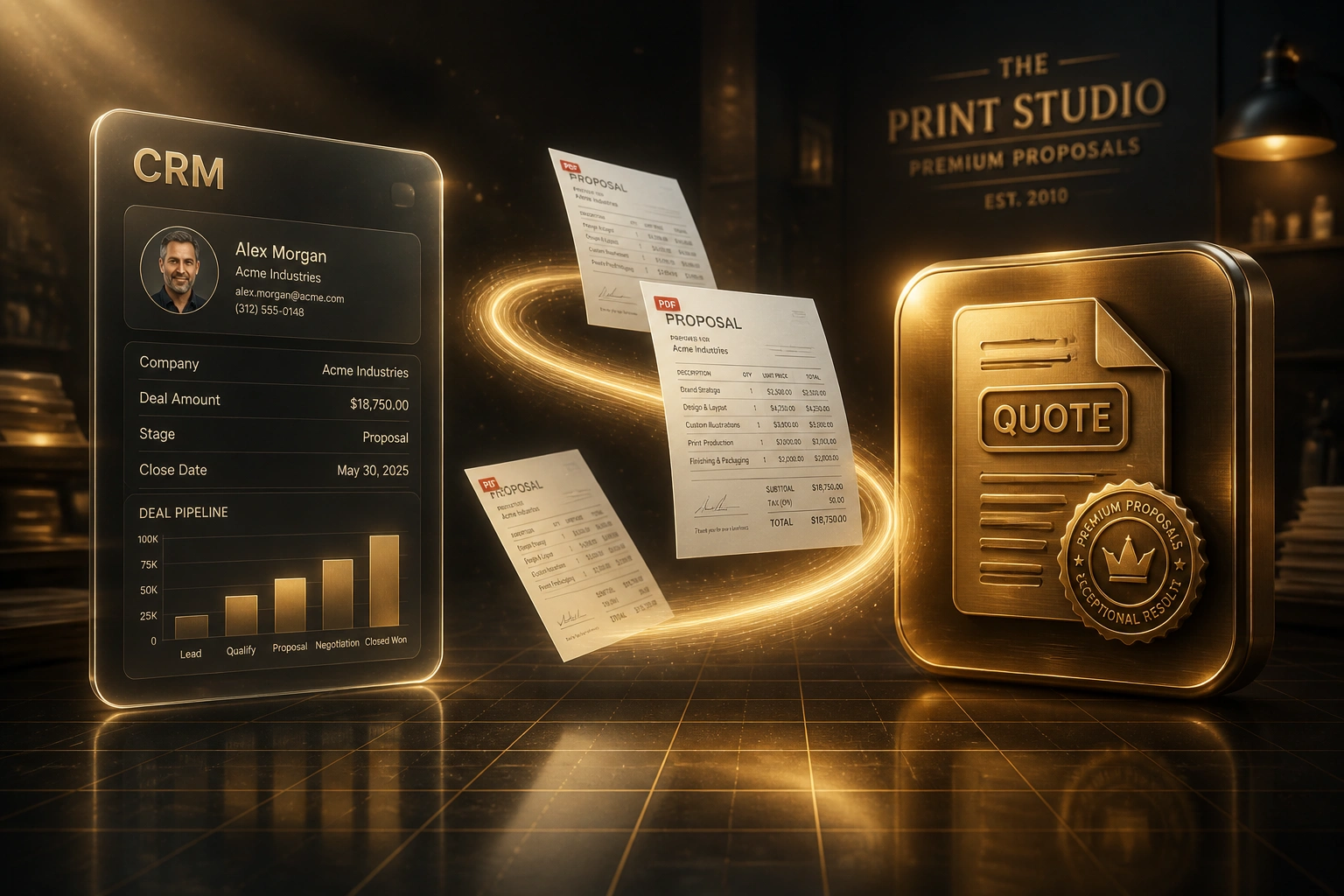
A glass CRM panel connected by a brass-gold ribbon of PDF proposal documents to a glossy QUOTE seal badge, illustrating automated CRM quote and proposal generation

CRM Quote Generation: From Pipeline to Professional Proposals

One sales team cut quote build time from 47 minutes to under 5. They recovered 12 hours a week, cut pricing errors near zero, and now ship branded proposal PDFs the same morning.

A glass CRM panel and a glossy marketing automation badge connected by a cyan ribbon of lead score cards, illustrating bidirectional CRM-marketing automation sync

CRM and Marketing Automation: Keeping Sales and Marketing Aligned

One client lifted MQL-to-SQL from 8% to 22% and cut lead response from 18 hours to under five minutes. They recovered R340K+ in year one with bidirectional CRM-marketing sync.

Glass CRM panel and a glossy Workflows Automation badge linked by an S-curved copper ribbon of workflow rule cards in a warm forge with electric blue sparks

Migrating CRM Workflows and Automations to a New Platform

One COO cut 87 undocumented CRM workflows to 41 live rules with full parity tests, restored SLA emails in 11 days, and recovered R184K in stalled day-one pipeline revenue.
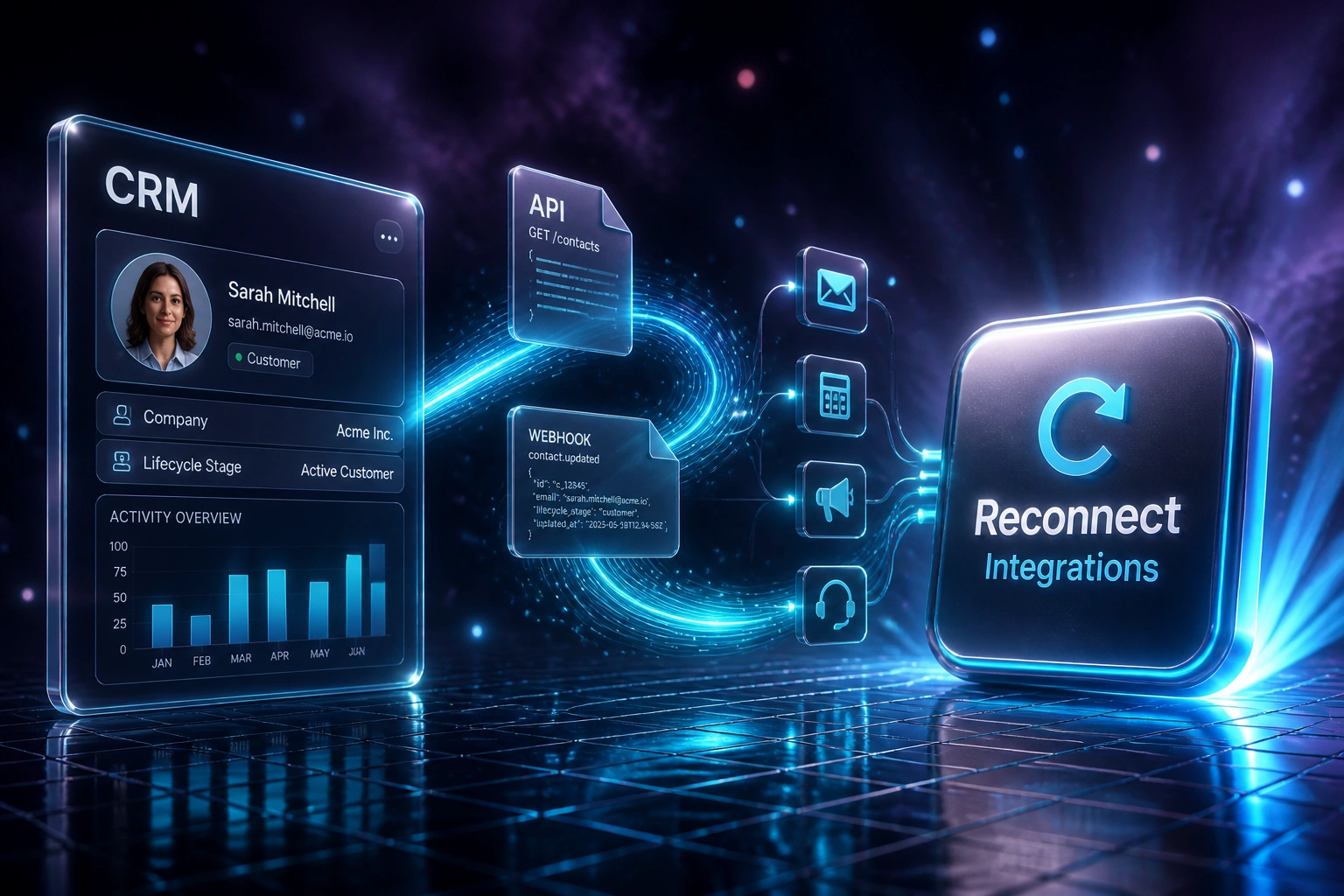
A glass CRM panel linked by a cyan cable ribbon of API and webhook documents to a glossy Reconnect Integrations badge in a violet dusk void

Reconnecting Integrations After CRM Migration

One mid-market team reconnecting 34 CRM apps cut silent sync failures to zero before cutover, with invoicing and email live in week one. Full inventory, Zapier rebuild, webhook smoke tests.
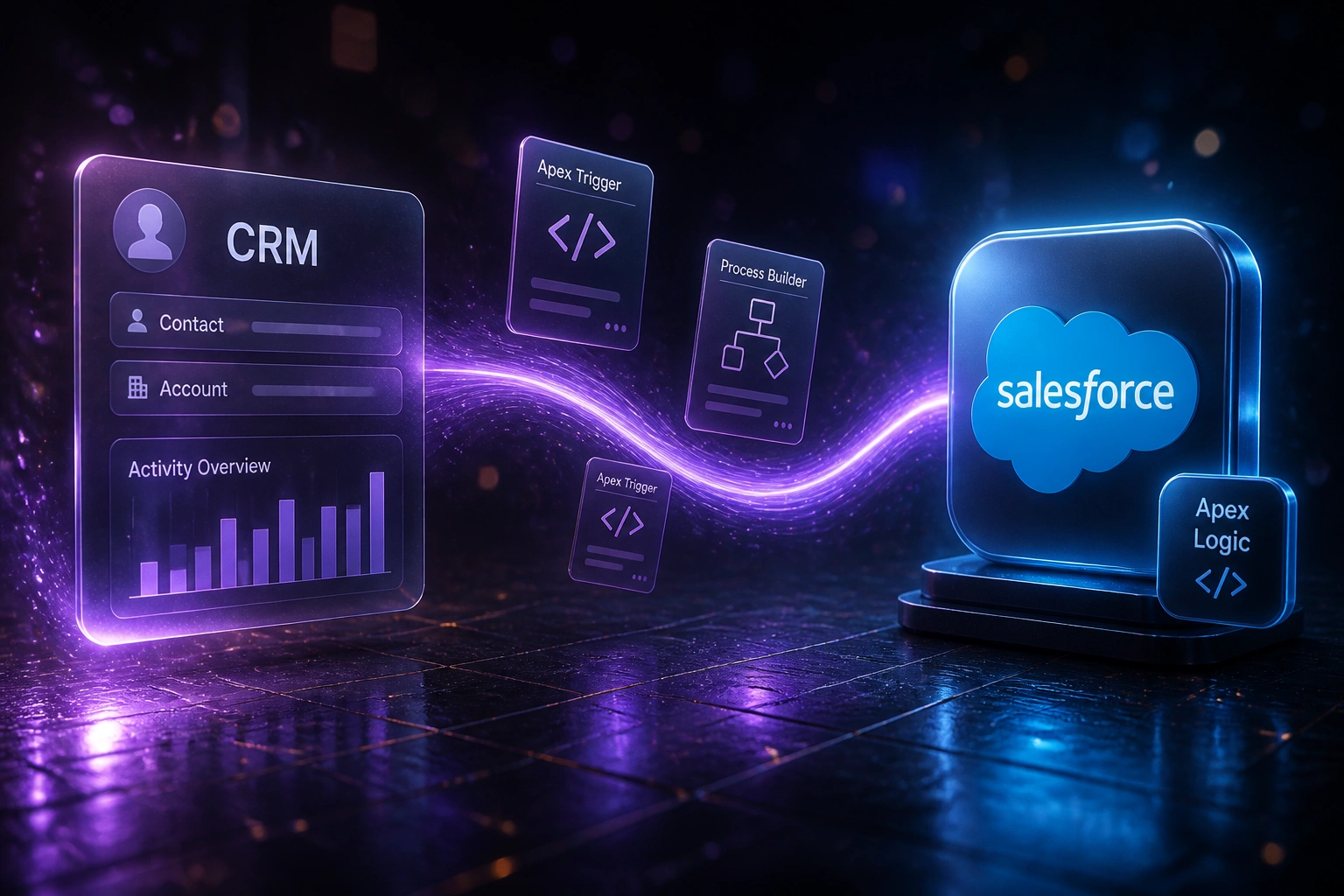
Glass CRM panel and Salesforce Apex Logic badge linked by an electric violet ribbon carrying Apex trigger and Process Builder cards over a charcoal forge floor

Migrating Salesforce Apex Triggers and Process Builder Logic

One client cut Apex cutover to 11 weeks with 34 parity scenarios and retired 19 dead paths, recovering day-one commission and SLA logic Salesforce data migration alone would leave behind.
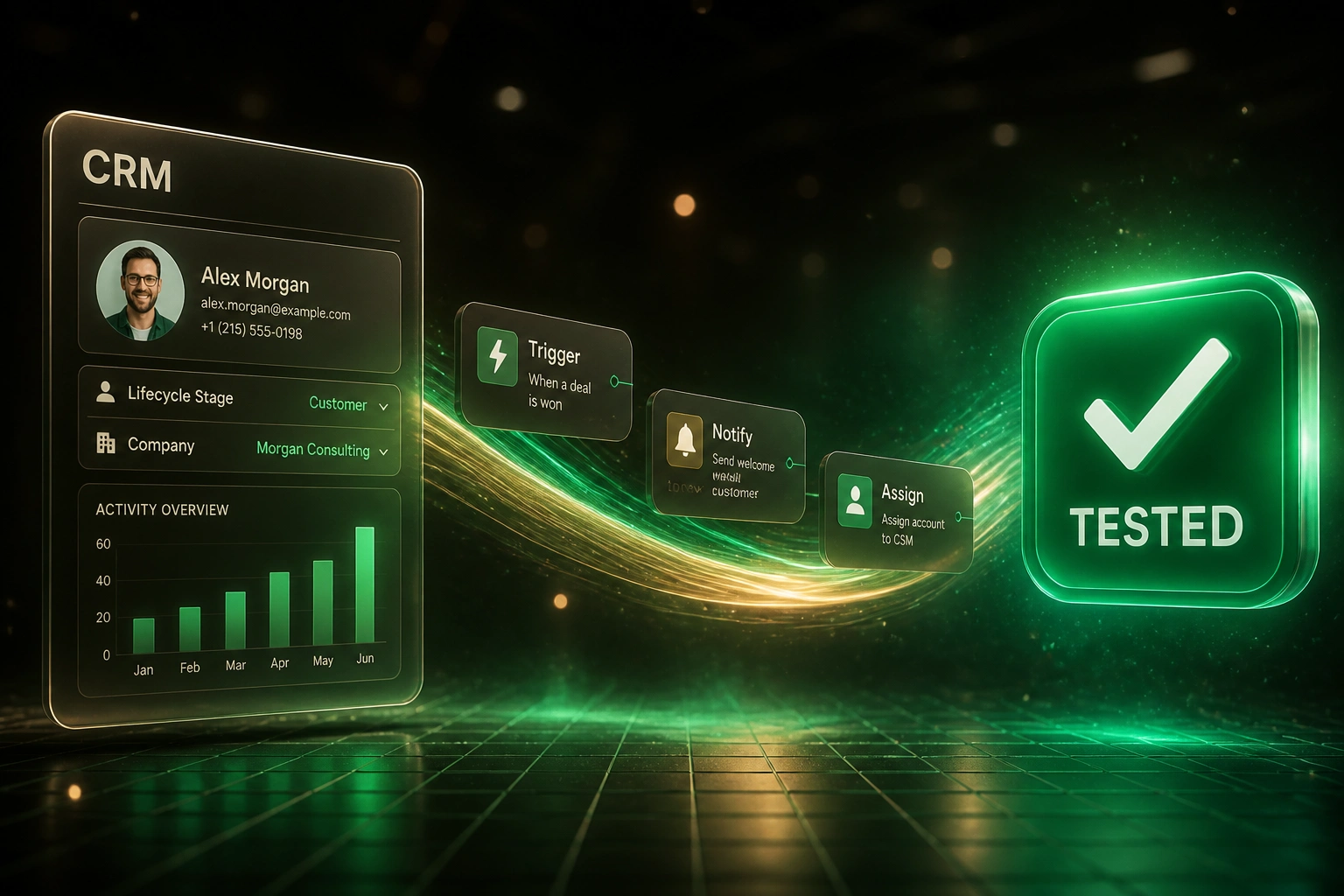
A glass CRM panel connected by an S-curved ribbon of workflow cards to an emerald TESTED validation badge, illustrating post go-live automation testing

Testing CRM Automations After Go-Live: First 30 Days

Caught 14 silent automation failures in 30 days. Restored lead assignment week one, recovering R480K stalled pipeline and cutting response from 18 hours to under 8 minutes.
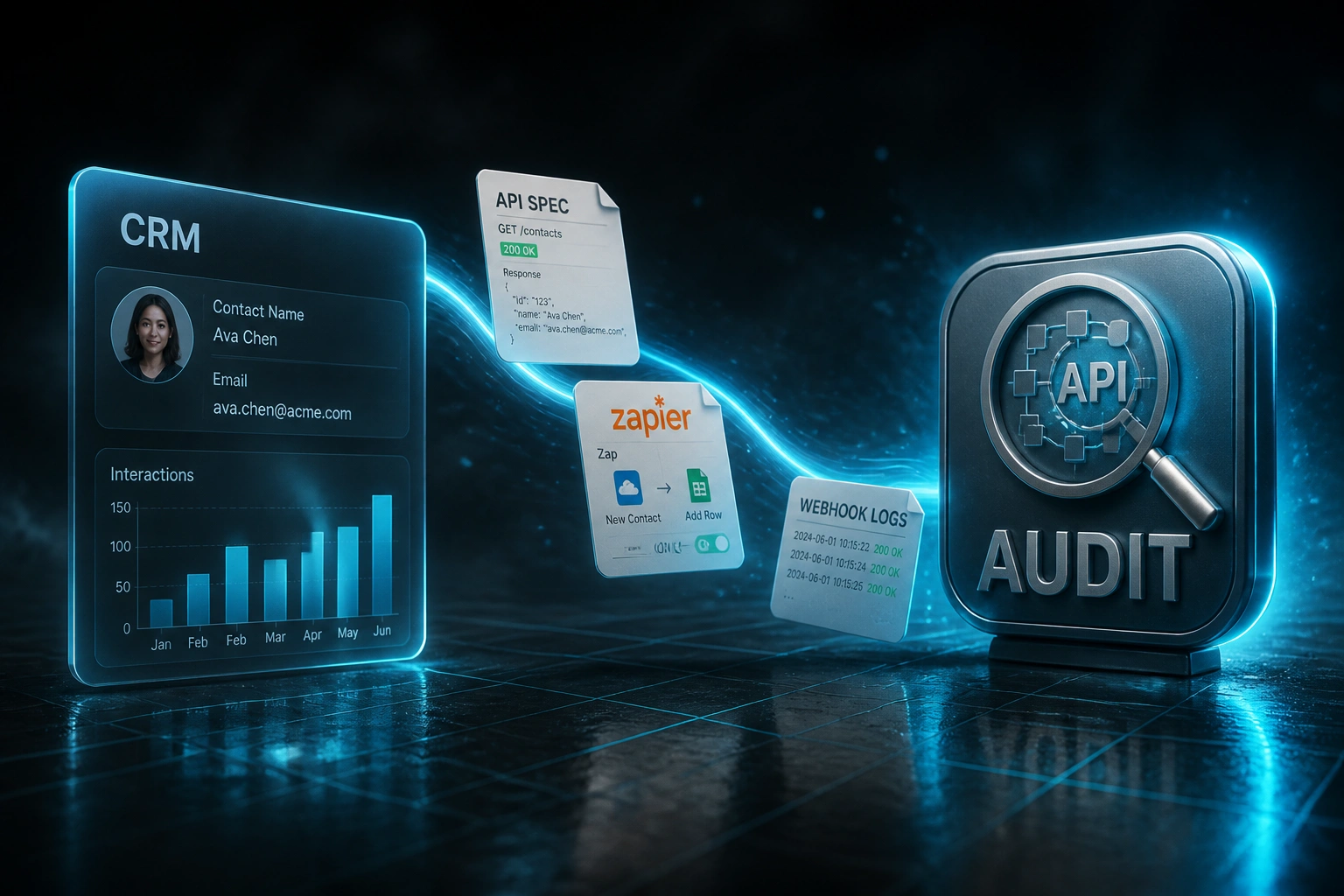
A glass CRM panel and a cyan-glow AUDIT badge linked by an S-curved ribbon of API specs, Zap cards, and webhook logs in a charcoal industrial void

Auditing Custom Integrations Before CRM Migration

They thought eight CRM connections were live. An audit found 27 shadow integrations. Migration went live with zero day-one outages, and they avoided R990,000 in emergency consulting.

Chat with us