Testing CRM Automations After Go-Live: First 30 Days
You cut over last week. Forms still capture leads. The board thinks the migration worked. Meanwhile welcome emails are not sending, deals sit without owners, and SLA alerts never fire. Silent automation failures compound every day in the first month.
We build the structured 30-day test plan that catches those gaps before they cost pipeline.
Sound Familiar?
These are the exact issues sales ops teams hit in the first month after CRM go-live:
- Welcome emails and stage-change notifications stopped on day one; nobody noticed until a prospect asked why they never heard back
- Lead assignment rules route to the wrong owner, or to nobody, while inbound forms still look healthy in the CRM
- Deals sit in "Negotiation" because the SLA alert and task escalation never fire after the migration
- Drip sequences enrol contacts but send nothing: merge fields broke, templates failed silently, or the trigger never matched
- Sales ops discovers broken automations only when pipeline stalls, not through a deliberate first-30-days test plan
Hypercare is not optional in month one. CRM go-live guidance treats four to six weeks of intensive support as the window that protects revenue while edge-case routing, notifications, and SLA clocks reveal themselves. Teams that roll the project off at cutover convert that spike into the first shadow spreadsheet.
What Post Go-Live Automation Testing Actually Does
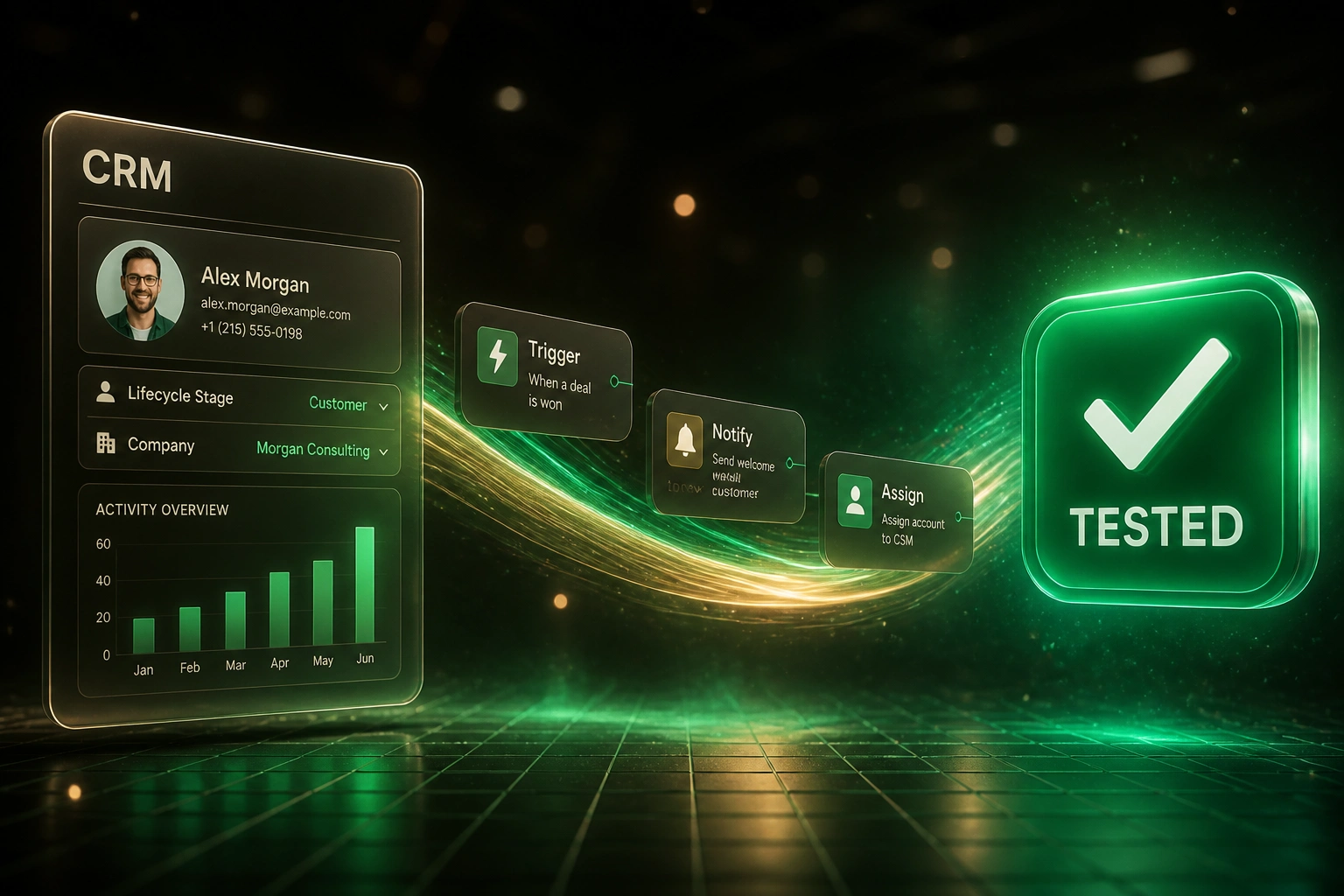
Inventory → probe → fix → scorecard. Every critical trigger, notification, and workflow proves itself on live paths.
Inventory Live Rules
Triggers, assignment rules, drips, notifications, and SLA alerts mapped with owners
Fire Synthetic Probes
Test leads, stage moves, and SLA clocks run against each revenue-critical path
Confirm Outcomes
Correct owner, email delivered, task created, sequence advanced: pass or fail
Patch and Re-Test
Controlled fix packs, then re-probe until the 30-day scorecard clears exit criteria
Everything You Need for CRM Validation in Month One
Trigger Inventory and Firing Tests
Every stage-change, form-submit, and field-update trigger gets a named owner and a live test record. We confirm it fires, not that it "should".
Notification and Email Delivery Checks
Welcome emails, internal alerts, and template merges verified in real inboxes. Silent send failures are the most expensive kind.
Assignment and Routing Validation
Territory, round-robin, and source-based ownership tested with edge cases: no match, multi-match, and after-hours leads.
Drip Sequence and Cadence Audits
Enrolment criteria, delays, branch paths, and suppression rules walked end-to-end so contacts are not stuck mid-sequence.
SLA Alert and Escalation Probes
Time-based clocks, task creation, and escalation paths exercised with synthetic deals so missed SLAs surface in week one, not month three.
30-Day Hypercare Scorecard
Daily then weekly pass/fail dashboard: firing rates, delivery rates, ownership accuracy, and open defects until exit criteria are met.
CRMs We've Run Post Go-Live Automation Testing On
From 18-Hour Lead Response to Under 8 Minutes
How a 35-person B2B services firm caught 14 silent automation failures in the first 30 days after CRM go-live and recovered stalled inbound pipeline.
Go-Live Without Automation Testing
- Migration declared done when record counts matched; workflows were "assumed rebuilt"
- Form leads landed in CRM but assignment rules pointed at deactivated users
- Welcome email and internal notify workflows showed as active, yet sent nothing
- Average first response stretched to 18 hours; several high-intent leads never contacted
- SLA tasks for stuck deals never created; managers only saw the stall in week-three forecast
Structured First-30-Days Test Plan
- Week-one probe suite found 14 defects across triggers, notifications, and routing
- Assignment restored to live round-robin; after-hours queue covered overnight forms
- Email delivery and merge fields verified in real inboxes before marketing spend resumed
- Inbound first response dropped below 8 minutes on automated routing plus alerts
- SLA escalations re-tested with synthetic deals; exit scorecard cleared at day 28
Before vs After Structured Automation Testing
How It Works
From first conversation to a cleared 30-day scorecard in one hypercare cycle.
Map Live Automations
Triggers, notifications, assignment rules, drips, and SLA alerts inventoried with owners and last-fired dates.
Free Scoping Call
30-minute call to rank revenue-critical paths and design the first-30-days test calendar.
Run the 30-Day Suite
Week-by-week probes: synthetic leads, stage moves, inbox checks, and SLA clocks against pass/fail criteria.
Fix, Monitor, Exit Hypercare
Defects patched in controlled batches. Exit when firing, delivery, and ownership metrics stay stable.
Frequently Asked Questions
We already validated the data migration. Why test automations again after go-live?
Data validation proves records landed. Automation testing proves triggers, notifications, assignment rules, drips, and SLA alerts still fire on those records. Workflows rebuilt in a new CRM often fail silently: wrong field names, picklist mismatches, or missing dependencies. Cutover UAT rarely covers every unhappy path. The first 30 days of live selling do.
What does post go-live CRM automation testing cover in the first 30 days?
Five layers: trigger firing on stage and form events, email and internal notification delivery with merge fields, lead and deal assignment accuracy (including edge cases), drip and sequence enrolment through to send, and SLA alert plus escalation clocks. We wrap it in a hypercare scorecard so sales ops can see pass/fail by week, not gut feel.
How long should hypercare last after CRM go-live?
Industry guidance for CRM hypercare is typically four to six weeks, sized to at least two full selling cycles rather than an arbitrary calendar date. We structure a focused first-30-days automation test plan inside that window, then exit only when defect rates and ownership accuracy stay stable.
What happens if we skip structured automation testing after go-live?
Silent failures compound daily. Leads sit unassigned while forms look fine. Welcome emails never send. Deals stall without SLA tasks. Independent CRM research puts failure to meet objectives around 50% to 55%, and opaque automation is a known driver of early adoption collapse. By the time pipeline reports look wrong, you have already lost weeks of follow-up.
Which CRMs do you run post go-live automation testing on?
We have run first-30-days suites on HubSpot, Salesforce, Pipedrive, Zoho CRM, Microsoft Dynamics 365, Monday.com, and custom CRMs. If your platform fires workflows, sequences, or assignment rules, we can inventory and probe them.
How much does a first-30-days CRM automation test plan cost?
Focused post go-live automation testing programmes for mid-market stacks typically range from R25,000 to R65,000. Larger estates with 40+ critical workflows, multi-team routing, and SLA chains sit higher. Against stalled inbound follow-up and weeks of sales-ops firefighting, most clients recover the fee inside the first avoided pipeline month.
Stop Discovering Broken Automations When Deals Stall
If you went live in the last month and have not systematically tested triggers, notifications, assignment rules, drips, and SLA alerts, silent failures are already compounding.
Tell us which CRM you cut over to, which workflows matter most to inbound and pipeline, and what you have already checked. We will show you exactly how a first-30-days automation test plan would run for your stack.