AI Demand Forecasting: One Number Purchasing and Sales Can Trust
Operations and commercial leaders still rebuild next month's demand in spreadsheets that miss seasonality and events. Stockouts hit the A-movers. Overstock ties up cash. Smart forecasting with demand prediction ML writes predicted demand into your ERP and CRM planning fields so both teams plan from the same figure.
We build the AI forecasting model that feeds inventory, purchasing, and sales planning.
Sound Familiar?
These are the exact issues our clients faced before AI demand forecasting:
- Spreadsheet forecasts miss seasonality, promos, and public holidays, so A-movers stock out while slow movers pile up
- Purchasing orders from one workbook while sales plans from another, and nobody trusts the baseline
- Planners burn most of the week rebuilding the forecast before every S&OP cycle instead of managing exceptions
- Safety stock buffers keep growing because last quarter's error still haunts the next purchase order
- Peak seasons and supply volatility expose the gap between gut-feel demand prediction and what actually sells
Global retail inventory distortion still costs about R28 trillion a year (IHL Group, 2025: $1.73 trillion at ~R16.34/USD), or 6.5% of retail sales. Peak seasons and supply volatility make spreadsheet baselines worse, while ERP vendors are shipping AI forecast modules. Waiting means another stockout cycle or another warehouse of slow movers.
What AI Demand Forecasting Actually Does
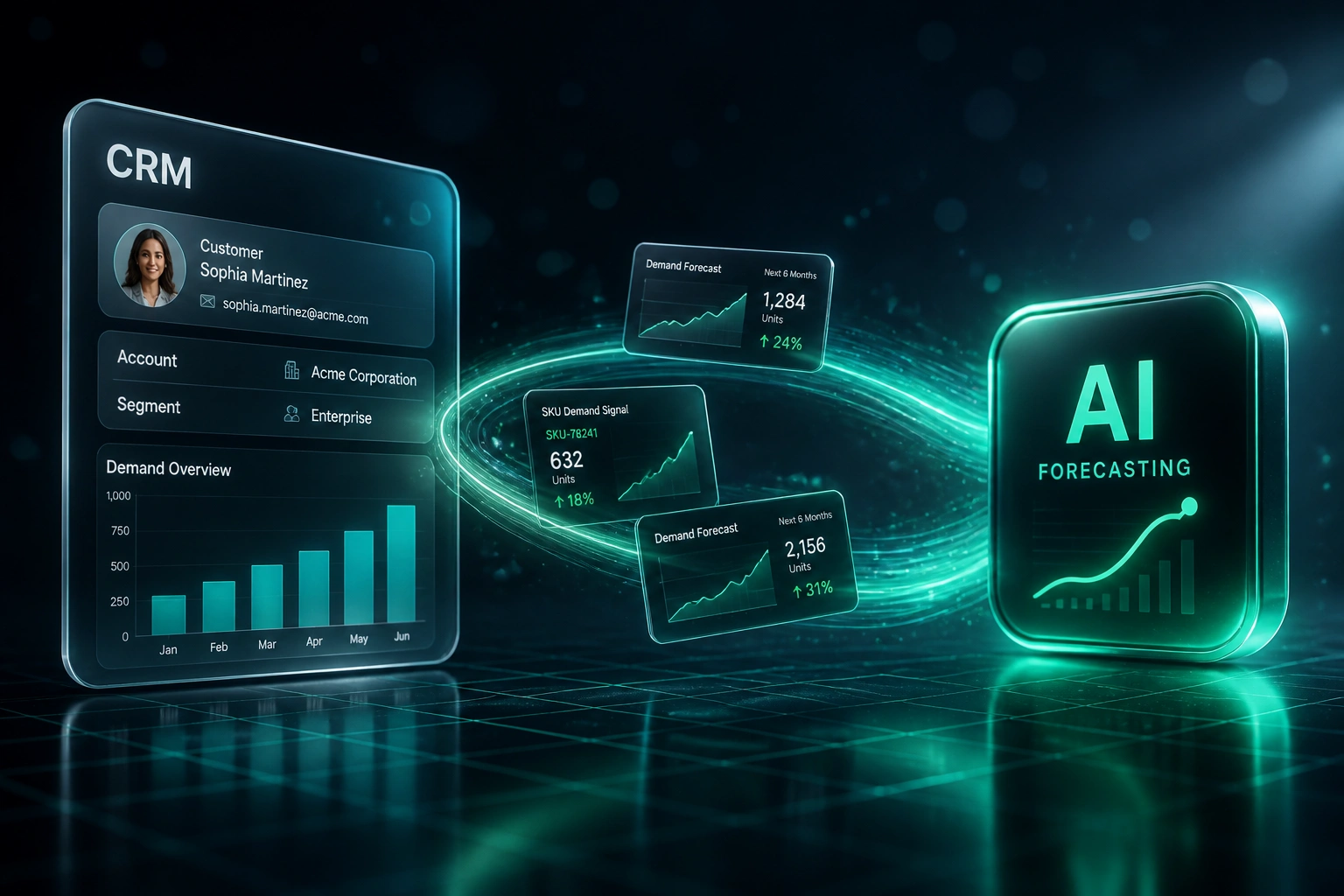
History and signals in → demand prediction ML → one planning number in ERP and CRM.
History Feeds the Model
Sales, inventory, promos, and CRM pipeline signals load from your systems
AI Forecast Runs
Seasonality, events, and external factors shape SKU-level demand prediction
Demand Writes Back
Predicted units land in ERP reorder and CRM planning fields automatically
One Shared Plan
Purchasing and sales work from the same number; planners manage exceptions only
Everything You Need for Reliable Smart Forecasting
Seasonality & Event Models
AI forecasting learns weekly, monthly, and holiday patterns plus promo lifts, so demand prediction ML stops treating December like July.
Multi-SKU Demand Prediction
We score forecasted units at SKU, category, and channel level from sales history, inventory movements, and CRM opportunity signals.
ERP & CRM Write-Back
Predicted demand lands in planning fields your team already uses: ERP reorder points, CRM forecast amounts, and purchasing worksheets.
External Signal Enrichment
Promotions, lead times, and seasonal calendars feed the model so smart forecasting reacts to events traditional moving averages ignore.
Exception Alerts
When actuals diverge from the forecast band, ops gets a ranked exception list instead of discovering the miss at month-end.
Continuous Retraining
Closed periods retrain the model on a schedule. Forecast accuracy stays current as your mix, pricing, and supplier lead times change.
Systems We've Connected for Demand Forecasting
From 32% MAPE to 14% MAPE
How a 45-person Gauteng distributor cut forecast error roughly in half, freed R2.5M in stock, and put purchasing and sales on one plan.
The Spreadsheet Ritual
- Demand planner rebuilt an Excel baseline every week from last year's sales
- Seasonality and promo lifts were gut feel; MAPE sat around 32%
- Purchasing and sales argued over different numbers in every S&OP
- Top 50 SKUs stocked out regularly while slow movers filled the warehouse
- About 14 hours a week went to forecast rebuilds, not exception management
The Shared Forecast
- Demand prediction ML runs weekly with seasonality, promos, and lead times
- Predicted units write into Sage planning fields and HubSpot forecast amounts
- MAPE on core SKUs fell to about 14%, inside McKinsey's 20–50% error-cut band
- Purchasing and sales open the same figure every Monday
- Planner time dropped to about 4 hours a week on exceptions and overrides
Before vs After AI Forecasting
How It Works
From first conversation to live demand forecasts in 4–7 weeks.
Tell Us Your Setup
Which ERP or CRM holds stock and sales history, how you plan today, and where forecasts keep missing.
Free Scoping Call
30-minute call with your ops or commercial lead to define SKU scope, horizon, and write-back fields.
Build & Shadow
We train the demand model on your history, write forecasts into planning fields, and shadow live cycles for accuracy.
Go Live & Monitor
Purchasing and sales plan from one number. Dashboards track MAPE, stockouts, and inventory turns.
Frequently Asked Questions
How is AI demand forecasting different from a spreadsheet or ERP moving average?
Spreadsheets and basic ERP averages project recent sales forward. AI forecasting (demand prediction ML) learns seasonality, promo lifts, and external factors, then writes a single predicted-demand figure into the planning fields purchasing and sales already use. The output is a trusted baseline for S&OP, not another worksheet nobody agrees on.
How is this different from AI report generation or churn prediction?
AI report generation summarises what already happened. Churn prediction scores which customers may leave. Demand forecasting looks forward: how many units you will need, by SKU and period, so inventory, purchasing, and sales plan from one number.
What data do we need for smart forecasting?
We usually start with 12–24 months of sales and inventory movements by SKU, plus promo calendars and lead times where you have them. CRM pipeline or open orders can enrich the signal. Thin history still works with simpler models; we expand features and retrain as volume grows.
Will planners trust and act on the forecast?
Adoption fails when the model feels like a black box. We ship explainability (seasonality, promo, trend contributions), calibrate against your MAPE baseline, and write results into the ERP or CRM fields your team already opens on Monday. A shadow cycle lets ops compare model output to gut feel before go-live.
How long does an AI demand forecasting project take?
Most builds take 4–7 weeks from scoping to go-live: data audit, model training, ERP or CRM field mapping, exception alerts, and a parallel shadow cycle. Cleaner SKU histories with clear promo tags can be live in about three weeks.
How much does AI demand forecasting cost?
Custom demand prediction with ERP or CRM write-back typically ranges from R55,000 to R120,000 depending on SKU count, data sources, and platforms. Teams carrying seven-figure inventory usually recover the build within 2–4 months from lower stockouts, less overstock, and planner hours alone.
Stop Running Inventory on Spreadsheet Forecasts
If purchasing and sales still argue over next month's demand, you are paying for stockouts, overstock, and planner hours that AI forecasting already solves.
Tell us which ERP or CRM holds your sales history, how you plan today, and where forecasts keep missing. We'll show you how demand prediction ML would write a trusted figure into your planning fields.