AI POPIA Compliance: Detect Data Breach Risks Before They Happen
CISOs, compliance officers, and Information Officers still discover over-privileged access, unusual exports, and shadow data flows after a security compromise is already reportable. Waiting for the breach to find the risk is how you end up explaining yourself to the Information Regulator.
We build POPIA AI that watches access patterns and data movement, and alerts your compliance team while you can still act.
Sound Familiar?
These are the exact issues CISOs and Information Officers faced before proactive risk detection:
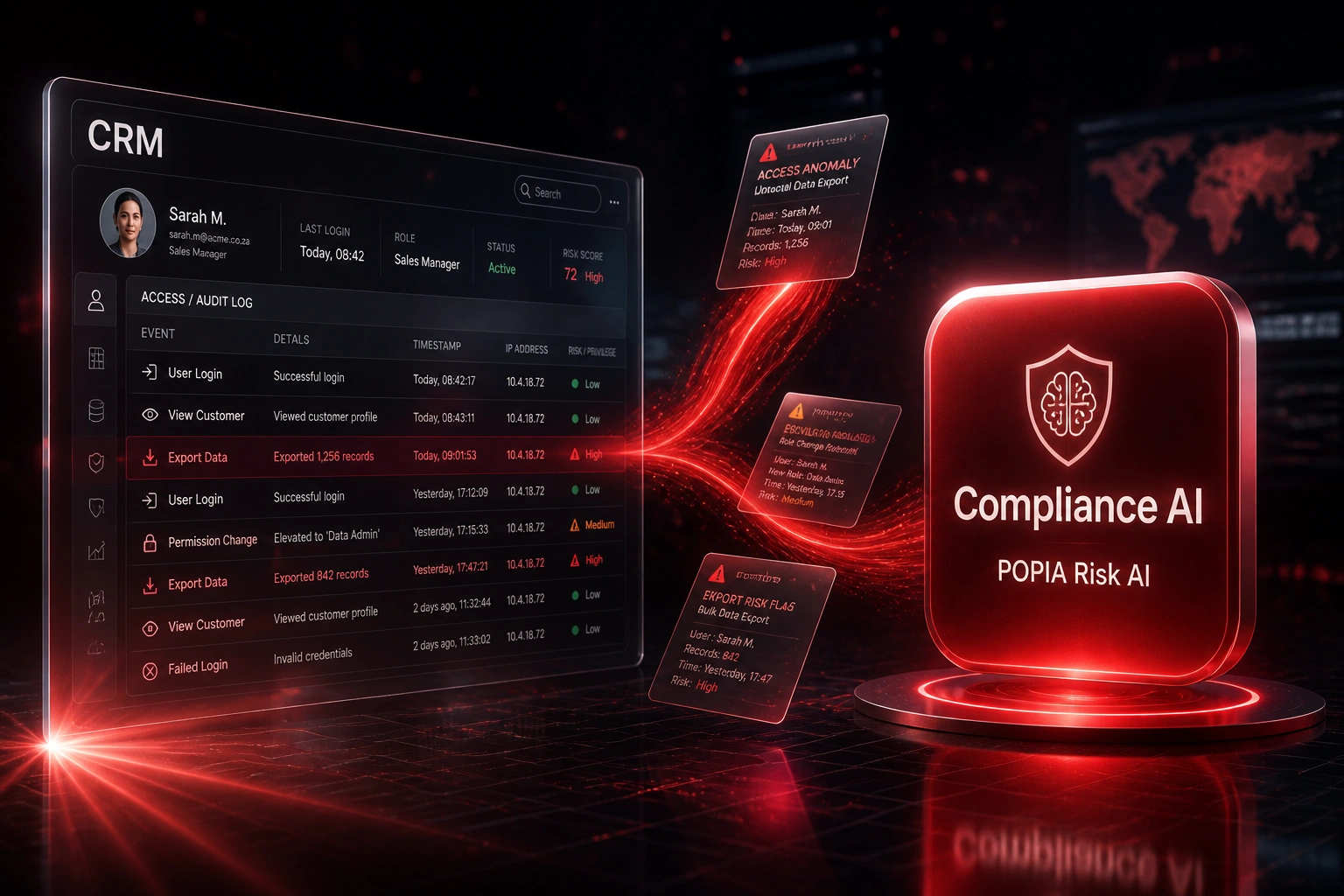
- Unusual CRM exports and bulk downloads only surface weeks later in a quarterly access review
- Over-privileged accounts keep broad personal-information access long after roles change
- Shadow data flows (spreadsheet dumps, shared drives, unmanaged integrations) sit outside your POPIA monitoring
- Your Information Officer learns about a security compromise after the fact, with a 72-hour notification clock already running
- Insider and credential misuse blends into normal login traffic until a reportable breach is already underway
POPIA section 22 expects notification as soon as reasonably possible, with Regulator guidance and industry practice treating roughly 72 hours as the target. The Information Regulator has already fined organisations for failing to report security compromises, and administrative penalties reach R10 million. Detection that starts at the quarterly review is not a defence.
What POPIA Breach Risk Detection Actually Does
Access or export happens → AI scores the pattern → risk flags reach compliance → you contain before it is reportable.
Access or Export Event
A user logs in, opens records, changes privileges, or exports a CRM or drive extract
Pattern Scored Against Baseline
Volume, time, role, and destination compared to that user's normal access behaviour
Compliance Team Alerted
Material POPIA risk routes to the Information Officer or CISO with evidence attached
Contain Before Notification
Revoke access, freeze the export path, and document the trail while the incident is still preventable
Everything You Need for Proactive SA Privacy Risk Detection
Access Pattern Baselines
AI learns normal login times, record volumes, and role behaviour per user and team, then flags deviations that look like POPIA breach risk, not routine work.
Unusual Export Detection
Bulk downloads, after-hours exports, and out-of-role CRM or ERP extracts trigger alerts with the user, volume, and destination context attached.
Privilege Drift Monitoring
Watch for over-privileged access that accumulates after promotions, contractor churn, or stale admin rights, before those rights become an unauthorised acquisition path.
Shadow Data Flow Mapping
Surface unmanaged copies of personal information leaving governed systems into spreadsheets, shared folders, and ad-hoc integrations your retention policy never saw.
Information Officer Alerting
Material risk routes to the Information Officer, CISO, or compliance lead with severity, evidence, and a suggested containment step while the window to act is still open.
Audit-Ready Evidence Trails
Every flag writes a timestamped access and data-flow trail you can hand to the Information Regulator if a security compromise must be notified under section 22.
Systems We've Wired for Access and Data-Flow Monitoring
From Weeks of Blind Spot to Under an Hour
How a Cape Town financial services firm stopped discovering unusual CRM exports in quarterly reviews and started flagging POPIA breach risk the same day.
The Quarterly Blind Spot
- Access reviews ran once a quarter; unusual exports sat in logs until someone sampled them
- A departed contractor's CRM rights stayed active for 11 weeks
- Bulk customer exports looked like legitimate sales prep until a client complaint landed
- Information Officer had no same-day view of who moved personal information out of the CRM
- Breach-readiness depended on hope that nothing reportable happened between reviews
The Proactive Risk Layer
- AI baselines each user's CRM access and flags out-of-pattern exports within the hour
- Privilege drift after role changes alerts identity and the Information Officer the same day
- Shadow spreadsheet dumps from governed systems surface as data-flow risk, not IT folklore
- Compliance reviews evidence packs instead of hunting through raw audit logs
- Containment starts while the event is still a risk, not a section 22 notification
Before vs After POPIA Risk AI
How It Works
From first conversation to live POPIA risk monitoring in 4–8 weeks.
Tell Us Your Risk Surface
Which CRM, identity, and storage systems hold personal information, and where unusual exports or privilege drift worry you most.
Free Scoping Call
30-minute call with your CISO, Information Officer, or compliance lead to set severity bands, alert owners, and data-flow priorities.
Build & Shadow
We baseline access patterns, wire export and privilege monitors, and shadow live traffic so you compare AI flags to known incidents.
Go Live & Tune
Switch on proactive POPIA risk alerts. We tune false positives until genuine breach-risk signals reach the right owner the same day.
Frequently Asked Questions
How is POPIA breach risk detection different from general AI compliance monitoring?
General compliance monitoring watches documents, communications, and policy drift for control gaps. This build watches access patterns and data movement: unusual exports, over-privileged accounts, and shadow flows that can become a section 22 security compromise. Same AI skill, different risk domain, aimed at catching breach risk before you must notify the Information Regulator.
How is this different from payment fraud or finance anomaly alerts?
Fraud and transaction anomaly tools score payments, claims, and AP disbursements for financial loss. POPIA AI monitors who accessed whose personal information, what they exported, and whether that behaviour matches their role. The owner is your Information Officer or CISO, not the payments desk.
What does POPIA require when a security compromise happens?
Section 22 requires you to notify the Information Regulator and affected data subjects as soon as reasonably possible after discovering unauthorised access or acquisition of personal information. Regulator guidance and industry practice treat roughly 72 hours as the expectation to aim for. Waiting until a quarterly review finds the export is already too late.
Which systems can feed access and data-flow monitoring?
Typical sources include HubSpot or Salesforce audit logs, Microsoft 365 and Google Workspace activity, Active Directory or Entra ID privilege changes, SharePoint and drive export events, and custom CRM or ERP access trails. If the personal information already lives somewhere governed, we can watch how it moves.
How long does a POPIA breach risk AI project take?
Most builds take 4–8 weeks from scoping to go-live: source connectors, baseline training, severity routing, Information Officer workflows, and a parallel shadow period. A focused CRM export and privilege monitor on clean audit logs can be live closer to three weeks.
How much does proactive POPIA risk detection cost?
Focused access-pattern and export monitoring typically starts from around R55,000. Broader builds covering identity privilege drift, multi-system data flows, and Regulator-ready evidence packs usually fall between R75,000 and R140,000. Against an average South African breach cost of R44.1 million, and POPIA administrative fines of up to R10 million, mid-market firms usually recover the build within one or two quarters from earlier containment and avoided incident cost.
Stop Waiting for a Breach to Discover the Risk
If your compliance monitoring for SA privacy still starts after someone exports a customer list, you are already behind the Information Regulator's clock.
Tell us which CRM and identity systems hold personal information, where unusual access worries you most, and who should own the alerts. We'll show you how proactive POPIA breach risk detection would work for your organisation.