AI Purchase Order Extraction: Capture PO Data Without Manual Entry
Your purchasing team is drowning in supplier POs that arrive as PDFs, emails, and scans, then retyping every line item, quantity, price, and delivery date into the ERP. Industry benchmarks put full PO processing at R260–R1,000 per document, with 11–15 minutes of active keying and a 1–4% field-level error rate that later breaks invoice matching.
We build AI PO extraction that turns those documents into structured procurement data in minutes, not hours.
Sound Familiar?
These are the exact issues our clients faced before AI purchase order extraction:
- Customer and supplier POs arrive as PDFs, email attachments, and scans, then buyers retype every line into the ERP
- Quantities, unit prices, and delivery dates get mistyped, then three-way matching fails weeks later
- Roughly one in four POs needs manual investigation when invoice and receipt data do not match the original order
- Procurement spends half a day chasing format chaos: different supplier layouts, handwritten markups, multi-page tables
- Order spikes and month-end backlog force overtime, while strategic supplier work waits behind the keying queue
Large buyers are tightening EDI and supplier-portal mandates, with non-compliance chargebacks commonly running 2–10% of PO or shipment value. ERP upgrades rarely solve PDF and email capture. Bad PO data still drives 23–31% three-way match exceptions. AI extraction closes the capture gap without waiting for every trading partner to go fully electronic.
What Purchase Order AI Actually Does
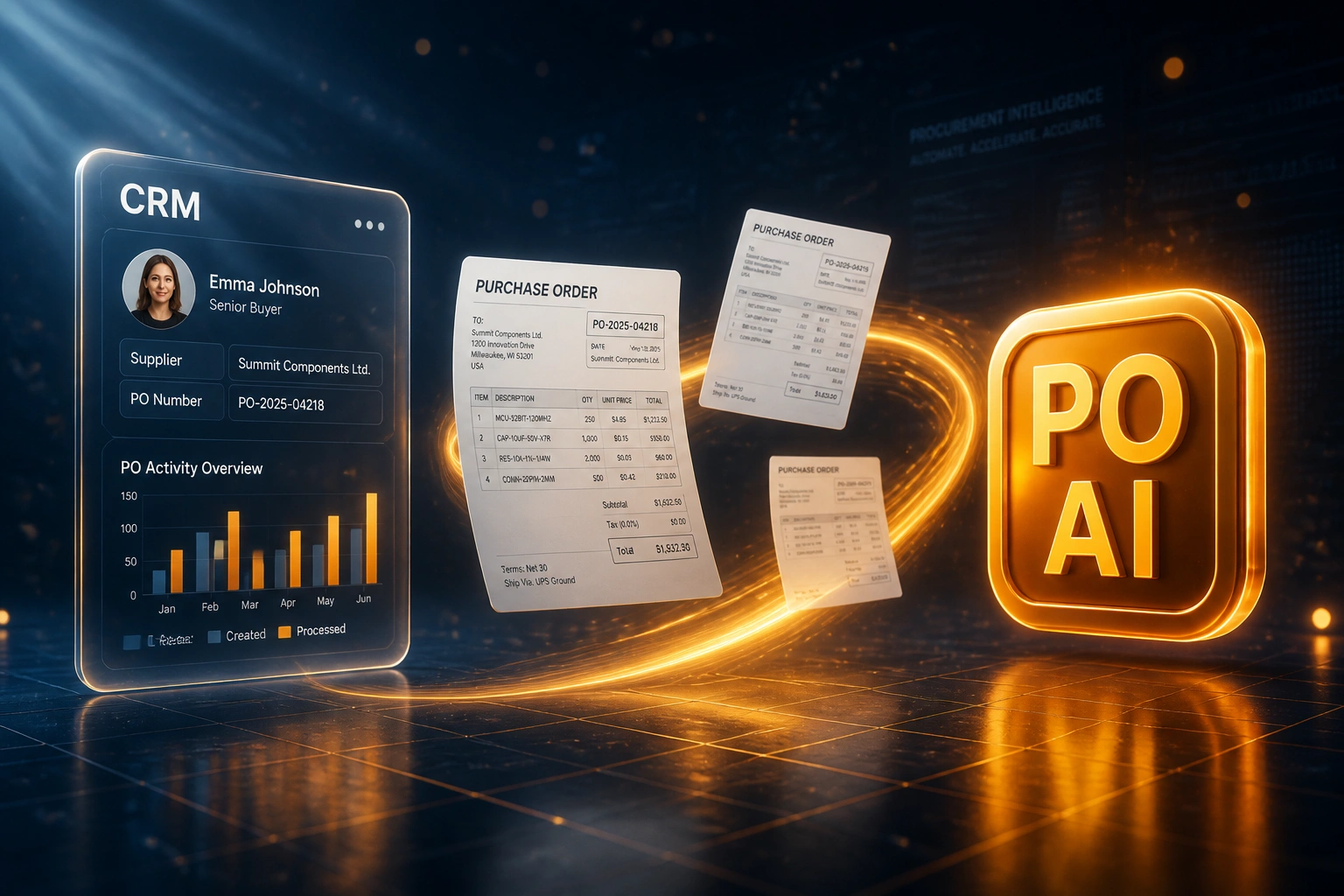
PO arrives → line items extracted → supplier matched → draft lands in the ERP. No human copying tables between systems.
PO Arrives
PDF, email attachment, or scan lands in the shared inbox or portal download
AI Extracts Fields
Header, line items, quantities, prices, and delivery dates become structured data
Supplier Matched
Vendor and SKU match against masters; exceptions pause with a clear reason pack
ERP Draft Ready
Buyer reviews and confirms in minutes; invoice matching starts from clean PO data
Document Automation Built for Procurement AI
AI PO Data Capture
PDFs, emailed orders, and scanned POs are read by AI. Header fields, line items, quantities, prices, and delivery dates extract into structured records.
Line-Item Table Extraction
Multi-page line tables with SKUs, units of measure, and extended totals are captured as rows, not a single lump sum your team has to rebuild by hand.
Supplier & ERP Matching
Extracted suppliers and items match against vendor masters and product catalogues. Ambiguous matches pause for review before anything posts to procurement.
Confidence Review Queue
High-confidence POs flow straight through. Low-confidence fields and odd layouts land in a short queue with the source highlight, so reviewers fix exceptions only.
Procurement System Write-Back
Clean orders land in Sage, SAP Business One, NetSuite, Xero Purchases, or your ERP as drafts ready for buyer confirmation and acknowledgement.
Audit Trail for Matching
Every extraction, override, and supplier match is logged against the source document, so invoice and goods-receipt disputes have a clear evidence pack.
ERPs and Procurement Systems We've Connected
From 14 Minutes per PO to 90 Seconds
How a mid-size industrial distributor cut PO data capture from 18 hours a week to three, and stopped quantity and price mismatches at the source.
The Manual Process
- Two buyers keyed ~220 customer and supplier POs a month from PDF and email
- Average 14 minutes per order: open file, match supplier, type every line
- About 3% of line items carried quantity or price typos into the ERP
- Roughly one in four invoices later needed matching investigation against bad PO data
- Month-end and promo spikes meant weekend catch-up just to clear the inbox
The Automated Process
- Inbound POs extract automatically; drafts appear in the ERP within minutes
- Buyers review high-confidence orders in about 90 seconds, exceptions only
- Line-item mismatches dropped under 0.5% with validation against masters
- Three-way match exceptions fell as invoices finally met clean PO data
- Purchasing time shifted to acknowledgements, shortages, and supplier talks
Before vs After PO Extraction AI
How It Works
From first conversation to live PO extraction in 2–4 weeks.
Tell Us Your Setup
Where POs arrive, which ERP or procurement system you use, how supplier matching works today, and where the backlog hurts most.
Free Scoping Call
30-minute call to map inbox → AI extract → supplier match → exception queue → ERP draft, and set confidence thresholds.
Build & Test
We train on your real PO mix, wire write-back, and run parallel against manual entry until accuracy meets your bar.
Go Live & Monitor
Buyers handle exceptions only. Monitoring tracks cost per PO, cycle time, straight-through rate, and matching exceptions.
Frequently Asked Questions
How is AI purchase order extraction different from basic OCR?
Basic OCR copies characters off the page. AI PO extraction understands purchase order structure: header fields, multi-line item tables, quantities, unit prices, delivery dates, and supplier identity. It validates totals, matches vendors and SKUs to your masters, and posts clean drafts into procurement or ERP, with a review queue only for low-confidence fields.
How accurate is AI PO data capture on real documents?
Modern intelligent document processing routinely reaches 95–99% field accuracy on clearly printed POs, with hybrid AI-plus-review workflows pushing effective accuracy above 99.5%. Manual single-pass data entry still sits at roughly 1–4% field-level errors. We keep humans on low-confidence fields and raise thresholds as your supplier history grows.
Which formats and systems can you connect?
We process PDF POs, email attachments, scans, and portal downloads into Sage, SAP Business One, NetSuite, Xero, Syspro, and custom ERPs. If the destination has an API or import path, we can write structured purchase orders into it with supplier and item matching.
Will this disrupt our purchasing team?
No. Your buyers keep the same ERP and approval habits. Automation removes the 11–15 minute keying step so people spend time on exceptions, supplier queries, and acknowledgements. We run parallel testing before switching off the manual path.
What happens when a PO does not match a supplier or SKU?
Unknown suppliers, ambiguous item codes, price variances against contracts, and low-confidence extractions pause in an exception queue with the source PDF, suggested match, and reason. Clean orders never wait behind those exceptions.
How much does AI purchase order extraction cost?
A focused PO capture pipeline into one ERP typically starts from around R25,000. Builds with supplier matching, multi-format intake, confidence queues, and multi-entity rules usually sit in the R35,000–R65,000 range. Teams processing a few hundred POs a month often recover the build cost within 2–3 months against manual processing costs of roughly R260–R1,000 per PO.
Stop Retyping Purchase Orders Into the ERP
If your purchasing team is still keying line items from PDFs and scans, you are spending money on a data capture problem that document automation already solves.
Tell us where POs arrive, which ERP you use, and where quantity and price mismatches hurt most. We will show you exactly how AI purchase order extraction would work for your operation.