API Gateway Authentication Setup: One Policy for Every Endpoint
Your CRM, payment rails, and partner APIs each grew their own auth scheme. Keys land in Slack, onboarding stalls for weeks, and rotating a leaked credential means a fire drill across every microservice.
We put gateway auth in front of the estate so api security is consistent, and backends stay simple.
Sound Familiar?
These are the exact issues our clients faced before centralising authentication at the gateway:
- CRM, payment, and partner APIs each enforce a different auth scheme inside their own microservice
- Keys and tokens still travel through Slack threads, shared drives, and onboarding tickets
- Partner go-live stalls for weeks while engineering provisions credentials by hand
- Rotating a leaked key means hunting across half a dozen services with no single deny switch
- Nobody can prove one consistent allow or deny policy when POPIA or a client security review asks
POPIA section 19 expects appropriate, reasonable technical measures to stop unlawful access to personal information. Credential sprawl across microservices and Slack is hard to defend when the Information Regulator or a client security team asks how you actually control API access.
What Gateway Authentication Setup Actually Does
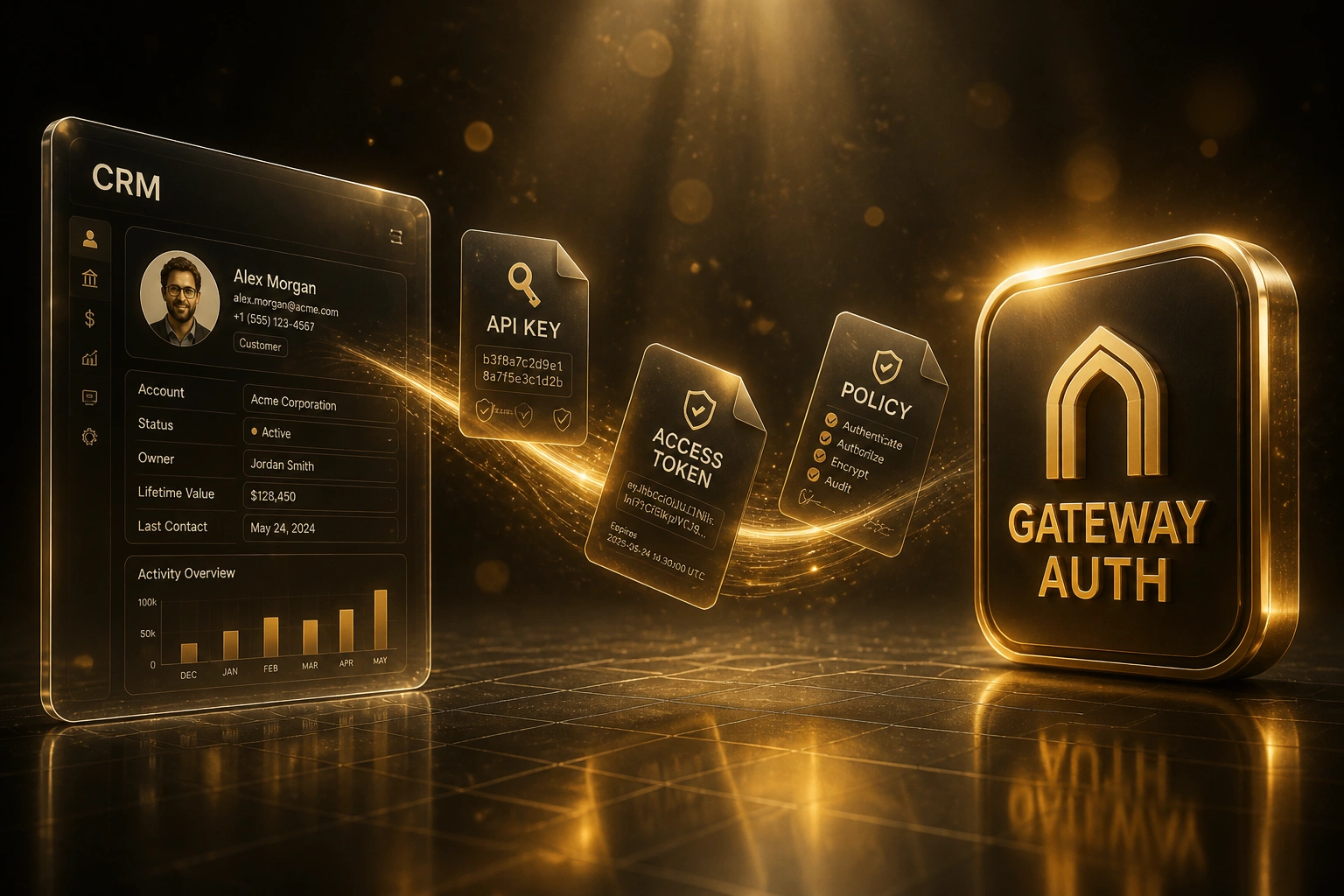
Partner calls the front door → policy checked once → backends stay free of auth sprawl.
Call Hits the Gateway
CRM, payment, or partner traffic arrives at one front door instead of a dozen private URLs
Centralised Auth Check
Keys, tokens, and partner credentials are validated against one gateway auth policy
Consistent Allow or Deny
The same rules apply across endpoints; revoked credentials stop at the edge immediately
Backends Stay Simple
CRM and payment microservices receive trusted identity and focus on business work
Everything You Need for Centralised Authentication
One Policy at the Edge
Gateway auth validates every CRM, payment, and partner call once. Downstream services receive trusted identity claims instead of reinventing login logic.
Centralised Authentication
Keys, tokens, and partner credentials live in one controlled layer. Your microservices stop owning scattered secret stores and one-off auth middleware.
Partner Key Rotation
Issue, rotate, and revoke partner credentials from a single place. A compromised key is cut off at the gateway without redeploying every backend.
Consistent Deny and Allow
The same allow and deny rules apply to every endpoint behind the front door, so api security no longer depends on which team wrote which service.
Simpler Backend Services
CRM sync, payment webhooks, and partner microservices shed auth baggage. They focus on business logic while the gateway owns identity and access.
Audit-Ready Access Trail
Who called what, with which credential, and whether the gateway allowed it. Evidence ready for POPIA section 19 reviews and client security questionnaires.
Surfaces We Secure Behind Gateway Auth
From 6 Weeks to 3 Days for Partner Credentials
How a 45-person logistics SaaS stopped Slack-shared keys, cut partner API onboarding from six weeks to three days, and rotates every credential from one gateway.
Auth Scattered Across Services
- Each CRM, payment, and partner microservice owned its own keys and allow lists
- New partners waited 4–6 weeks for engineering to provision credentials by ticket
- Production keys appeared in Slack when someone needed a “quick” sandbox copy
- Rotating a leaked partner key took 8+ hours across seven services
- Security reviews asked for one deny policy; nobody could produce it
Gateway Auth Owns the Front Door
- Every partner and CRM call is authenticated once at the gateway
- Approved partners receive credentials in a guided playbook within three days
- Slack stops being the secret store; vault and gateway policies own issuance
- Rotation is a single gateway action with dual-key grace, not a multi-service hunt
- Allow and deny rules, plus an access trail, ready for POPIA and client audits
Before vs After Gateway Authentication Setup
How It Works
From first conversation to live gateway authentication in 3–5 weeks.
Tell Us Your Setup
Which CRM, payment, and partner APIs you expose, where keys live today, and how long a new partner waits for credentials.
Free Scoping Call
30-minute call to map auth sprawl, pick the gateway auth model, and estimate payback against onboarding delay and rotation effort.
Build & Test
We centralise authentication at the gateway, migrate partners off Slack-shared keys, and rehearse rotation and cutover in staging.
Go Live & Monitor
Production cutover with monitoring. One place to rotate credentials, one deny path, and alerts when unusual access appears.
Frequently Asked Questions
How is gateway authentication different from picking API keys versus OAuth?
Pattern selection decides which credential type fits each surface. Gateway authentication setup puts that decision in one enforcement layer so every CRM, payment, and partner call is checked the same way before it reaches a backend. You still choose keys, OAuth, or tokens where they belong; the gateway makes the policy consistent.
How long does API gateway authentication setup take?
A focused programme for your core CRM, payment, and partner surfaces usually takes 3–5 weeks from scoping to production cutover. Inventory and a first policy layer can land within two weeks. Larger estates with many partners and legacy keys take closer to 6–8 weeks.
Will this disrupt live partner and CRM integrations?
No. We dual-run the new gateway auth path in staging, migrate partners in controlled batches, and keep a rollback window. Partners get a clear credential playbook instead of a surprise outage.
Does centralised authentication help with POPIA?
Yes. POPIA section 19 expects appropriate, reasonable technical and organisational measures to prevent unlawful access to personal information. A single gateway policy, rotation control, and access trail are easier to evidence than auth logic scattered across microservices and Slack threads.
What happens when a partner key is leaked?
You revoke or rotate at the gateway. Downstream CRM and payment services do not each need an emergency patch. That is the commercial point of centralised authentication: one place to cut access, and a shorter window between discovery and containment.
How much does gateway authentication setup cost?
Focused gateway auth for a core set of CRM, payment, and partner surfaces typically starts from around R45,000. Broader programmes with partner self-service credentials, rotation automation, and audit trails usually sit between R70,000 and R120,000. Against IBM’s 2025 average of about R77 million for breaches involving compromised credentials, most teams see payback on the first avoided incident or the first quarter of faster partner revenue.
Stop Scattering Auth Across Every Microservice
If partner keys still live in Slack and every CRM or payment service invents its own login rules, you are paying for delay and risk that gateway authentication already solves.
Tell us which APIs you expose to partners, where credentials live today, and how long onboarding takes. We will show you what centralised authentication at the gateway would look like for your stack.