Social Media Data Aggregation: Collect Insights with Apify
Your marketing lead still screenshots LinkedIn, Instagram, X, and Facebook page feeds, pastes them into a sheet, and hopes nobody missed the weekend spike. Manual social media scraping cannot quantify share of voice the way an Apify feed can, and by the time the pack is ready the conversation has moved on.
We turn public social data aggregation into a governed feed for brand monitoring, trend analysis, and audience research inside the CRM and BI stack you already run.
Sound Familiar?
These are the exact issues our clients faced before social data aggregation:
- Your brand manager still screenshots LinkedIn, Instagram, X, and Facebook page feeds into a shared drive, then rebuilds the weekly pack by hand
- Sentiment spikes land over a weekend and nobody notices until Monday afternoon, when the narrative has already hardened
- Share of voice across platforms is a gut feel, not a number you can take to the CMO
- Enterprise listening seats burn R195,000+ a year before you have covered X properly, yet your SA public-page coverage still has gaps
- Audience research lives in four tabs and a spreadsheet, so campaign planning starts from last month's memory instead of this week's data
X retired flat-fee API tiers for new developers and moved reading at volume onto pay-per-use pricing, with enterprise firehose historically quoted near R684,000 a month (~US$42,000). Official API access for brand monitoring social coverage is no longer a casual budget line. A governed Apify public-page feed is often the practical path for mid-market marketing teams that still need always-on signals.
What Social Data Aggregation Actually Does
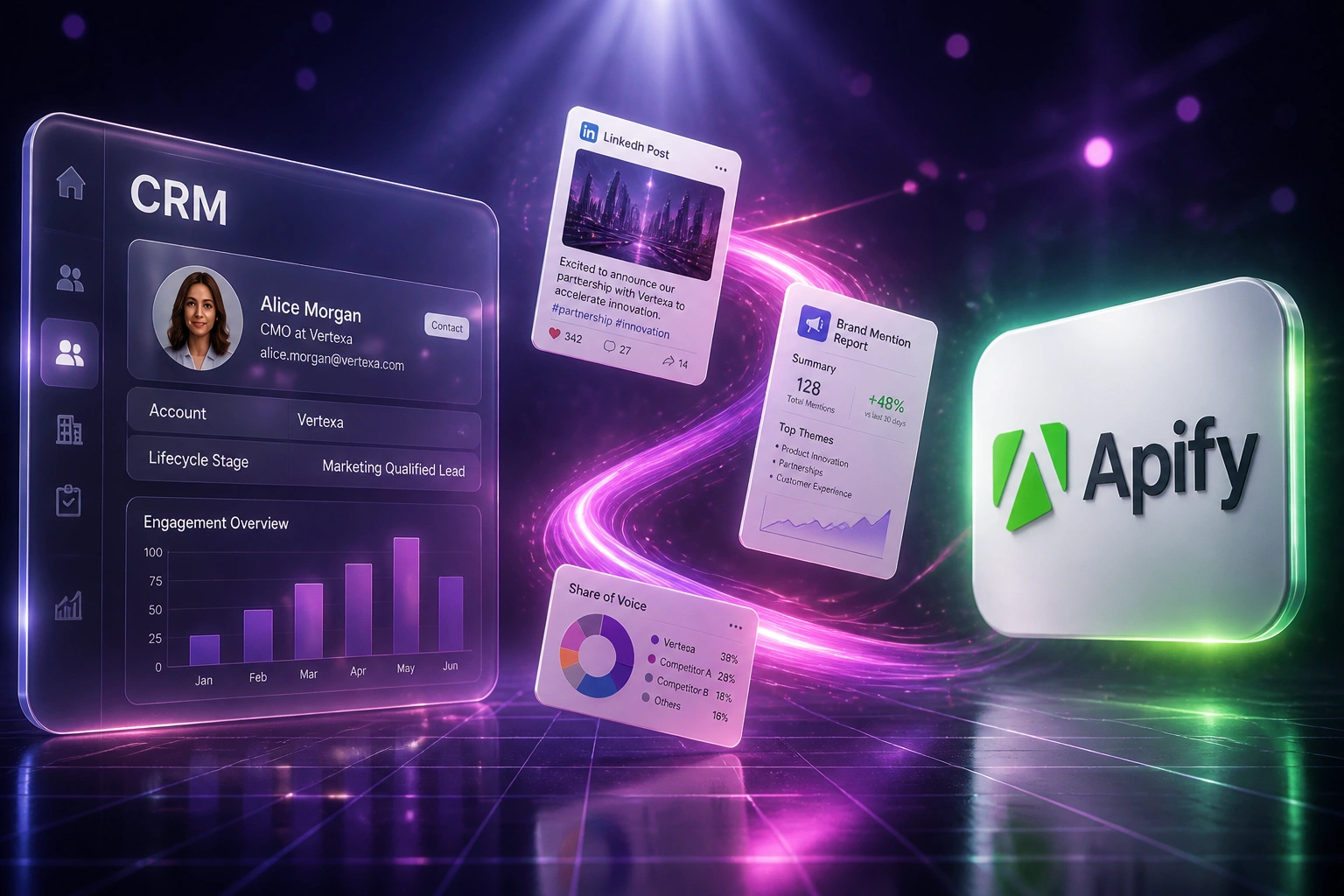
Public posts collected → normalised → alerted → landed in CRM or BI. No screenshot folders.
Actors Collect Public Posts
Scheduled Apify runs pull public LinkedIn, Instagram, X, and Facebook page content for your brand and competitors
Feed Normalised
Captions, authors, timestamps, and engagement metrics land in one schema ready for analysis
Spikes Alerted
Volume or sentiment thresholds fire Slack, email, or WhatsApp before the Monday pack
CRM / BI Updated
Marketing works from HubSpot, Sheets, or Looker with share-of-voice and trend views already built
Everything You Need for Brand Monitoring Social Coverage
Multi-Platform Public Collection
Apify Actors pull public posts, engagement metrics, and mention signals from LinkedIn public posts, Instagram public profiles, X/Twitter public pages, and Facebook pages on a schedule you choose.
Normalised Social Feed
Posts from every platform land in one schema: caption, author, timestamp, likes, comments, shares, and source URL, ready for brand monitoring and trend analysis.
Spike & Sentiment Alerts
Slack, email, or WhatsApp when mention volume jumps or negative language clusters. Your marketing lead acts in minutes, not after the Monday screenshot ritual.
Share-of-Voice Scoring
Compare your brand against named competitors across platforms so audience research and board packs show a quantified share of voice, not a pile of screenshots.
CRM & BI Delivery
Clean rows push into HubSpot, Google Sheets, Looker Studio, Power BI, or your warehouse so social data aggregation feeds the stack marketing already trusts.
Governed Public-Page Cadence
Scheduled runs, retries, and run alerts keep public-page monitoring alive when platform layouts shift. Coverage does not go dark because someone forgot to open a tab.
Sources and Destinations We Wire
From 14 Hours/Week to 2 Hours/Week
How a mid-size SA consumer brand stopped screenshotting social feeds and started catching sentiment spikes before the board pack.
The Manual Process
- Brand manager opened LinkedIn, Instagram, X, and Facebook pages three times a day and saved screenshots
- Junior marketer rebuilt a weekly share-of-voice sheet from those folders every Friday
- A weekend complaint thread was noticed on Monday at 15:00, more than 36 hours late
- Competitor campaign spikes only surfaced when someone happened to scroll the right feed
- CMO packs were always one cycle behind the live conversation
The Automated Process
- Apify Actors collect public posts on a set cadence for brand and three competitors
- Normalised rows land in HubSpot and Looker Studio with share-of-voice views
- Volume and negative-language thresholds alert Slack within the hour
- Marketing reviews digests and exceptions instead of rebuilding the sheet
- Audience research for campaigns starts from this week's public conversation
Before vs After Audience Research Data Automation
How It Works
From first conversation to live aggregation feed in 2–4 weeks.
Tell Us Your Setup
Which brands and competitors to watch, which public pages matter, and where late discovery hurts most.
Free Scoping Call
30-minute call to pick Actors, fields, run frequency, alert thresholds, and where the governed feed should land.
Build & Test
We wire Apify runs to your CRM or BI destinations, pilot brand plus competitors, and compare freshness against your manual check cycle.
Go Live & Monitor
Switch off the screenshot ritual. Monitoring catches failed runs so brand coverage never goes dark on a long weekend.
Frequently Asked Questions
What is social media data aggregation with Apify?
It is a scheduled pipeline where Apify Actors collect public social posts and engagement metrics from platforms such as LinkedIn public posts, Instagram public profiles, X/Twitter public pages, and Facebook pages, normalise them into one feed, and deliver that feed into your CRM or BI stack for brand monitoring, trend analysis, and audience research. We design for public-page monitoring where platforms allow it, not for bypassing private content or login walls.
How is this different from Meltwater, Brandwatch, or Sprout listening?
Enterprise listening platforms often start around R245,000–R408,000 a year (about US$15,000–US$25,000 at ~R16.30/USD), and Sprout's listening add-on alone sits near R195,000 a year (~US$999/month). An Apify-based aggregation feed is scoped to the public pages and keywords you name, lands in tools you already own, and typically costs a fraction of a full listening seat while still giving marketing a governed, always-on signal.
How long does manual social listening take without automation?
Productivity research on social media managers puts manual monitoring at roughly 10–15 hours a week when you include keyword searches, notification scrolling, competitor checks, and weekly report writing. PR reporting alone often takes four or more hours before anyone interprets the coverage. Teams that automate collection typically recover five to seven hours a week per brand manager.
Why does response speed matter for brand crises?
5WPR's Crisis Tax research found that companies responding quickly and transparently recovered market capitalisation in about 60 days on average, while slow or defensive responders faced six months to seven years, or never fully recovered, and suffered about 4.7 times the market-cap losses of fast peers. The same research notes that AI search engines can lock crisis narratives into brand portraits within 24–48 hours. Catching the spike early is a shareholder issue, not only a PR courtesy.
Is this compliant public data collection?
Yes. We scope Actors to publicly visible pages and posts, respect rate limits and platform constraints, and avoid encouraging collection behind logins or against terms of service. The brief for legal and marketing is public-page brand monitoring and audience research, with a clear audit of sources and fields. If a platform narrows what is public, we adjust the Actors rather than force access.
How much does Apify social data aggregation cost?
Simple one-way Actor-to-sheet pipelines start from around R15,000. Scheduled multi-platform aggregation with alerts, share-of-voice scoring, and CRM or BI delivery typically ranges from R25,000 to R60,000. Teams burning 10+ hours a week on screenshots and packs usually recover the project cost within 2–3 months from marketing time alone, before counting the avoided enterprise listening seat.
Stop Screenshotting Social Feeds by Hand
If your brand team is still rebuilding share of voice from four open tabs, you are spending money on a problem that public-page monitoring already solves.
Tell us which platforms and competitors matter, where the weekly pack currently lives, and what a late spike has cost you. We will show you exactly how Apify social data aggregation would feed your CRM and BI stack.