Checksum Validation: Verifying Data Integrity Across Transfers and Storage
Your dumps and archives look fine until month-end or an audit. Silent bit-rot and transfer corruption hide inside files that open without complaint, then fail when you need them most.
We build hash verification at every trust boundary, so corruption is caught before forensic recovery.
Sound Familiar?
These are the exact issues CTOs and IT ops leads bring us when files "look fine" but cannot be trusted:
- Nightly database dumps and file exports look fine in Explorer, but nobody has verified a hash since they left the source system
- A restore or audit export fails checksum validation months later, and nobody can say when the silent corruption started
- Cloud uploads skip client-side CRC or SHA checks, so transfer corruption only surfaces when finance needs the file
- Backup jobs report success while the underlying objects have drifted from their recorded digests
- POPIA evidence packs and month-end archives cannot prove integrity to auditors or insurers without hash trails
AWS now defaults CRC-based integrity checks on new S3 uploads, and Azure Blob has long supported Content-MD5 and transactional digests. If your import and archive paths still skip hash verification, you are behind the platforms you already pay for, and behind the corruption risk CERN measured at roughly 1.2×10⁻⁹ of bytes written going permanently bad within six months.
What Checksum Validation Actually Does
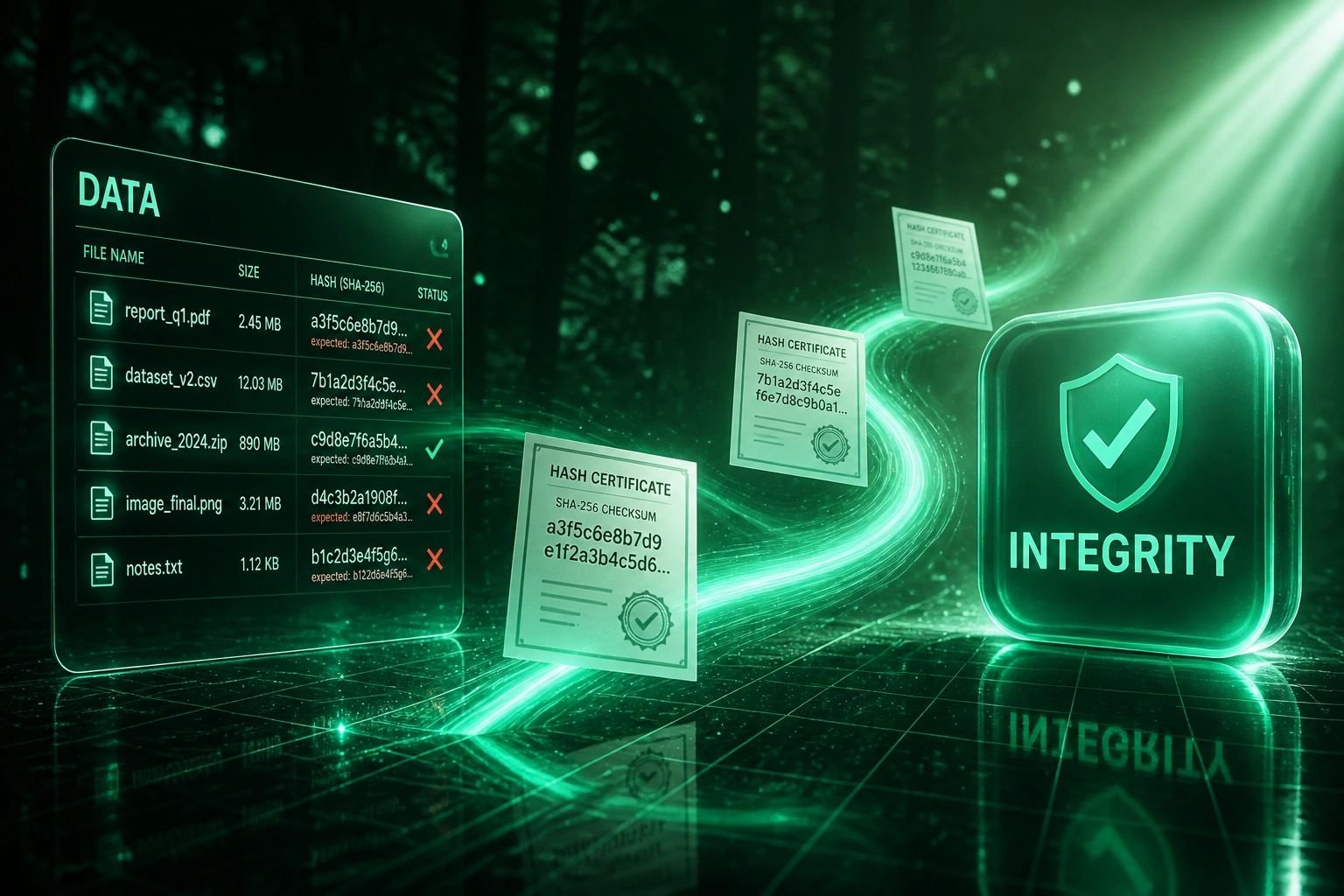
Hash at source → verify on transfer → re-check in storage → prove restores. Silent corruption never gets a free pass.
Digest at Source
Export or dump completes and a CRC or SHA-256 digest is recorded in a manifest
Verify on Arrival
S3, Azure, SFTP, or NAS landing zone recomputes the hash before the object is accepted
Re-Check at Rest
Scheduled scans catch bit-rot and drift against stored digests while the source is still available
Prove the Restore
Ransomware drills and audit exports start from known-good objects with a hash trail
Everything You Need for Reliable Hash Verification
Transfer-Boundary Checksums
Every export, SFTP pull, and cloud upload carries CRC32, SHA-256, or MD5 digests computed at source and verified at destination before the file is accepted.
Import Gate Validation
Database dumps, CSV loads, and archive restores are rejected or quarantined when the hash does not match the manifest, so silent corruption never enters production.
At-Rest Re-Verification
Scheduled jobs recompute digests against stored metadata on S3, Azure Blob, and on-prem shares so bit-rot is caught in weeks, not at the next disaster restore.
Integrity Manifests
Each batch gets a signed manifest of filenames, sizes, algorithms, and digests. Auditors and ransomware recovery teams get a known-good baseline, not a hopeful guess.
Mismatch Alerting
Ops is alerted the moment a transfer or storage scan fails hash verification, with enough context to re-pull from source before the bad copy is trusted.
Restore Proof Runs
Periodic restore drills verify that backup objects still match their recorded checksums, so a ransomware or load-shedding recovery starts from known-good data.
Platforms and Pipelines We Cover
From Blind Trust to Verified Archives
How a mid-market logistics ops team caught silent corruption before a failed month-end restore became a forensic recovery project.
Hope-Based Integrity
- Nightly SQL dumps uploaded to object storage with no client-side checksum
- Finance only noticed when a quarter-end restore failed hash checks from the vendor tool
- Nobody could say which nightly copy was last known-good
- External forensic recovery quote landed at R2.4M plus multi-week downtime risk
- Audit evidence packs had no digest trail for POPIA disclosure readiness
Hash-Gated Pipelines
- SHA-256 manifests generated with every dump; CRC verified on S3 upload
- Import gates reject mismatched objects before they touch staging databases
- Weekly at-rest re-verification flags drift while source systems are still online
- 14 silent hash mismatches caught and re-pulled in the first quarter
- Restore-proof drills finish with a signed integrity report for leadership
Before vs After Integrity Pipelines
How It Works
From first conversation to live integrity pipelines in 2–4 weeks.
Map Your Trust Boundaries
Where files leave systems, land in object storage, and get restored. Which transfers already carry digests, and which are blind.
Free Integrity Scoping Call
30-minute call with your CTO or IT ops lead to prioritise high-risk dumps, archives, and backup paths.
Build Verification Pipelines
We wire checksum generation, transfer validation, at-rest re-checks, and alerting around your real storage and import jobs.
Prove and Hand Over
You get working pipelines, sample mismatch reports, and a restore-proof run so leadership can trust the next audit or recovery.
Frequently Asked Questions
How is checksum validation different from database repair or crash recovery?
Checksum and hash verification is proactive. It detects silent corruption during transfers, imports, and long-term storage before you need forensic repair. Crash recovery gets a dead SQL instance online after an unclean shutdown. Corrupted database repair surgically fixes pages and indexes once damage is already known. Integrity pipelines exist so those emergencies happen less often, and so restores start from verified-good copies.
Which checksum and hash algorithms do you use?
We match the pipeline to the risk: CRC32 and CRC64 for fast transfer checks (including AWS S3 default integrity protections), SHA-256 for archival and compliance evidence, and MD5 where legacy systems or Azure Blob Content-MD5 workflows already depend on it. The commercial outcome is the same: every critical object has a digest you can re-verify.
Will this slow down our nightly exports and cloud uploads?
CRC-based checks are designed for high-throughput pipelines and parallelise well on large objects. Cryptographic hashes such as SHA-256 cost more CPU on multi-gigabyte dumps, so we schedule them at the boundary that matters (source write, upload complete, or weekly at-rest scan) instead of recomputing everything on every hop.
How does this help with ransomware recovery and POPIA evidence?
Sophos research shows median ransomware recovery costs jump roughly eightfold when backups are compromised versus intact. Hash manifests let you prove which restore points are still known-good. For POPIA and audit packs, recorded digests show that exported personal-data evidence has not silently drifted in storage between creation and disclosure.
What storage platforms can you cover?
Amazon S3 (including client-side CRC defaults and Batch Operations compute-checksum jobs), Azure Blob (Content-MD5 and transactional checks), Google Cloud Storage, SFTP and NAS shares, plus MySQL, PostgreSQL, and SQL Server dump and backup files that move between on-prem and cloud.
How much does a checksum integrity pipeline cost?
Focused transfer and import validation for a handful of critical paths typically starts around R35,000. Broader coverage across object storage, dump pipelines, at-rest re-verification, and restore-proof runs usually lands between R55,000 and R120,000. Against a single avoided forensic recovery or failed month-end restore, most mid-market teams see payback inside one quarter.
Stop Discovering Corruption on Restore Day
If your dumps and archives only get integrity-checked when something has already gone wrong, you are paying for forensic recovery that checksum validation would have prevented.
Tell us which transfers, object stores, and database dumps matter most. We will show you where hash verification belongs, what it costs in Rand, and how quickly it pays for itself against one avoided failed restore.