Compliance Data Retention Automation: Archive, Anonymise, or Delete on Schedule
You know the policy says how long data must be kept. In practice, CRM contacts, tickets, and files sit for years past their purpose, or get wiped too early. Manual retention reviews fail at scale, and every year of over-retention raises fine risk and storage cost.
We build automated retention policies that enforce the schedule across your systems, with an audit trail you can hand to the Regulator.
Sound Familiar?
These are the exact issues compliance and risk leads bring us before automation:
- Retention schedules live in a PDF while expired contacts, tickets, and files never leave the systems
- Compliance and IT spend weeks each year hunting for records that should already be archived or deleted
- Nobody can prove when a record was anonymised or deleted, so every audit becomes a reconstruction exercise
- CRM, ERP, support, and shared drives each keep their own copy with different (or no) expiry rules
- Under-retention risks Companies Act and tax penalties; over-retention inflates storage and POPIA exposure
The Information Regulator has already issued R5 million POPIA infringement notices, and GDPR storage-limitation failures sit in a category with average fines around €3.8 million (about R72 million). A policy PDF without scheduled enforcement is not a defence.
What Data Retention Automation Actually Does
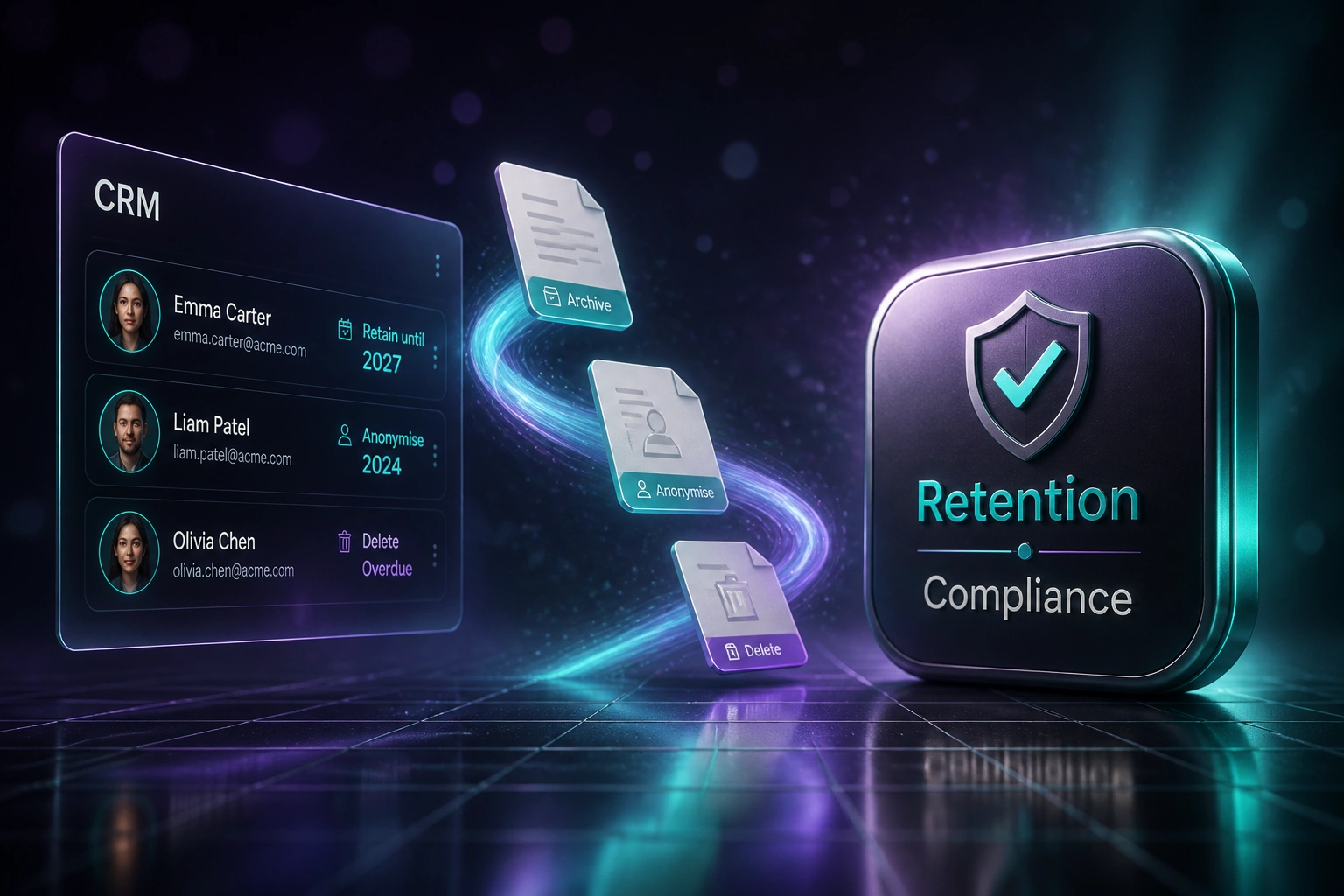
Record hits its window → disposition runs → evidence is logged. No annual scramble across systems.
Record Hits Expiry
Retention clock fires for a contact, invoice, ticket, or file class
Disposition Runs
Archive, anonymise, or delete according to the approved schedule
Cross-System Sync
Matching copies in CRM, ERP, and storage follow the same outcome
Evidence Logged
Immutable disposition log ready for POPIA, GDPR, or Companies Act review
Everything You Need for Defensible Compliance Archiving
Policy-Driven Schedules
Record types map to POPIA, GDPR, and Companies Act windows. Contacts, invoices, tickets, and files expire on a clock, not a spreadsheet reminder.
Archive, Anonymise, or Delete
Each class gets a disposition: cold archive for statutory records, anonymisation for analytics that no longer need PII, or secure deletion when the purpose ends.
Cross-System Enforcement
The same retention clock hits CRM, accounting, helpdesk, and object storage so a deleted contact does not linger in three other tools.
Legal Hold Overrides
Active disputes and Regulator requests freeze deletion for named records. Holds lift on release so the schedule resumes without manual chase.
Audit-Ready Evidence Packs
Every disposition writes who, what, when, and why. When the Information Regulator asks, you export the log instead of rebuilding history from emails.
Exception Queues
Edge cases land in a review queue for compliance sign-off. Your team handles exceptions; automation handles the 95% that match the schedule.
Systems We've Wired into Retention Schedules
From 240 Hours/Year to 32 Hours/Year
How a mid-market short-term insurer cut manual retention reviews, purged over-retained CRM and claims data, and recovered more than R210,000 in year one.
The Manual Process
- Compliance and IT ran an annual spreadsheet review across CRM, claims, and shared drives
- 240 hours a year chasing owners for keep-or-delete decisions
- Nearly half of closed contacts had no documented retention end date
- No immutable log of what was deleted, so audits meant reconstructing from tickets
- Storage and backup spend climbing while POPIA storage-limitation risk grew
The Automated Process
- Record classes map to POPIA, GDPR, and Companies Act windows with named dispositions
- Expired contacts anonymise or delete on schedule; statutory claims packs archive cold
- Legal holds freeze named matters without stopping the rest of the clock
- Exception queue handles edge cases; compliance reviews hours, not weeks
- Disposition log exports in minutes when the Information Officer needs evidence
Before vs After Data Retention Automation
How It Works
From first conversation to live retention policies in 3–6 weeks.
Map Your Retention Gaps
Which systems hold personal information, which schedules you already have, and where over-retention or under-retention is happening today.
Free Scoping Call
30-minute call with your compliance officer or COO to align POPIA, GDPR, and Companies Act windows with real system behaviour.
Build & Test
We wire schedules, dispositions, holds, and evidence logs into your stack, then dry-run on a sample set before any live deletes.
Go Live & Monitor
Policies run on schedule. Exception queues and alerts keep humans in the loop only when a record needs a decision.
Frequently Asked Questions
What is compliance data retention automation?
It is the operational layer that turns your retention schedule into scheduled actions across systems: archive statutory records, anonymise personal information that no longer needs to identify anyone, or delete records when the lawful purpose ends. The policy stops living in a PDF and starts running with an evidence trail.
How does this differ from POPIA CRM compliance or a consent platform?
POPIA CRM programmes focus on lawful basis, operator agreements, and DSAR queues inside the CRM. Consent platforms prove who agreed to marketing. Retention automation is the clock that archives, anonymises, or deletes across CRM, ERP, support, and storage on schedule, with holds and audit logs. Most mid-market teams need all three; this page is specifically about the clock.
What are the real fine and cost risks if we keep over-retaining?
POPIA section 109 caps administrative fines at R10 million. The Information Regulator has already issued R5 million infringement notices. Under GDPR, storage-limitation failures sit in the general-principles bucket (average fine around €3.8 million, about R72 million at current rates), and retailers have been fined around €856,000 (about R16 million) for indefinite retention. Separately, ISACA cites organisations spending up to US$34 million (about R560 million) holding redundant data.
How long must we keep company records in South Africa?
The Companies Act 71 of 2008 generally requires company records to be kept for at least seven years, with some registers kept indefinitely. Tax and industry rules can be longer. POPIA and GDPR then require that personal information not be kept longer than needed for the purpose. Automation is how you honour both: keep what the Act demands, dispose of what privacy law forbids you to hoard.
Will automation delete records we still need for disputes or audits?
No. Legal holds and preservation flags suspend disposition for named matters. Statutory classes (for example accounting records under the Companies Act) map to archive, not delete. Dry-runs and exception queues mean nothing irreversible happens without a rule you approved.
How much does retention automation cost?
A focused schedule on one or two systems typically starts around R35,000. Cross-system policies with holds, anonymisation, and evidence packs usually land between R55,000 and R120,000. Against manual review cycles that burn hundreds of hours a year, and against R10 million POPIA exposure, most mid-market clients see payback inside the first annual review cycle.
Stop Running Retention Reviews by Spreadsheet
If your compliance team still decides keep-or-delete once a year by hand, you are carrying fine risk and storage cost that a schedule can already remove.
Tell us which systems hold personal information, which retention windows your counsel already signed off, and where over-retention hurts most. We will show you how automated archive, anonymise, and delete policies would run for your business.