Compliance Task Management and Tracking: Nothing Missed, Everything Proven
If your regulatory compliance checklist still lives in spreadsheets and calendars, you already know the risk: one missed deadline means fines, audit findings, or licence exposure. Compliance officers, COOs, and risk leads feel it as deadline anxiety, not admin inconvenience.
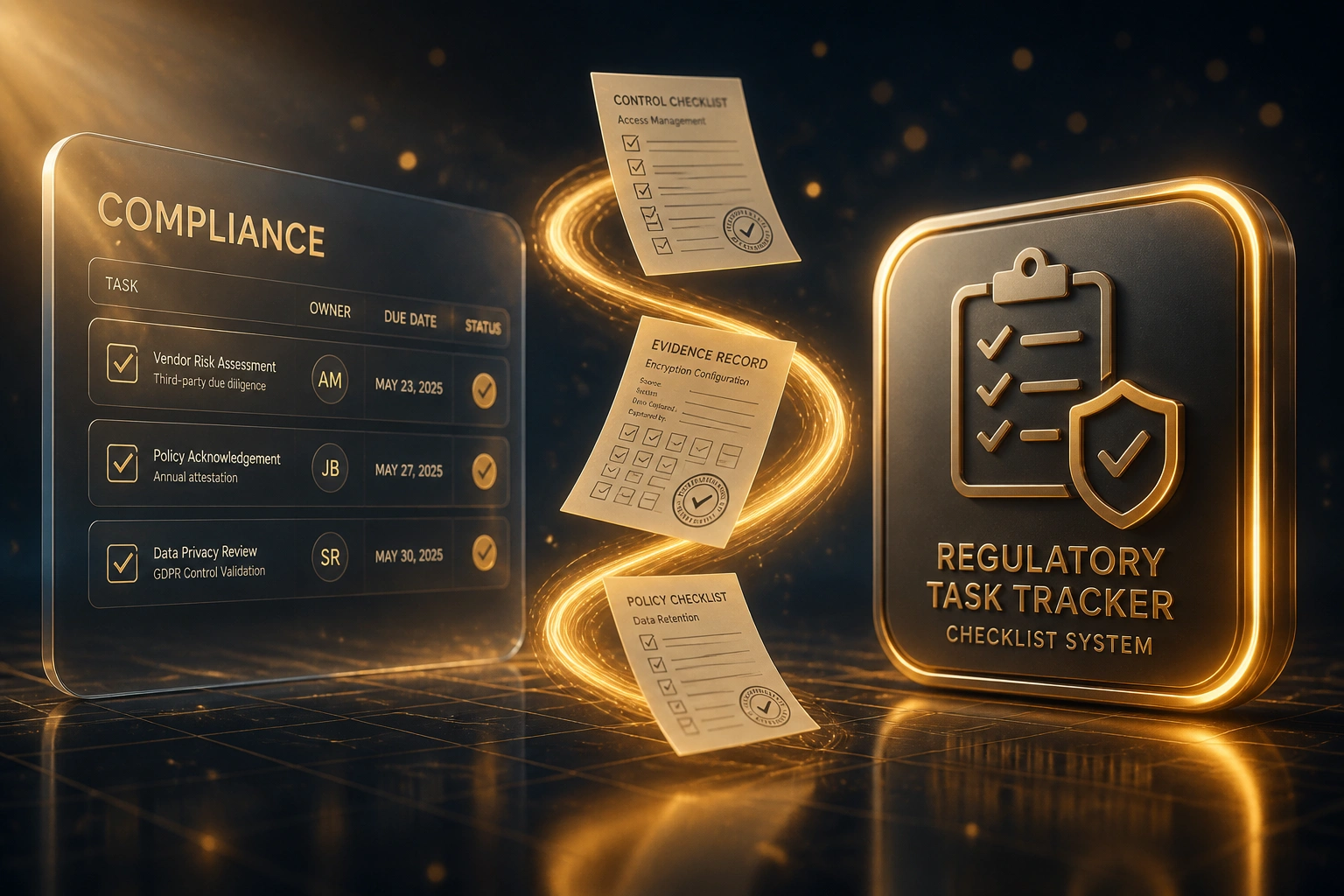
We build the compliance task tracking that assigns owners, seals evidence, and leaves an audit trail.
Sound Familiar?
These are the exact issues our clients faced before dedicated compliance task tracking:
- Hundreds of recurring POPIA, FICA, labour, and licence tasks live in spreadsheets and shared calendars with no single owner of truth
- Due dates slip quietly until an inspector, auditor, or board pack surfaces the gap
- Evidence for each control lives in email threads and personal drives, so audit prep becomes a scramble
- Handovers fail when a compliance officer leaves: unfinished tasks and missing proof travel with them
- Leadership asks "are we on track?" and the answer takes half a day of status chasing
Among organisations that missed a regulatory requirement, half of senior leaders estimated the financial loss at R8.2 million to R16.4 million, and 14% reported losses above R16.4 million. In South Africa, POPIA administrative fines reach R10 million, FICA company penalties reach R50 million, and a single law firm has already been fined R7.7 million for basic RMCP and training failures. Spreadsheet tracking is not a control; it is a liability.
What Compliance Task Management Actually Does
Obligation due → owner notified → evidence attached → audit trail sealed. Compliance reviews exceptions, not calendars.
Schedule Recurring Tasks
POPIA, FICA, labour, and licence obligations land on a shared calendar with owners and due dates
Escalate Before Deadline
Reminders and escalations fire to the owner, then the compliance lead, while there is still time to act
Attach and Seal Evidence
Proof files attach to the task with a timestamped trail of who completed and approved the control
Export the Audit Pack
Inspectors and auditors receive a filtered status pack instead of a folder scramble
Everything You Need for Regulatory Task Tracking
Recurring Compliance Checklists
POPIA reviews, FICA RMCP controls, BCEA labour obligations, and licence renewals run on schedules with owners, due dates, and escalation when items age.
Owner and Escalation Rules
Every task has a named owner and a backup. Overdue items escalate to the compliance officer, COO, or risk lead before the deadline, not after it.
Evidence Attach and Seal
Policies, screenshots, training registers, and signed attestations attach to the task. Once sealed, the audit trail records who attached what and when.
Audit-Ready Status Packs
Export a filtered pack by regulation, period, or control family. Auditors see completed tasks, owners, timestamps, and linked evidence in one place.
Board and Risk Reporting
Open, overdue, and completed counts roll into a compliance dashboard your risk committee can read without opening fifty spreadsheets.
System Write-Back
Completed training, policy acknowledgements, and control tests can write status into your HRIS, CRM, or document library so the tracker and source systems stay aligned.
Platforms We've Connected for Compliance Task Tracking
From 14 Hours/Week to 2.5 Hours
How a Cape Town FSCA-registered financial services firm stopped missing compliance deadlines, cut audit prep by 140 hours, and walked into a FIC-related review with evidence already attached.
The Manual Process
- Compliance officer chased ~180 recurring POPIA, FICA, and FAIS tasks across Excel and Outlook
- Owners updated status by email; overdue items only surfaced in the weekly stand-up
- Evidence lived in personal drives, so audit prep meant reconstructing proof under deadline pressure
- Two statutory filings nearly missed in one year when calendar reminders were dismissed
- Board packs took a full day of status chasing before each risk committee meeting
The Tracked Process
- Recurring obligations run on a shared tracker with named owners and escalation ladders
- Evidence attaches to each task; overdue items escalate before the statutory date
- Audit prep exports a filtered pack instead of reconstructing email threads
- Zero missed statutory deadlines in the first twelve months after go-live
- Risk committee dashboard shows open, overdue, and completed counts without spreadsheet merges
Before vs After Compliance Task Tracking
How It Works
From first conversation to live compliance task tracking in 2–4 weeks.
Tell Us Your Setup
Which regulations you track today, where checklists live, and which missed deadlines or audit scrambles hurt most.
Free Scoping Call
30-minute call to map obligations → owners → evidence → escalations → reporting for your compliance calendar.
Build & Test
We encode recurring tasks, attach evidence rules, and run parallel against your current spreadsheet for one reporting cycle.
Go Live & Monitor
Switch off calendar chasing. Monitoring flags overdue items and missing evidence before the statutory deadline.
Frequently Asked Questions
How long does compliance task management setup take?
A focused compliance task tracker with owners, due dates, evidence attach, and escalation takes 2–4 weeks from scoping to go-live. Single-regulation builds (for example POPIA only) can be live in about two weeks. Multi-regulation programmes covering POPIA, FICA, labour, and licence renewals typically take 4–6 weeks.
Which tools can you connect for regulatory task tracking?
We have connected SharePoint, Google Workspace, Monday.com, Asana, ClickUp, Notion, and custom trackers. If your compliance checklist still lives in Excel and Outlook calendar reminders, we can start there and harden ownership, escalation, and evidence before full system write-back.
How does this help with POPIA, FICA, and labour audits?
Each recurring obligation becomes a tracked task with an owner, due date, and attached evidence. When an Information Regulator enquiry, FIC inspection, or labour inspector asks for proof, you export a filtered pack instead of reconstructing email threads and personal folders.
Will compliance officers still own the judgement calls?
Yes. The tracker schedules work, escalates overdue items, and seals evidence. Your compliance or risk lead still decides what is adequate, when to escalate to the board, and how to remediate findings. Automation removes the chasing, not the professional judgement.
What happens when a task owner leaves the business?
Open tasks reassign to a backup owner or queue. Attached evidence and the audit trail stay on the task, so institutional memory does not walk out with the person who kept the spreadsheet on their laptop.
How much does compliance task management and tracking cost?
A focused compliance checklist with owners, escalations, and evidence attach starts from around R25,000. Multi-regulation programmes with board reporting packs and HRIS or CRM write-back typically range from R40,000 to R75,000. Most clients recovering admin hours and cutting missed-deadline risk see ROI within two to three months.
Stop Letting Compliance Deadlines Live in Spreadsheets
If your compliance or risk lead is still chasing regulatory tasks across Excel and calendars, you are carrying missed-deadline and audit-evidence risk that dedicated tracking already solves.
Tell us which obligations you track today, where checklists live, and which missed deadlines or audit scrambles hurt most. We will show you exactly how compliance task management would work for your programme.