ComplyAdvantage Integration: AI-Powered AML and Sanctions Screening
Your compliance queue is drowning in false-positive alerts. Manual sanctions, PEP, and adverse media checks burn analyst hours, stall onboarding, and still leave FICA audit gaps when the evidence lives in three different tools.
We wire ComplyAdvantage into your CRM so machine learning compliance cuts the noise and recovers capacity.
Sound Familiar?
These are the exact issues our clients faced before ComplyAdvantage integration:
- Analysts clear the same false-positive name hits all morning while true risk sits further down the queue
- Sanctions, PEP, and adverse media live in separate tools, so onboarding waits on three screens instead of one
- CRM holds DOB and nationality, yet screening still runs on name-only matches that flood the case queue
- Alert backlog grows faster than headcount, so FICA take-on slows whenever the MLRO is away
- Audit preparation means reconstructing who screened whom from emails and spreadsheets
Alert fatigue is a regulatory risk, not just an ops inconvenience. When 90–95% of hits are noise, true matches get the same cursory review as everything else. FICA TFS screening remains mandatory at take-on, and a 2024 FIC sanction of R7.77 million against an attorneys' firm was upheld for TFS screening and RMCP failures. Capacity recovered through machine learning compliance is capacity that stays on real risk.
What ComplyAdvantage Integration Actually Does
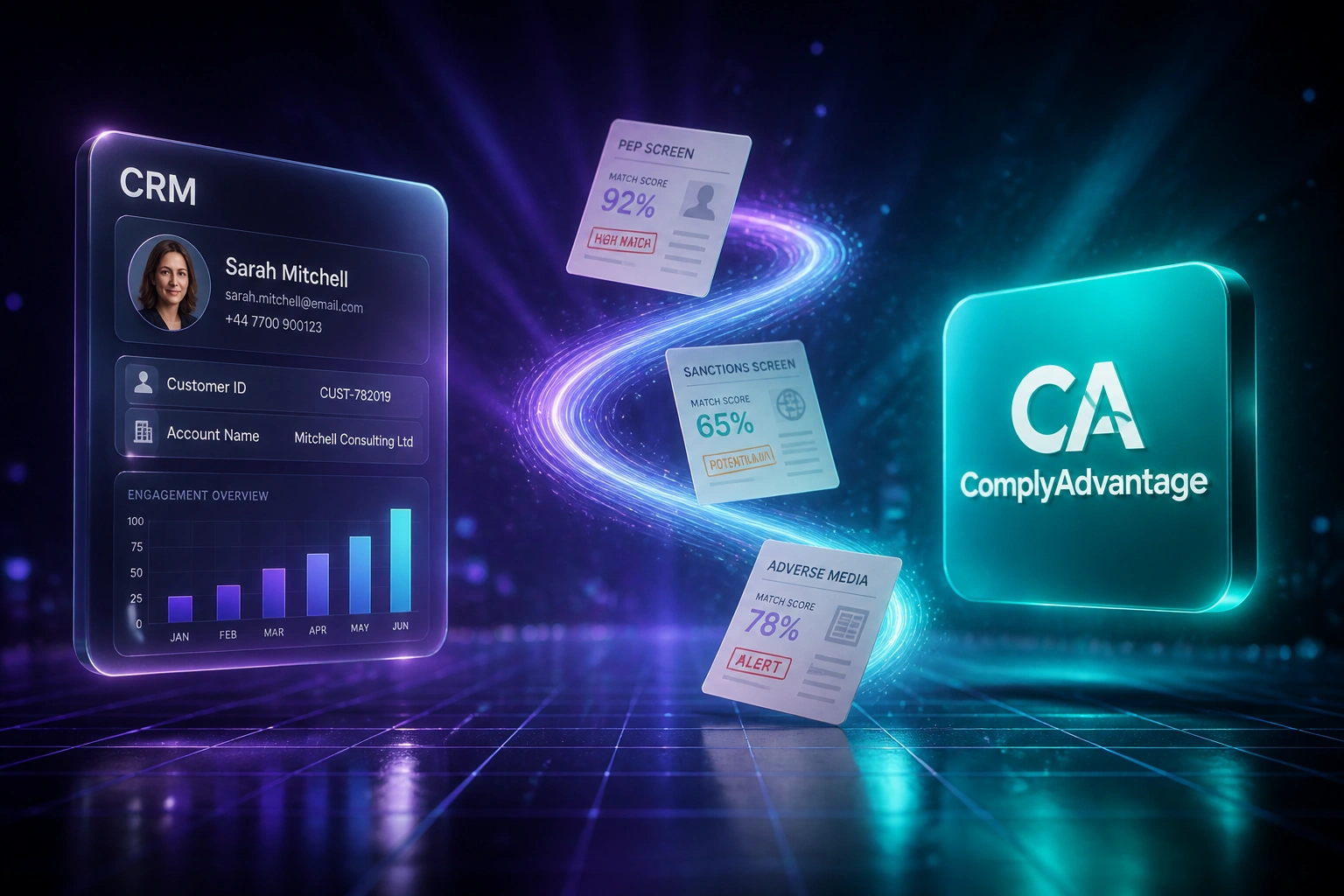
Client enters CRM → AI AML screen runs → low-noise result logs → clear clients proceed. One API, not three portals.
Client Enters Onboarding
A new CRM contact or application triggers screening with secondary identifiers already attached
ComplyAdvantage Screens
Sanctions, PEP, and adverse media checked in one AI-powered call with ML match scoring
Noise Filtered, Result Syncs
Low-confidence hits suppress; clear, potential, or blocked status writes to the client record
Analysts Decide Exceptions
Clear clients proceed same day. Matches escalate to your MLRO with evidence already attached
Everything You Need for Reliable AI AML Screening
Single-API Screening Stack
One ComplyAdvantage integration covers sanctions, PEP, RCA, and adverse media so onboarding does not bounce between three vendor portals.
Machine Learning Match Scores
AI-driven matching scores each hit so low-confidence name collisions auto-clear and analysts only open alerts that deserve human judgement.
CRM Field Enrichment
Date of birth, nationality, and ID from your CRM weight the screen so common SA names stop generating empty cases.
Exception-Only Queues
Clear results auto-progress onboarding. Potential matches pause the workflow and land in your compliance queue with evidence attached.
Full Audit Trail Sync
Every screen result, disposition, and remediation note writes back to the client record for FIC and internal audit without spreadsheet archaeology.
Ongoing Monitoring Hooks
Ongoing screening alerts when a client's risk profile changes after take-on, so mid-relationship PEP or sanctions hits surface the same day.
Systems We've Connected to ComplyAdvantage
From 18 Hours/Week to 3.5 Hours/Week
How a mid-size South African wealth platform cut alert noise with ComplyAdvantage and recovered R260,000 in year one.
The Manual Process
- Compliance cleared sanctions, PEP, and adverse media hits across separate tools
- 30–45 minutes per alert, most of them name-only false positives
- Clear clients still waited 1–2 days when the exception queue backed up
- CRM fields that could narrow matches never reached the screening step
- FIC inspection prep meant reconstructing dispositions from shared folders
The Automated Process
- CRM take-on triggers one ComplyAdvantage API screen for sanctions, PEP, and media
- ML match scores suppress low-confidence hits before an analyst opens the case
- Clear results auto-progress; only potential matches reach compliance
- Same-day clearance for clear clients, every time
- Full case history sits on the client record for FIC audits
Before vs After Integration
How It Works
From first conversation to live AI AML screening in 3–5 weeks.
Tell Us Your Setup
Which systems hold new clients, how you screen today, and where false-positive volume hurts most.
Free Scoping Call
30-minute call to map onboarding triggers, match thresholds, and how exceptions should escalate to compliance.
Build & Test
We build the ComplyAdvantage API integration, test with your real client profiles, and validate false-positive handling with your MLRO.
Go Live & Monitor
Switch off fragmented manual screens. Monitoring and alerting keep AI AML screening reliable as volumes grow.
Frequently Asked Questions
How long does a ComplyAdvantage AML screening integration take?
A standard CRM or onboarding screen takes 3–5 weeks from scoping to go-live. Simpler one-way screens into a single system can be live in about 2 weeks. Multi-system setups with custom exception queues and ongoing monitoring take closer to 5–7 weeks.
Do we already need a ComplyAdvantage licence?
Yes. ComplyAdvantage (now often delivered alongside Moody's Maxsight ecosystems) licenses screening volume separately. Starter plans publish from about R1,800 per month for low entity counts; enterprise books are quoted on volume. We scope the technical integration once licensing is in place, or in parallel with your account manager.
Will this replace our FIC TFS list obligations?
No. FICA still requires you to scrutinise clients against the targeted financial sanctions list and related obligations under sections 26A–28A. ComplyAdvantage strengthens that screening with global sanctions, PEP, and adverse media data plus a durable audit trail. Your RMCP still owns the policy; the integration executes it consistently.
How much can machine learning compliance cut false positives?
ComplyAdvantage publishes up to an 82% reduction in false positives from AI-powered matching, and the AJ Bell customer story reported an 82% drop in alert volume after optimisation. Industry benchmarks still put untuned sanctions and PEP false-positive rates at 90–95%, so wiring ML matching into your CRM is usually where capacity returns.
What happens when there is a potential match?
Clear results can auto-progress onboarding. Potential matches pause the workflow, notify your compliance queue, and attach match detail so the MLRO can resolve, escalate, or file the required FIC reports without reconstructing evidence from emails.
How much does ComplyAdvantage integration cost?
Integration build fees typically start from around R25,000 for a focused onboarding screen, with more complex CRM, exception, and ongoing-monitoring workflows in the R40,000–R75,000 range. Most clients clearing 40+ alerts a week recover the build cost within 2–4 months from analyst time alone, before counting reduced enforcement risk.
Stop Burning Analyst Hours on False Positives
If your team is still clearing name-only hits across fragmented screening tools, you are spending money and taking risk on a problem ComplyAdvantage machine learning already solves.
Tell us which systems hold your new clients, how you screen today, and where alert fatigue worries the MLRO. We will show you exactly how AI-powered AML screening would work for your institution.