ComplyAdvantage Ongoing Monitoring: Continuous Client Risk Surveillance
Your onboarding screen cleared the client. Twelve months later a PEP appointment or sanctions listing can still sit invisible until the next periodic review. Point-in-time screening is not enough under FICA ongoing due diligence expectations.
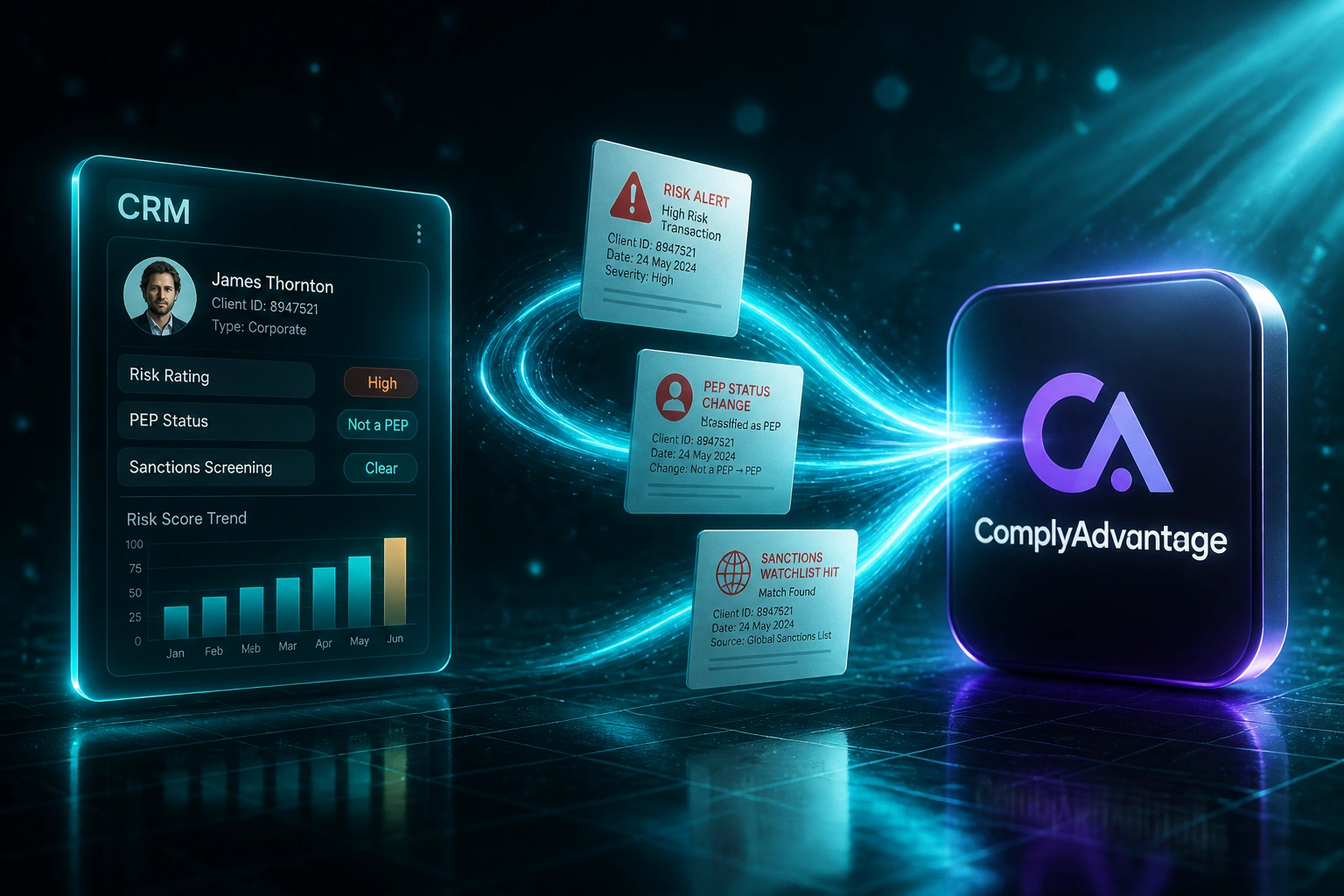
We wire ComplyAdvantage ongoing monitoring into case management so risk alerts create cases and escalate the same day.
Sound Familiar?
These are the exact issues MLROs face when continuous surveillance stops at take-on:
- Point-in-time screening at onboarding is treated as finished, so mid-relationship PEP or sanctions hits sit invisible until the next annual review
- Periodic full-book rescreens take weeks of analyst overtime and still leave months of silent risk drift between cycles
- ComplyAdvantage monitoring alerts arrive in email or a vendor portal, then wait for someone to open a case by hand
- Escalation to the MLRO depends on who notices the alert, so high-risk profile changes do not follow a consistent ladder
- Audit packs reconstruct ongoing due diligence from spreadsheets instead of a continuous case trail tied to each client
FICA section 21C requires ongoing due diligence for the life of the relationship, including keeping client information up to date. Annual batch rescreens alone leave a blind window regulators and FATF peer reviews increasingly treat as a control failure, not a scheduling choice.
What Continuous Surveillance Actually Does
Risk profile changes → alert fires → case opens → MLRO escalates. No silent drift between annual reviews.
Monitoring Stays On
Active clients remain on ComplyAdvantage ongoing monitoring after onboarding clears
Risk Profile Changes
New sanctions, PEP status, or adverse media hits the monitored book in near real time
Case Auto-Created
Webhook opens a case in your CRM or case queue with evidence attached
Escalation & Disposition
Severity rules route to the MLRO; outcomes write back to the client record
Everything You Need for Reliable Risk Alerts
Continuous Client Rescreening
Enable ComplyAdvantage ongoing monitoring so monitored clients are rescreened against the latest lists on a daily cycle, not only at annual review.
Sub-Minute Risk Change Alerts
Wire real-time notifications so global risk-profile changes surface in under 40 seconds, instead of waiting on 24–48 hour data-reseller lag.
Automatic Case Creation
Monitoring hits open structured cases in your CRM or case system with match detail attached, so analysts never copy alerts from a vendor inbox.
MLRO Escalation Ladders
Route sanctions, new PEP status, and adverse-media changes through your RMCP severity rules, with SLA clocks and senior approval trails.
CRM Risk Status Sync-Back
Client risk ratings, monitoring status, and open-case flags write back to the relationship record so relationship managers see exposure the same day.
Inspection-Ready Audit Trail
Every alert, disposition, and escalation note stays linked to the client for FICA section 21C evidence without spreadsheet archaeology.
Systems We've Wired for Ongoing Monitoring
From 14 Hours/Week to 3 Hours/Week
How an FSCA-licensed Cape Town wealth firm closed the silent risk window between annual reviews and recovered analyst capacity.
The Manual Process
- Annual full-book rescreen plus quarterly high-risk batch, with no mid-cycle alerts
- Analysts spent ~100 minutes per low-risk periodic file on data chase and checklist work
- ComplyAdvantage hits that did surface sat in email until someone opened a case
- A mid-year PEP appointment on an existing client went unnoticed for four months
- MLRO escalation depended on who happened to read the vendor portal that week
The Automated Process
- Ongoing monitoring enabled on the active book; daily rescreens run without analyst kickoff
- Risk-profile changes open CRM cases automatically with match detail attached
- Severity rules escalate sanctions and new PEP hits to the MLRO within the same day
- Relationship managers see risk-status flags on the client record without asking compliance
- Periodic reviews still run on schedule, but focus on judgement instead of list chasing
Before vs After Continuous Surveillance
How It Works
From first conversation to live continuous surveillance in 3–5 weeks.
Tell Us Your Setup
Which systems hold active clients, how you run periodic reviews today, and where monitoring alerts currently stall.
Free Scoping Call
30-minute call to map monitoring enablement, webhook destinations, case fields, and MLRO escalation thresholds.
Build & Test
We wire ComplyAdvantage ongoing monitoring into your stack, replay sample risk-profile changes, and validate case creation with your compliance lead.
Go Live & Monitor
Switch off manual batch-only reliance. Alerting and case queues keep continuous surveillance reliable as the book grows.
Frequently Asked Questions
How is ongoing monitoring different from onboarding AML screening?
Onboarding screening is a point-in-time check before you take the client on. Ongoing monitoring keeps that client under continuous surveillance after take-on, rescreening against updated sanctions, PEP, and adverse-media data and raising cases when the risk profile changes. FICA section 21C expects ongoing due diligence through the life of the relationship, not a one-off screen.
How quickly does ComplyAdvantage surface a risk-profile change?
ComplyAdvantage publishes that its Mesh applications identify global risk changes in under 40 seconds, because they run on proprietary real-time intelligence rather than third-party data resellers that can lag 24–48 hours. When monitoring is enabled, monitored customers are also rescreened on a daily cycle against the latest screening configuration.
Do we still need annual or risk-based periodic reviews?
Yes. Continuous surveillance complements your RMCP periodic-review calendar; it does not replace relationship reviews, source-of-funds refresh, or enhanced due diligence for high-risk clients. What it removes is the blind window where a sanctions listing or PEP appointment can sit undetected for months between scheduled reviews.
What happens when a monitoring alert fires?
The integration creates a case in your CRM or case-management queue with the match detail attached, applies your severity routing, and notifies the right compliance owner. Clear or muted profiles do not interrupt the relationship. Potential matches pause for human disposition with a durable audit trail.
Will this disrupt relationship managers or existing case tools?
No. We design the flow to land in the tools your team already uses. Relationship managers see risk-status updates on the client record; compliance works the exception queue. We run parallel testing before you retire batch-only dependence.
How much does ComplyAdvantage ongoing monitoring integration cost?
Integration build fees typically start from around R30,000 for webhook-to-case wiring on an existing ComplyAdvantage book, with fuller CRM sync, escalation ladders, and audit write-back in the R45,000–R80,000 range. Most teams spending 10+ hours a week on manual periodic rescreen triage recover the build cost within 2–4 months from analyst time alone, before counting reduced enforcement exposure.
Stop Relying on Annual Batch Rescreens Alone
If mid-relationship PEP and sanctions changes only surface at the next periodic review, you are carrying silent risk that FICA ongoing due diligence already expects you to manage.
Tell us which systems hold your active book, whether ComplyAdvantage monitoring is licensed, and where alerts currently stall. We will show you exactly how continuous surveillance, case creation, and escalation would work for your RMCP.