Conflicting Data Reconciliation: Resolving Discrepancies Between Two Systems
Your CFO watches CRM, ERP, and accounting disagree on the same customers and balances. Unresolved conflicts burn hours every week and create audit risk when both systems claim to be right.
We find the root cause, decide the correct value, and unify the records.
Sound Familiar?
These are the exact issues our clients faced before conflicting data reconciliation:
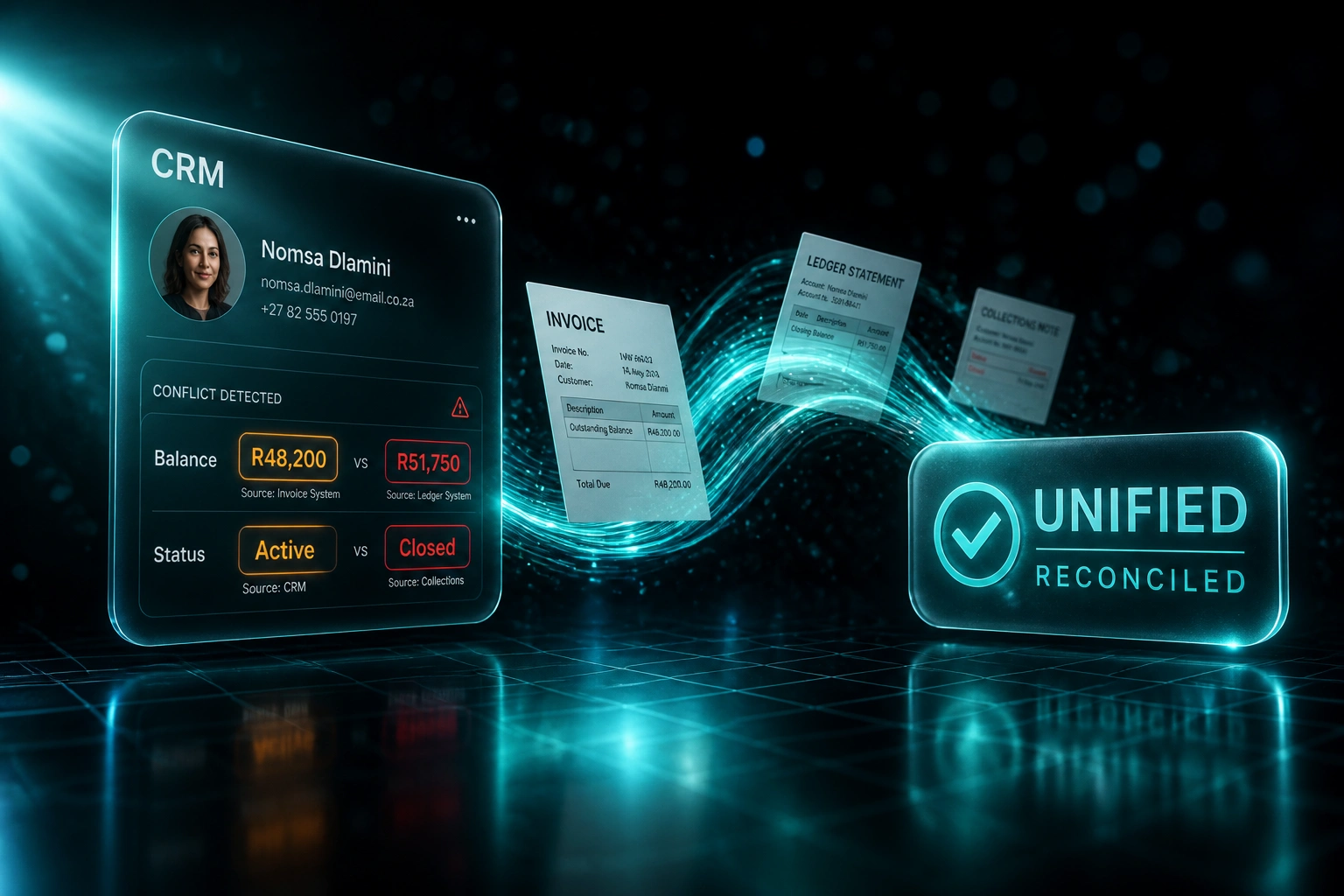
- CRM shows R48,200 outstanding while the ledger shows R51,750 for the same customer, and both teams insist their system is correct
- Finance spends days every month matching entity by entity because sync tools only copy values, they never decide which value wins
- Customer status is Active in sales and Closed in collections, so credit holds, invoices, and commission all fire on the wrong truth
- Duplicate billing and credit notes pile up when the same order reference exists with different amounts in two systems
- Month-end and SARS season turn into forensic archaeology instead of a controlled close
Month-end, SARS filings, and external audit do not wait for your teams to agree. Every unresolved discrepancy between systems that should match becomes rework, write-off risk, or a finding. Duplicate billing and wrong credit holds are symptoms of the same root problem: no authoritative value when two systems diverge.
What Conflicting Data Reconciliation Actually Does
Detect mismatches → find root cause → decide the correct value → write both systems back into agreement.
Compare Shared Entities
Same customers, orders, and balances pulled from CRM, ERP, and accounting side by side
Flag System Discrepancies
Every conflicting field surfaces with evidence from both sides, not a silent overwrite
Decide Correct Values
Ownership rules and review queues determine which system wins for each field class
Unify and Prevent Drift
Both systems update to the reconciled truth, with ongoing checks catching new conflicts early
Everything You Need for Reliable Data Unification
Conflict Detection Across Systems
We compare the same entities across CRM, ERP, and accounting and surface every field that disagrees: balances, statuses, VAT numbers, ship-tos, and product codes.
Root-Cause Matching Rules
Conflicts are traced to cause: manual overwrite, failed sync, duplicate master, or timing lag. Matching rules decide which source owns which field, with human review for ambiguous cases.
Authoritative Value Resolution
We do not average two wrong numbers. Ownership rules and evidence determine the correct value, then write it back so both systems agree on the same entity.
Quarantine and Exception Queues
Unresolved conflicts land in a review queue instead of silently overwriting finance. Ops clears exceptions; the rest of the business keeps moving.
Audit Trail for Every Decision
Each reconciliation records what disagreed, which value won, why, and who approved it. Auditors and SARS reviewers get a defensible trail, not a spreadsheet folklore.
Ongoing Divergence Prevention
After the cleanup, scheduled reconciliation catches new mismatches early so month-end stops becoming a firefight of conflicting master data.
Systems We Reconcile Across
From 15 Hours/Week of Conflict Triage to Under 2
How a mid-market distributor stopped CRM and accounting fighting over the same customers, and cut close from 12 days to 5.
The Manual Conflict Chase
- Ops and finance compared HubSpot balances to Sage line by line in spreadsheets
- 15 hours a week spent deciding which system won on status, credit, and ship-to
- Duplicate invoices and credit notes when order amounts diverged between systems
- Month-end close stretched to 12 working days chasing unmatched items
- Audit prep meant reconstructing decisions from email threads with no trail
The Reconciled Process
- Nightly conflict detection flags every entity where CRM and Sage disagree
- Ownership rules auto-resolve the clear cases; exceptions hit a review queue
- Authoritative values write back to both systems so they stay unified
- Close dropped to 5 working days with far fewer unmatched items
- Every decision carries a timestamped reason code for auditors
Before vs After Data Unification
How It Works
From first conversation to reconciled systems in 3–5 weeks for a focused two-system programme.
Map the Conflicts
Which systems should agree, which entities diverge today, and which mismatches burn the most hours or audit risk.
Free Scoping Call
30-minute call to set ownership rules, match keys, and which conflict class to resolve first.
Reconcile and Parallel Run
We detect conflicts, resolve authoritative values, write back both sides, and validate against your current month-end pack.
Go Live and Monitor Drift
Manual triage drops to exceptions. Ongoing checks flag new system discrepancies before the next close.
Frequently Asked Questions
How is conflicting data reconciliation different from a normal sync?
A sync copies fields from A to B. Reconciliation decides which system is right when both already claim correctness and disagree on the same customer, order, or balance. We identify the root-cause mismatch, pick the authoritative value, and unify both systems so they stop fighting each other.
Which systems can you reconcile?
We routinely reconcile CRM against ERP and accounting: HubSpot, Salesforce, or Pipedrive against Xero, Sage, SAP, QuickBooks, or a custom ledger. If both systems expose the entities you care about, we can compare and unify them.
What happens when neither system is clearly correct?
Ambiguous cases go to a quarantine queue with evidence from both sides: timestamps, source documents, VAT numbers, and related transactions. Your ops or finance lead approves the winning value. We never silently overwrite a balance that affects revenue or SARS reporting.
Will this help month-end close and audit readiness?
Yes. Mid-market closes often stretch 10 to 15 working days when finance is still chasing inter-system discrepancies. Resolving conflicts upstream cuts rework in the close window and leaves an audit trail of how each disputed value was decided.
How long does a conflicting data reconciliation project take?
A focused reconciliation across two core systems typically takes 3 to 5 weeks from scoping to live. Broader programmes covering CRM, ERP, and accounting with heavy duplicate cleanup and ownership rules usually take 5 to 8 weeks, including parallel validation against the current close process.
How much does conflicting data reconciliation cost?
Focused two-system reconciliation with conflict rules and write-back typically starts around R40,000. Broader forensic programmes across CRM, ERP, and accounting usually land between R55,000 and R110,000. Most clients recover that inside 2 to 4 months against the hours currently spent resolving system discrepancies by hand.
Stop Paying for Systems That Disagree
If your CRM, ERP, and accounting keep fighting over the same entities, you are funding labour and audit risk that forensic reconciliation removes.
Tell us which two systems disagree most, what fields blow up month-end, and how close season feels today. We will show you exactly how conflicting data reconciliation would work for your business.