Credit Score Decisioning: Automate Approve, Decline, and Refer Workflows
Your credit analysts burn hours manually applying score cutoffs and policy rules to every application. Clear cases wait in the same queue as grey-zone referrals, decision latency stretches from hours into days, and inconsistent outcomes become an NCA audit risk as volumes rise.
We build automated credit decisioning that evaluates scores against your risk appetite and routes approve, decline, or refer in seconds for clear cases.
Sound Familiar?
These are the exact issues SA lenders and store-credit retailers faced before automated decisioning:
- Credit analysts spend 30 to 60 minutes applying score cutoffs and policy rules to every application by hand
- Clear approve and decline cases sit in the same queue as grey-zone referrals, so decision latency stretches to days
- Two analysts reviewing the same file can reach different outcomes, which creates audit and fairness risk under the NCA
- Risk appetite changes live in a spreadsheet or policy PDF while the floor keeps using last month's thresholds
- NCR examiners ask for the decision rationale at grant, and the trail is scattered across emails, notes, and bureau PDFs
NCA Regulation 23A requires a documented affordability assessment and a bureau debt-repayment check within seven business days before grant (fourteen for mortgages). Manual decisioning that cannot reconstruct the score, rules, and rationale at grant date is both a bottleneck and an examination exposure.
What Automated Credit Decisioning Actually Does
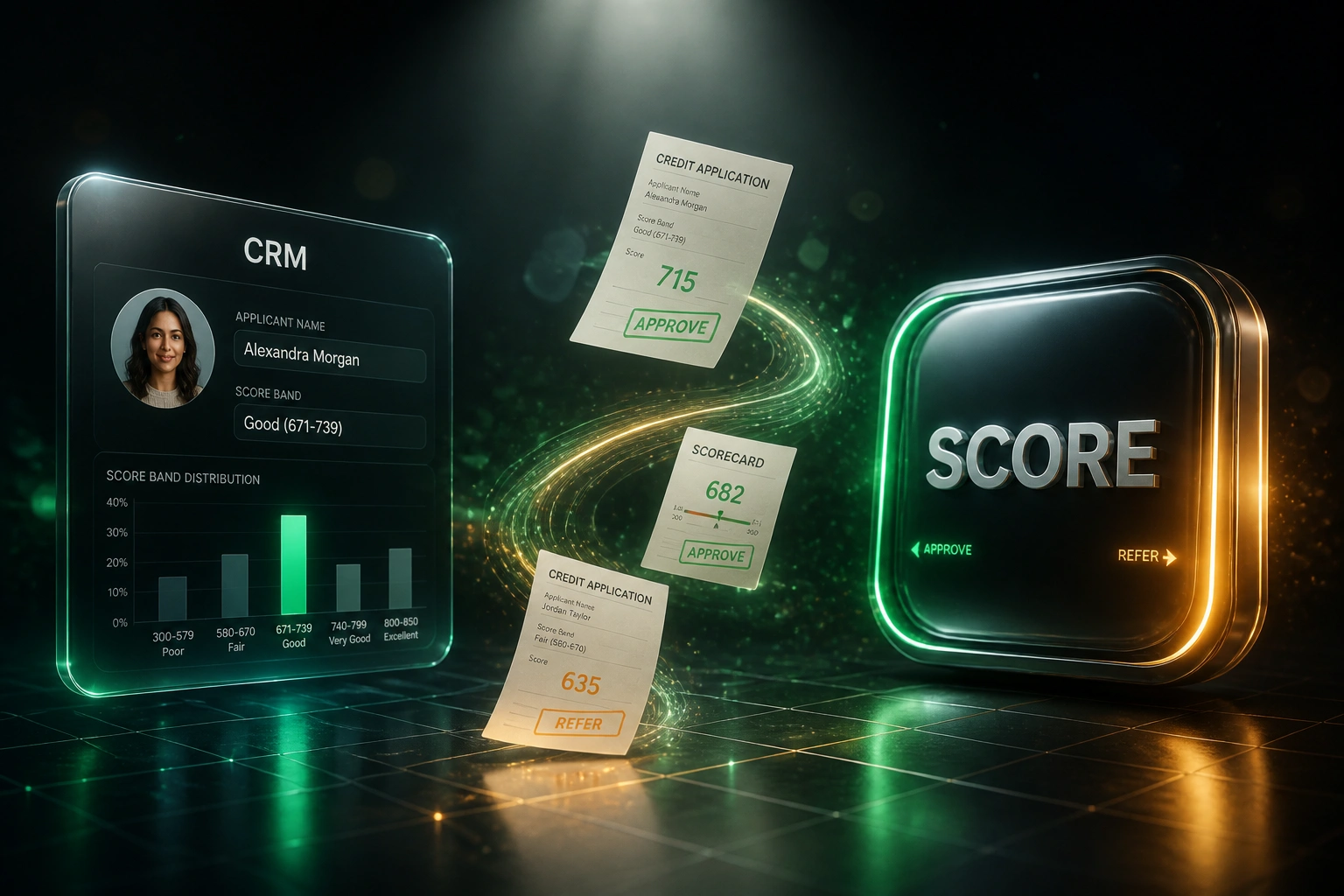
Score arrives → risk appetite applied → approve, decline, or refer. Analysts only touch the grey zone.
Application & Score Ready
Bureau score and affordability inputs land in your CRM or loan origination system
Risk Appetite Applied
Score cutoffs, DTI limits, and product rules evaluate the file in seconds
Approve, Decline, or Refer
Clear cases decide automatically; grey-zone files route to an analyst with reason codes
Outcome Written Back
Status, rationale, and policy version sync to the loan file for sales, stores, and examiners
Everything You Need for Risk-Based Decisioning
Score-Based Auto Routing
Bureau score and affordability inputs hit your risk appetite rules. Clear cases auto-approve or auto-decline; grey-zone files route to refer with the full scorecard attached.
Configurable Risk Appetite
Score cutoffs, debt-to-income limits, negative lists, and product-level bands are maintained by credit risk, not buried in IT tickets. Change policy without rewriting the floor.
Approve, Decline, Refer Outcomes
Every application returns one of three outcomes with recorded reasons. Straight-through processing for the clear majority; analysts only see files that need judgement.
NCA Affordability Alignment
Decisioning sits after bureau and income checks so Regulation 23A inputs feed the same workflow. Decline reasons and discretionary-income logic stay examination-ready.
CRM & Loan System Write-Back
Outcome, reason codes, and policy version write back into your CRM or origination stack. Sales and store desks see status without chasing the credit floor.
Full Decision Audit Trail
Score used, rules fired, outcome, timestamp, and analyst override (if any) land on one record. When examiners ask what you decided and why, you answer from the file.
Systems We've Wired into Decisioning Workflows
From 48 Hours Average to Under 60 Seconds
How a Gauteng retailer with store credit cut decision latency, freed analysts for grey-zone referrals, and recovered R412,000 in year one.
The Manual Process
- Three credit analysts applied score cutoffs and policy rules to every store-credit application by hand
- Average 40 minutes per file, with clear approves stuck behind complex referrals
- Decision turnaround averaged 1–3 business days; peak weeks stretched past 48 hours
- Analyst outcomes differed on borderline scores, creating fairness and audit friction
- Risk appetite updates took weeks to reach the floor consistently
The Automated Process
- Score and affordability inputs hit a configured risk-appetite engine automatically
- 72% of applications straight-through approved or declined in under 60 seconds
- Analysts only review the ~14% refer band, with reason codes and scorecard attached
- Policy version and decision rationale written back to every loan file
- Cutoff changes published by credit risk the same day, with a full version trail
Before vs After Credit Decisioning Automation
How It Works
From first conversation to live decisioning in 3–5 weeks.
Tell Us Your Setup
Where scores land today, how approve/decline/refer is applied, and which policy rules create the biggest queue.
Free Scoping Call
30-minute call to map risk appetite bands, NCA affordability inputs, and write-back into your CRM or loan system.
Build & Test
We encode your scorecard and routing rules, run parallel against manual decisions, and validate audit packs before go-live.
Go Live & Monitor
Clear cases decide in seconds. Analysts focus on referrals. Monitoring flags policy drift and override patterns early.
Frequently Asked Questions
How is this different from a credit bureau integration?
Bureau integrations pull the score and credit history. Credit score decisioning sits after that pull: it applies your risk appetite and routes each application to approve, decline, or refer. Most lenders need both wired as sequential steps.
How long does credit decisioning automation take to set up?
A standard approve/decline/refer engine with CRM write-back takes 3–5 weeks from scoping to go-live. Builds that include multi-product scorecards, affordability rule packs, and analyst override workflows typically take 5–8 weeks.
Will clear cases still need a credit analyst?
No. Well-tuned consumer lending engines target 60–80% straight-through processing. Analysts focus on the refer band (typically around 10–15% of volume) where judgement genuinely adds value, instead of re-applying the same cutoffs all day.
How does this support NCA affordability and audit readiness?
Decisioning consumes the same bureau and income inputs your affordability assessment already requires. Every outcome stores the score, rules fired, policy version, and reason codes so NCR examinations can reconstruct the decision at the date of grant.
Can credit risk change cutoffs without a development project?
Yes. We design the risk appetite layer so credit managers adjust score bands, DTI limits, and product rules through a controlled configuration surface. Changes are versioned and logged for audit, then applied to new applications immediately.
How much does credit score decisioning automation cost?
Decision engines with approve/decline/refer routing and write-back typically range from R35,000 to R80,000 depending on product count and policy complexity. Lenders processing 50+ applications a week usually see ROI within 2–4 months against analyst time alone.
Stop Burning Analyst Hours on Clear Credit Decisions
If your credit floor still applies the same score cutoffs by hand while NCA affordability expectations and application volumes keep rising, you are spending money on a bottleneck that decisioning automation already solves.
Tell us where bureau scores land today, how approve, decline, and refer are applied, and which product rules create the longest queues. We will show you exactly how risk-based decisioning would work for your lending or store-credit book.