Contract Renewal Invoicing: CRM to Accounting Automation
Annual contracts only get paid when someone remembers the renewal date. That calendar dependency leaks revenue, skips contractual uplifts, and turns every Q4 into a cliff of late invoices.
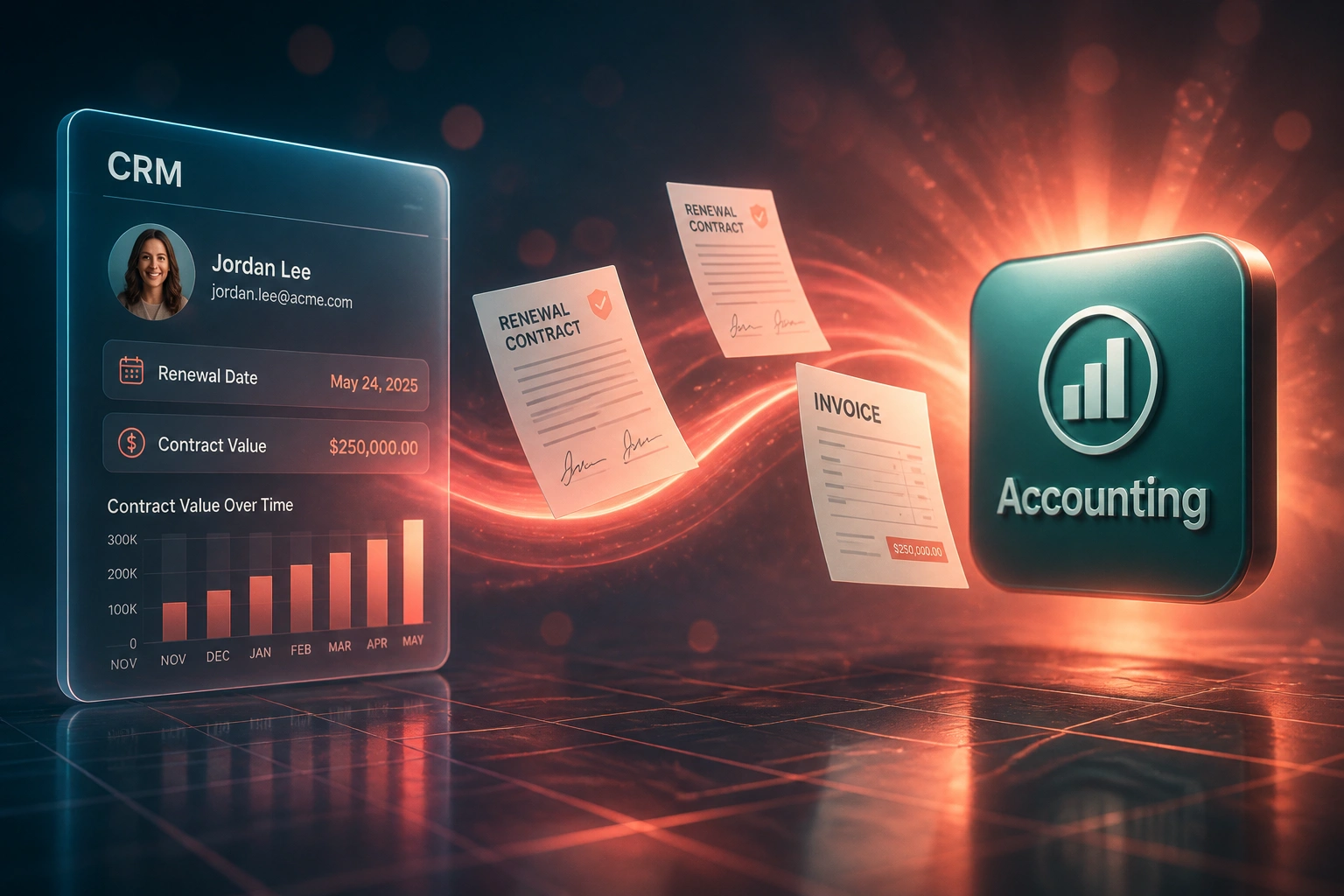
We wire CRM renewal dates to accounting so renewal invoicing runs on schedule.
Sound Familiar?
These are the exact issues sales ops and finance leads face when annual billing depends on a calendar:
- Renewal dates live in a shared spreadsheet that nobody trusts by Q3
- Annual invoices go out weeks late because someone had to remember the date
- Contractual price uplifts are skipped, so clients renew at last year's rate
- Notice periods expire before sales ops starts the renewal conversation
- Q4 piles up dozens of renewals at once and finance falls weeks behind
Financial year-end and Q4 create a renewal cliff. When dozens of annual contracts come due in the same window, manual calendars fail hardest: invoices go out late, uplifts get skipped, and notice periods expire before anyone starts the conversation.
What Contract Renewal Invoicing Actually Does
Renewal date hits → invoice created with uplift → payment synced back. No spreadsheet, no forgotten anniversary.
CRM Hits Renewal Date
Contract anniversary or notice window fires from the CRM renewal field
Invoice Created with Uplift
Draft renewal invoice appears in accounting with the correct amount, VAT, and escalation
Payment Synced Back
Client pays → CRM contract updates to Paid and next renewal date advances
Portfolio Stays Current
No missed renewals, no skipped uplifts, no Q4 scramble for annual billing
Everything You Need for Reliable Annual Billing
Renewal-Date Triggers
The CRM holds each contract's renewal date and notice window. At the agreed lead time, a draft renewal invoice appears in accounting with no calendar chasing.
Automatic Price Uplift
Fixed percentage, CPI-linked, or custom escalations are encoded once. The renewal invoice applies the correct uplift so annual billing never rolls forward at the old rate.
Notice-Period Alerts
Sales ops and account leads get tasks 60 to 90 days out, well before the notice window closes. Renewal conversations start on time, not after the client has already decided.
Multi-Year Contract Support
Annual, 24-month, and 36-month terms all work from the same CRM record. Staged renewals and anniversary billing fire on the right date without a separate process for each tenure.
Payment Status Sync-Back
When the client pays the renewal invoice, the CRM contract updates to Paid and the next renewal date advances. Sales always knows which renewals are secured.
Renewal Portfolio Dashboard
See every upcoming renewal, uplift due, and overdue invoice in one view. Finance and sales ops stop discovering missed annual billing at year-end.
Platforms We've Connected for Renewal Invoicing
From 5 Missed Renewals to Zero
How a 35-person B2B services firm stopped leaking annual contract revenue and got renewal invoices out 11 days sooner.
The Manual Process
- Sales ops tracked 72 annual contracts in a shared spreadsheet
- Average 14 days from renewal date to invoice sent
- Five contracts lapsed unbilled in one financial year (R1.1M at risk)
- CPI uplifts skipped on 12 renewals because nobody updated the sheet
- Q4 alone put 28 renewals due in six weeks with no capacity plan
The Automated Process
- CRM renewal date triggers a draft invoice in Xero on schedule
- Finance reviews and approves; uplifts apply automatically
- Zero lapsed renewals in the first full year
- Notice-period tasks fire 60 days out so sales starts early
- Q4 renewal cliff handled without overtime or late invoices
Before vs After Renewal Automation
How It Works
From first conversation to live renewal invoicing in 2–4 weeks.
Map Your Renewals
Tell us which CRM and accounting system you use, how annual contracts are structured, and where renewal invoicing breaks down.
Design Renewal Rules
30-minute scoping call to define lead times, notice periods, uplift logic, VAT treatment, and which fields drive each invoice.
Build and Validate
We build the integration, test with your real contract book, and run parallel for a renewal cohort so every draft matches your expectation.
Go Live and Monitor
Switch off the spreadsheet calendar. Monitoring and alerts keep renewal invoicing on schedule, with exception handling for paused or disputed contracts.
Frequently Asked Questions
How is this different from monthly recurring invoice automation?
Monthly recurring billing fires every cycle for subscriptions and retainers. Contract renewal invoicing fires once per year (or multi-year anniversary) when a CRM renewal date is reached. It handles notice periods, contractual uplifts, and the Q4 renewal cliff that monthly subscription billing never sees. If your revenue sits in annual or multi-year service contracts, this is the automation you need.
Which CRM and accounting combinations work for renewal invoicing?
We have built renewal invoicing automations for HubSpot, Pipedrive, Salesforce, Zoho CRM, and Monday.com on the CRM side, paired with Xero, QuickBooks, Sage (Business Cloud and Pastel), NetSuite, and FreshBooks on the accounting side. If both systems have an API, we can connect them. The CRM holds renewal dates, notice windows, and uplift rules; accounting receives the invoices on schedule.
Can it apply CPI or fixed percentage uplifts at renewal?
Yes. Fixed percentage, CPI-linked, or custom escalations are encoded per contract type at setup. When the renewal trigger fires, the invoice amount reflects the uplift automatically. That stops clients renewing at last year's rate because nobody updated a spreadsheet cell.
What happens if a client disputes or pauses a renewal?
Validation and exception rules keep disputed renewals in draft and alert the account lead. Paused contracts stop generating invoices until the CRM status returns to active. Nothing goes out half-built, and nothing keeps billing a client who has asked to hold.
How long does setup take from first call to live renewal invoicing?
A standard renewal invoicing automation takes 2 to 4 weeks from scoping to go-live. Simpler one-way date-to-invoice syncs can be live within 2 weeks. Complex portfolios with mixed tenures, multi-entity VAT, and custom uplift tables take 4 to 6 weeks. We always run a parallel renewal cohort before switching off the manual calendar.
What does this cost and when do we see ROI?
Simple one-way renewal invoice syncs start from around R15,000. Full renewal management with notice-period alerts, uplift rules, and payment sync-back typically ranges from R25,000 to R60,000. Most firms with 40 or more annual contracts see full ROI within 6 to 10 weeks from prevented leakage and staff time alone.
Stop Depending on a Calendar for Annual Billing
If renewal invoices only go out when someone remembers a date, you are leaving revenue on the table every financial year.
Tell us which CRM and accounting system you use, how many annual contracts you renew, and where the process breaks. We will show you exactly how CRM-triggered renewal invoicing would work for your book.