Deduplicating Customers Across CRM and Accounting: One Master Customer Record
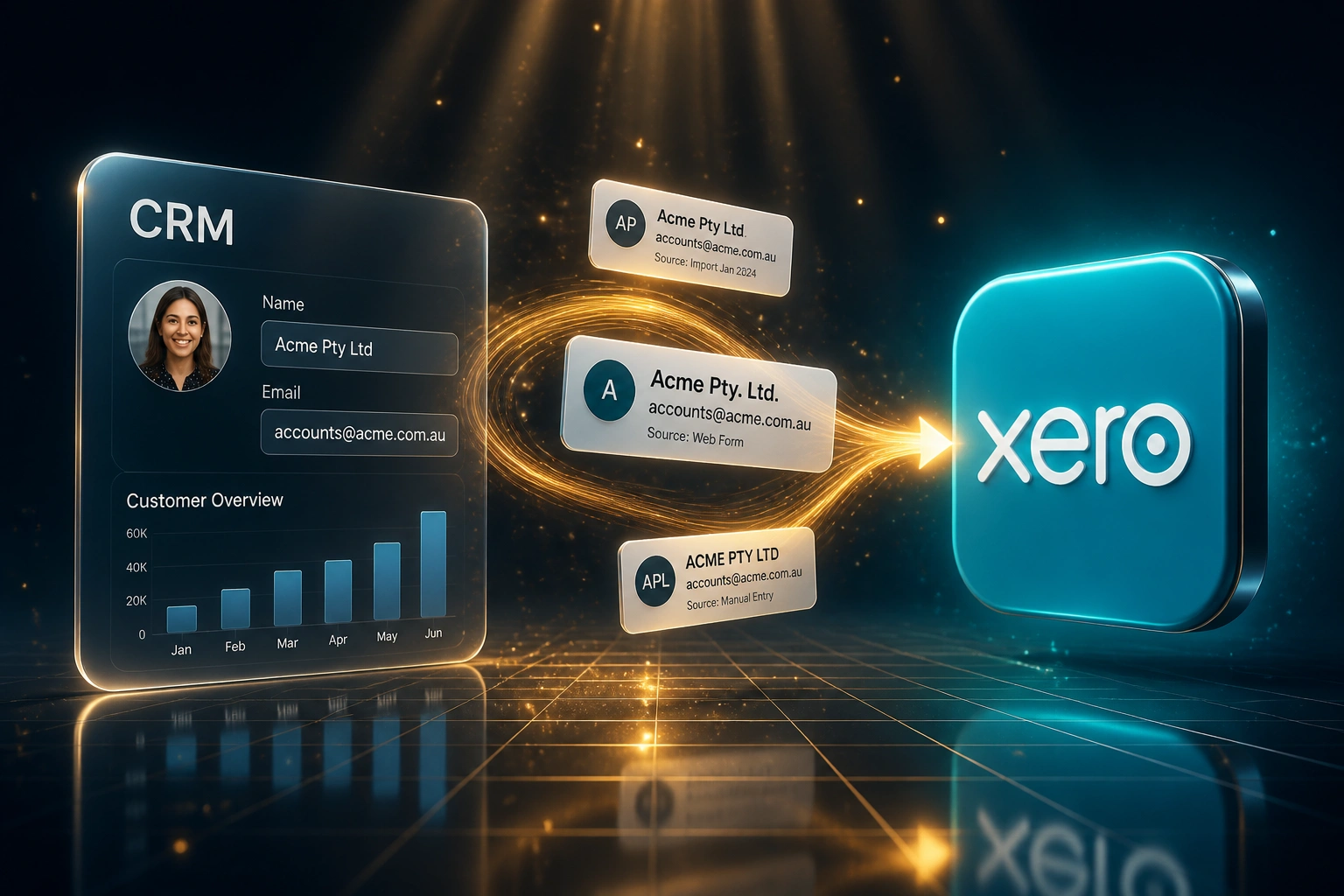
Finance finds the same client billed twice. Or an invoice goes to a stale address. CRM says "Acme (Pty) Ltd" and Xero or Sage says "ACME PTY LTD", so they never matched. That is not an onboarding problem. It is a cross-system dedup problem sitting in your books today.
We build the match rules and master customer record so billing and CRM share one identity.
Sound Familiar?
These are the exact issues finance controllers and ops leads bring us when customer deduplication has been deferred for years:
- The same client appears twice: "Acme (Pty) Ltd" in the CRM and "ACME PTY LTD" in Xero or Sage, so invoices never match the sales record
- Finance raises a second invoice because the CRM contact failed to match an existing debtor, and the client gets billed twice
- Automated invoice syncs fail or create new contacts because VAT numbers, registration numbers, and name spellings do not line up
- Collections chase the wrong address while the CRM still shows the old postal details from a duplicate record
- Credit risk and aged-debtor reports split one customer across two debtor codes, so exposure looks smaller than it is
Audit findings, POPIA data-quality reviews, and failed automated invoice syncs are the usual triggers. Once auditors or SARS ask which record is authoritative, "we have two versions of the same client" stops being a tidy-up task and becomes a control finding.
What Cross-System Dedup Actually Does
Profile → match → master record → clean sync. Existing duplicates get resolved; new ones get blocked.
Profile Both Systems
Pull CRM contacts and accounting debtors, normalise names, VAT numbers, and registration numbers
Match and Score
Deterministic keys first, then fuzzy name and address scoring with a confidence threshold
Master Customer Record
Link CRM and accounting IDs to one identity, apply merge rules, queue ambiguous pairs
Clean Ongoing Sync
Invoices and updates hit the right customer. New duplicates are blocked at the source
Everything You Need for a Master Customer Record
Fuzzy Name Matching
Normalised company names catch "Acme (Pty) Ltd", "ACME PTY LTD", and "Acme Pty. Ltd" as one entity, not three separate customers.
VAT and Registration Keys
Deterministic matches on VAT numbers and company registration numbers resolve the majority of B2B pairs with near-zero risk before fuzzy rules run.
Master Customer Record
One golden identity links the CRM account and the accounting debtor. Billing and sales share the same customer, not two conflicting versions.
Merge and Survivorship Rules
You decide which system wins on address, payment terms, tax codes, and credit limit. Critical fields are never overwritten by accident.
Review Queue for Ambiguous Matches
High-confidence pairs auto-link. Borderline matches land in a short review queue so finance confirms before any merge goes live.
Ongoing Cross-System Dedup
New contacts are scored against both systems on every sync. Duplicates are blocked at the source instead of cleaned up months later.
Platforms We Match Across
From 14 Hours/Week to 2 Hours/Week
How a 45-person professional services firm stopped double-billing clients and gave finance a single master customer record across HubSpot and Xero.
The Duplicate Mess
- 8,400 HubSpot companies and 6,100 Xero contacts with no shared ID map
- Fuzzy profiling found an 18% cross-system duplicate rate (~1,100 clusters)
- Finance spent evenings matching failed invoice syncs by eye
- Three clients received duplicate invoices in one quarter; two demanded credit notes
- Aged-debtor reports understated exposure because balances sat on two debtor codes
The Master Customer Map
- VAT and registration keys auto-linked over half the pairs on the first pass
- Fuzzy name rules plus a review queue resolved the rest without data loss
- Survivorship: Xero wins billing address and tax codes; HubSpot wins sales contacts
- Invoice sync failures from unmatched contacts dropped to near zero
- Credit controllers see one debtor identity, one balance, one DSO clock
Before vs After Cross-System Dedup
How It Works
From first conversation to a live master customer map in 3 to 6 weeks.
Profile Your Duplicates
Which CRM, which accounting platform, how many contacts on each side, and where unmatched invoices or double-bills already hurt.
Free Scoping Call
30-minute call to design match keys (VAT, reg number, email, fuzzy name), survivorship rules, and the review queue.
Match, Merge & Test
We run the matching pass on real data, build the master customer map, and validate merges in parallel before go-live.
Go Live & Monitor
Flip on ongoing cross-system dedup. Monitoring flags ambiguous pairs so your team only reviews what needs a human eye.
Frequently Asked Questions
How is this different from a new-customer onboarding flow?
Onboarding creates the accounting customer once when a deal is won. This page is about the mess that already exists: the same client billed under two names across CRM and accounting. We clean and match those duplicates with fuzzy name rules, VAT and registration keys, a master customer record, and merge rules so billing and CRM share one identity going forward. Many clients run both.
How long does cross-system customer deduplication take?
A typical project takes 3 to 6 weeks from scoping to go-live. Smaller datasets with clean VAT numbers can finish in about two weeks. Large historical backfills with heavy fuzzy matching and multi-entity credit rules take closer to 6 to 8 weeks.
Which CRMs and accounting systems can you match across?
We have matched contacts between HubSpot, Pipedrive, Salesforce, Zoho CRM, Monday.com, and Freshsales on the CRM side, and Xero, QuickBooks, Sage (including Pastel), Zoho Books, NetSuite, and FreshBooks on the accounting side. If both systems expose contacts via API, we can build the master map.
What happens when two records look similar but are not the same company?
Ambiguous pairs go to a review queue with a confidence score and the fields that drove the match. Your finance or ops lead confirms or rejects. Only high-confidence pairs auto-link. Nothing merges without a rule you approved.
Will this disrupt invoicing while we clean up?
No. We run matching and proposed merges in parallel against your live systems. Invoicing continues as normal. We only switch sync and merge behaviour once the master map is validated and you sign off.
How much does cross-system customer deduplication cost?
Scoped cleanups with a master customer map typically start from around R25,000. Broader bidirectional match rules, ongoing prevention, and multi-entity setups usually land between R35,000 and R70,000. Most mid-size teams recover the investment within 2 to 4 months from staff time and avoided double-billing alone.
Stop Billing the Same Client Twice
If CRM and accounting still disagree on who your customers are, every invoice sync, credit note, and collections chase is guessing.
Tell us which CRM and accounting platform you run, roughly how many contacts sit on each side, and where unmatched invoices or double-bills already hurt. We will show you how a master customer record and match rules would work for your books.