Inter-Company Billing: CRM Deals, Transfer Pricing, Clean Close
When a CRM deal spans two companies in your group, finance still builds inter-company invoices by hand and applies transfer prices from a spreadsheet. That is how month-end turns into mismatch hunting, and how internal invoicing becomes an audit risk instead of a controlled process.
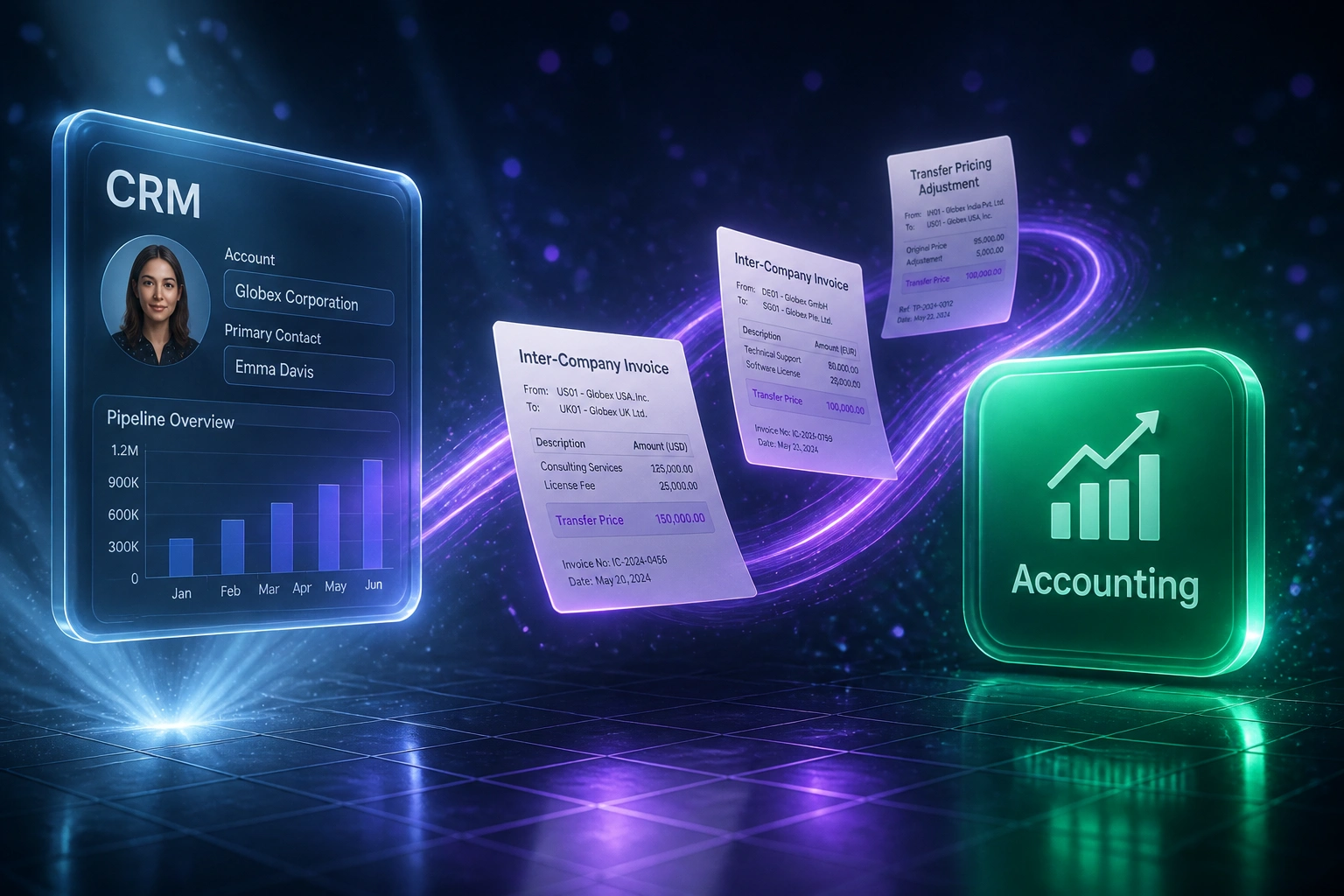
We automate entity-aware billing so every internal invoice uses the same transfer pricing rules.
Sound Familiar?
These are the exact issues group finance teams faced before entity-aware billing:
- A won CRM deal spans two legal entities, then finance builds inter-company invoices by hand in two ledgers
- Transfer prices live in a spreadsheet, so the same markup is applied differently depending who raises the invoice
- Receivable and payable sides post days apart, and consolidation stalls on mismatches every month-end
- Internal invoicing consumes tens of hours a month while external billing waits
- SARS or external audit asks for contemporaneous transfer pricing evidence, and the trail is emails and reworked journals
SARS transfer pricing documentation is no longer optional above R100 million of aggregate potentially affected transactions. Master File and Local File obligations apply, and understatement penalties under the Tax Administration Act run from 10% to 200% of the shortfall depending on behaviour. Inconsistent internal prices without a contemporaneous trail is exactly what auditors and SARS probe first.
What Entity-Aware Inter-Company Billing Does
Deal closes across entities → transfer price applied → both ledgers post → group close stays on track.
Multi-Entity Deal Closes
Sales marks a deal won with selling and buying entity fields set in the CRM
Transfer Price Applied
Rules engine picks the markup or cost-plus rate for that entity pair and product
Both Ledgers Post
Matching inter-company invoices land in each organisation in the same cycle
Close Without Chaos
Balances match for elimination, and the deal trail is ready for audit sampling
Everything You Need for Group Internal Invoicing
Entity-Pair Deal Triggers
When a CRM deal names a selling entity and a buying entity, the integration raises matching inter-company invoices in both organisations at the configured transfer price.
Transfer Pricing Rules Engine
Markups, cost-plus percentages, and agreed internal rates sit as controlled rules, not tribal knowledge. Every internal invoice uses the same policy the group declared.
Dual-Ledger Posting
Both the receivable and payable sides post in the same cycle, so inter-company balances match before consolidation starts, not after someone hunts the difference.
Audit-Ready Documentation Trail
Each internal invoice links back to the CRM deal, entity pair, and pricing rule applied. That is the contemporaneous evidence SARS and group auditors expect.
Exception Alerts Only
Missing entity fields, out-of-policy rates, or unmatched counterparties pause for finance review. Clean deals flow through without a human in the loop.
Faster Group Close
When inter-company billing is consistent from day one, reconciliation stops consuming a third of your close window and consolidation starts on schedule.
Platforms We've Connected for Group Billing
From 40 Hours/Month to 9 Hours/Month
How a five-entity South African industrial group stopped spreadsheet transfer pricing and closed four days faster.
The Manual Process
- Group finance rebuilt inter-company invoices from CRM deal notes in two Xero organisations
- Transfer markups sat in a shared spreadsheet, re-keyed differently by whoever raised the invoice
- Receivable and payable sides often posted days apart, so balances never matched at first pass
- Inter-company reconciliation alone took about 40 hours every month
- External audit flagged inconsistent internal prices as a documentation gap
The Automated Process
- Won deals with entity pairs trigger matching inter-company invoices in both ledgers
- Transfer pricing rules apply the same markup every time, with exceptions flagged for review
- Both sides post in the same cycle, so consolidation starts from matched balances
- Finance reviews and approves in about nine hours a month
- Each internal invoice carries deal, entity pair, and rule ID for SARS and group audit
Before vs After Integration
How It Works
From first conversation to live inter-company billing in 3–6 weeks.
Tell Us Your Setup
How many legal entities, which CRM and ledgers, and how transfer prices and internal billing rules work today.
Free Scoping Call
30-minute call to map entity pairs, pricing policies, and the CRM fields that should trigger inter-company invoices.
Build & Test
We wire entity-aware billing and transfer pricing rules, test with real group deals, and run parallel for a week against your manual process.
Go Live & Monitor
Switch off spreadsheet markup and dual data entry. Monitoring surfaces only the deals that still need a human pricing decision.
Frequently Asked Questions
How is inter-company billing different from multi-entity customer invoicing?
Multi-entity routing sends an external customer invoice to the correct company's VAT number. Inter-company billing creates the internal invoices between your own entities when a CRM deal spans two companies, applying transfer pricing rules so both ledgers stay aligned for consolidation and audit.
Can the integration enforce our transfer pricing policy?
Yes. We encode your agreed markups, cost-plus rates, and entity-pair rules so every internal invoice uses the same policy. Finance reviews exceptions only when a deal falls outside the rule set, which is how groups keep pricing consistent for SARS and group audit.
What does SARS expect on transfer pricing documentation?
Where aggregate potentially affected transactions exceed R100 million, South African taxpayers must file a Master File and Local File with SARS. Even below that threshold, contemporaneous records that support arm's length pricing remain essential. Automated billing that stamps each internal invoice with the deal, entity pair, and rule applied gives you that trail without rebuilding it at year-end.
Which CRMs and accounting systems can support group internal billing?
We've built entity-aware flows with HubSpot, Pipedrive, Salesforce, Zoho CRM, and Monday.com into multiple Xero organisations, Sage Business Cloud, Sage Evolution, and NetSuite subsidiaries. If your CRM can store selling and buying entity fields, and your ledgers are separate organisations or companies, we can raise matching inter-company invoices.
Will this disrupt month-end while we go live?
No. We run parallel for at least a week: the integration drafts internal invoices while your team still posts manually, then you compare. Only when both sides match do we switch off the spreadsheet process.
How much does CRM-driven inter-company billing cost?
Entity-pair invoicing into two organisations with fixed transfer prices starts from around R40,000. Groups with three or more entities, cost-plus rules, and dual-ledger matching typically range from R55,000 to R95,000. Teams already spending 30 or more hours a month on manual internal billing and reconciliation usually see ROI within 2–4 months.
Stop Rebuilding Inter-Company Invoices by Hand
If your group still applies transfer prices from a spreadsheet and posts both sides of internal invoices manually, you are spending month-end on a problem automation already solves.
Tell us how many legal entities you run, which CRM and ledgers you use, and where internal billing breaks down. We will show you exactly how entity-aware billing would work for your group.