Inventory-Aware Invoicing from CRM Deals to Accounting: Check Stock Before You Confirm
Your sales team closes deals in the CRM without knowing accounting stock is already allocated. By the time the warehouse sees the shortfall, you are cancelling orders, burning trust, and explaining why "in stock" was never true.
We build the CRM inventory check that confirms only what you can ship, then deducts stock on invoice.
Sound Familiar?
These are the exact issues product and wholesale teams face when CRM deals ignore accounting stock:
- Sales closes a deal in the CRM while accounting stock for that SKU is already allocated elsewhere
- Warehouse discovers the shortfall only when the pick list prints, then sales has to cancel or partial-ship
- Stock checks are a phone call or WhatsApp to the warehouse before every large order
- Invoices raise in accounting without deducting inventory, so available-to-promise stays wrong for days
- Customers who were told "in stock" get an apology email, and 70% of shoppers in that position buy from a competitor next time
Industry inventory accuracy still averages only 94–96%, and 34% of retailers reported discrepancies that led to overselling in 2024. If sales confirms from the CRM without a live stock check, phantom quantity is a process failure waiting to happen, not a warehouse accident.
What Inventory-Aware CRM Invoicing Actually Does
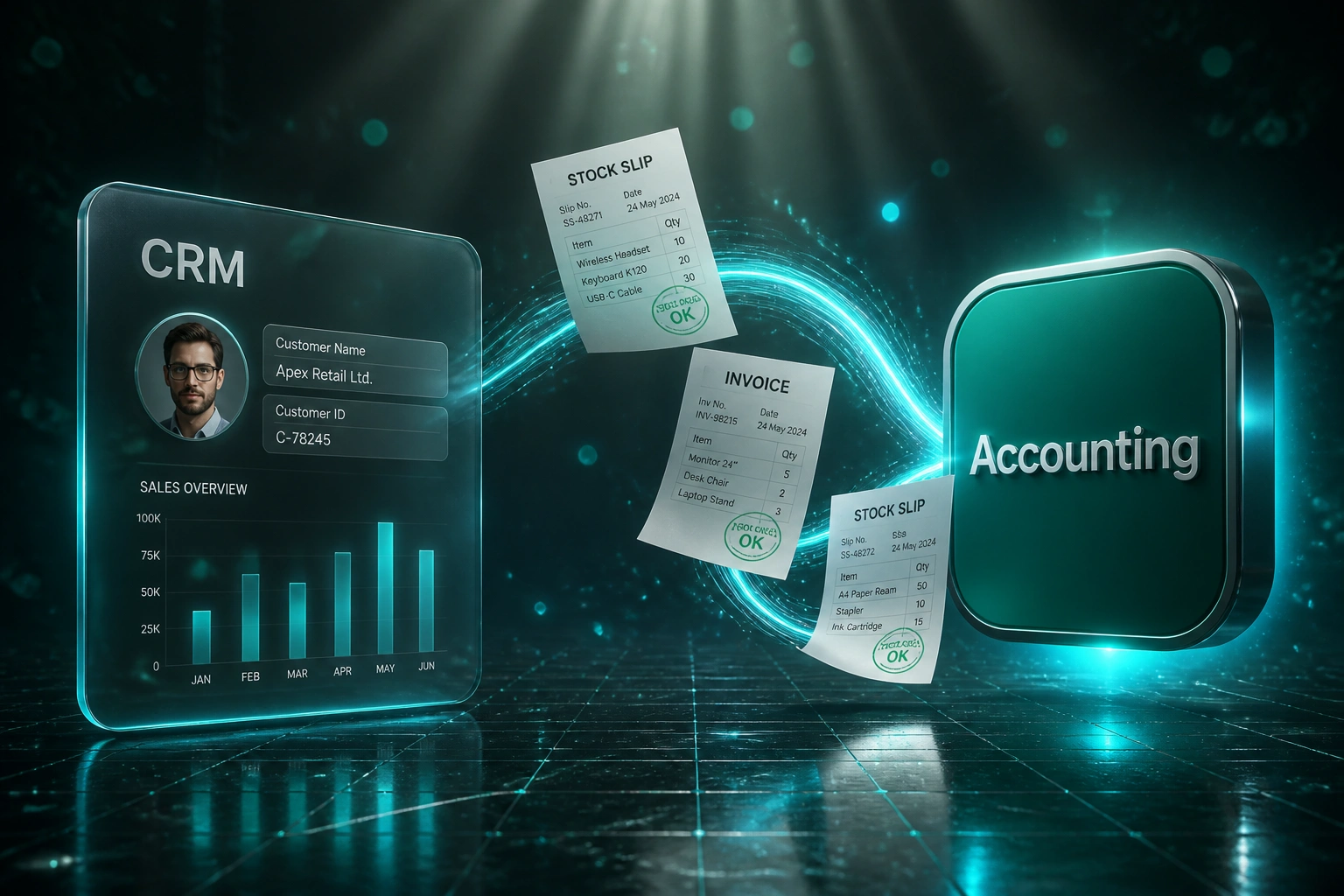
Deal ready → stock check → confirm only if available → invoice deducts. No overselling, no phantom promises.
Deal Ready in CRM
Sales moves a product deal toward Won in HubSpot, Pipedrive, or your CRM
Live Stock Check
Integration reads available-to-promise quantity from accounting before confirm
Confirm or Block
Enough stock: deal confirms and may soft-reserve. Short stock: alert, partial, or block
Invoice Deducts Stock
Accounting invoice posts and quantity deducts so the next deal cannot oversell
Everything You Need for Honest Product Availability
Live Stock Check on Confirm
Before a CRM deal can confirm, the integration reads available quantity from accounting. Short stock blocks the win or forces a partial commitment.
Available-to-Promise Rules
On-hand minus allocated, reserved, and open sales orders. Sales sees what they can honestly promise, not a stale spreadsheet figure.
Stock Deduction on Invoice
When the accounting invoice posts, inventory deducts immediately so the next CRM deal cannot oversell the same units.
Soft Reservation on Won Deals
Won deals can reserve quantity until the invoice lands, so two salespeople cannot commit the last pallet twice.
Shortage Alerts to Ops
If stock drops below the quantity on an open deal, ops and sales get the alert before the customer does.
SKU Mapping to Ledger Items
CRM product codes map to accounting items so the stock check hits the right SKU, warehouse location, and unit of measure.
CRMs and Ledgers We've Connected for Stock Checks
From 12 Oversell Cancellations a Month to One
How a Gauteng wholesale distributor stopped sales confirming deals against phantom stock and recovered almost half a million rand in year one.
The Manual Stock Check
- Sales closed deals in Pipedrive without seeing Sage available quantity
- Ops phoned or WhatsApped the warehouse eight to ten hours a week for stock checks
- Twelve stock-related cancellations a month on average, each costing R800–R1,200 to unwind
- Invoices posted without deducting inventory, so available-to-promise drifted for days
- Customers who were told "in stock" left angry reviews and bought from competitors
The Inventory-Aware Process
- Deal confirm triggers a live available-to-promise check against Sage stock
- Short SKUs block or partial-confirm with an ops alert before the customer is told
- Won deals soft-reserve quantity until the invoice posts
- Invoice deduction keeps the next salesperson from selling the same pallet twice
- Warehouse phone checks dropped to exception cases only
Before vs After Inventory-Aware Integration
How It Works
From first conversation to live stock-checked invoicing in 3–5 weeks.
Map Stock Truth
Which accounting system owns inventory, how allocations work, and which CRM stages should trigger a stock check.
Free Scoping Call
30-minute call to design available-to-promise rules, soft reservations, and what happens when stock is short.
Build & Parallel Test
We wire the stock check and invoice deduction, then run against live SKUs alongside your current warehouse calls.
Go Live & Monitor
Switch off the phone-and-WhatsApp stock check. Alerts fire only when human judgment is still needed.
Frequently Asked Questions
What is inventory-aware invoicing between CRM and accounting?
It is a stock check against your accounting inventory before a CRM deal confirms, followed by an automatic stock deduction when the invoice posts. Sales cannot promise units that the warehouse has already allocated, and the ledger stays honest after every invoice. It is about product availability and overselling prevention, not about syncing the product catalogue itself or capturing purchase-order numbers.
How is this different from product catalogue sync?
Catalogue sync keeps SKUs, prices, and tax codes aligned so quotes and invoices use the same product list. Inventory-aware invoicing asks a different question: how many of those SKUs can you actually ship today? You can have a perfect price list and still oversell if quantity never leaves accounting into the CRM confirmation step.
Which CRMs and accounting systems can you connect for stock checks?
We have built inventory-aware flows with HubSpot, Pipedrive, Salesforce, Zoho CRM, and Monday.com into Xero, Sage Business Cloud, Sage Pastel, Sage Evolution, and QuickBooks. If your accounting system exposes on-hand and allocated quantities, and your CRM can gate a deal stage, we can run the check before confirm.
What happens when stock is short on a deal?
You choose the rule during scoping: block the confirm, allow a partial quantity, or open a back-order line with a promised date. Ops gets the shortage alert either way. The point is that the customer commitment matches what the warehouse can ship, before anyone says "confirmed".
Will sales or warehouse need to change how they work?
Sales keeps working in the CRM. Warehouse keeps picking from accounting or the WMS. The change is that confirmation already includes a live available-to-promise check, and invoicing deducts stock automatically. We run parallel testing so you can compare the old phone check against the automated result before you switch off the manual step.
How much does inventory-aware CRM-to-accounting invoicing cost?
A focused stock-check-on-confirm plus invoice deduction starts from around R25,000. Setups with soft reservations, multi-warehouse ATP, shortage alerts, and SKU alias mapping typically range from R35,000 to R70,000. Product and wholesale teams cancelling even a handful of oversold orders a month usually see payback within two to four months from avoided cancellations, staff time, and retained customers alone.
Confirm Only What You Can Ship
If sales is still closing product deals without a live stock check in accounting, you are paying for cancellations, warehouse chaos, and customers who will not come back.
Tell us which CRM and ledger you run, how inventory is allocated today, and which SKUs cause the most oversell pain. We will show you exactly how inventory-aware invoicing would work for your warehouse and sales floor.