Mapping CRM Deal Line Items to Accounting Invoice Lines: Keep Every Product Row Intact
Your multi-product deals look clean in the CRM. Then finance collapses six SKUs into one lump-sum invoice line, and product margins, VAT accuracy, and client bill detail disappear with them.
We build the line item mapping that preserves every deal product on the invoice.
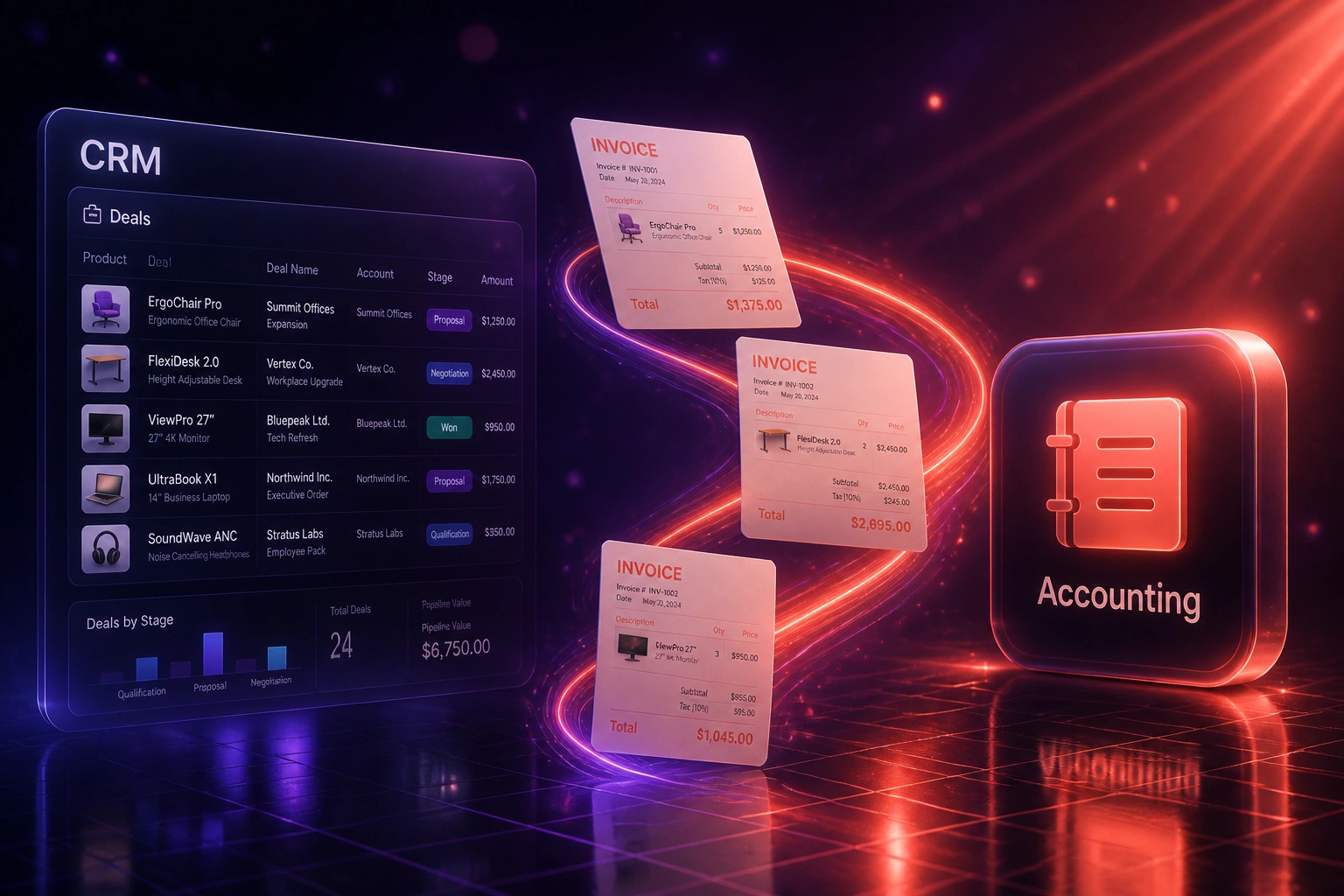
Sound Familiar?
These are the exact issues sales ops and finance leads face when deal products do not survive as invoice lines:
- Multi-product CRM deals collapse into a single lump-sum invoice line in accounting
- Finance spends 20–30 minutes per deal retyping description, quantity, price, and tax rate by hand
- Product margin reports are useless because every SKU is buried in one generic line
- Mixed-rate deals get one VAT treatment, so SARS-facing invoices carry the wrong tax per line
- Month-end variance hunts start with “which products were actually on that invoice?”
Over 60% of business invoices contain at least one error, and tax calculation mistakes alone account for about 27% of those failures. Collapsing mixed-rate CRM products into one line is a fast way to join that statistic, and it quietly feeds the 1–5% revenue leakage that billing gaps typically cost.
From Deal Products to Invoice Lines, One Row at a Time
Deal closes → each CRM product maps → invoice lines keep description, quantity, price, tax, and account code.
Multi-Line Deal Wins
Sales closes a deal with several products, quantities, and prices already on the record
Line Item Mapping Runs
Each CRM product row resolves description, tax rate, account code, and unit economics
Invoice Lines Stay Intact
Accounting receives one invoice line per product, not a single collapsed total
Margins and VAT Hold
Product P&Ls and per-line tax treatments match what was sold in the CRM
Line Item Mapping Finance Can Trust
Deal-Line to Invoice-Line Mapping
Every CRM product row becomes its own accounting invoice line with description, quantity, unit price, tax rate, and account code intact.
Per-Line Tax Treatment
Standard, zero-rated, and exempt products keep their own VAT rates. Mixed-rate deals no longer force a single tax code onto every line.
Account Code Fidelity
Each line carries its mapped revenue account so product P&Ls stay readable without a reclassification marathon.
Quantity and Price Integrity
Unit price, quantity, and discounts travel exactly as sold in the CRM. No rounding surprises from collapsing rows into a total.
Collapse Detection Alerts
If a sync would flatten multiple CRM products into one invoice line, the run is held and flagged before finance posts it.
Product Catalog Alignment
CRM SKUs stay linked to accounting items so future deals reuse the same product mapping, description, and tax rules.
Platforms We've Wired for Line Item Fidelity
From 28 Minutes of Line Rebuilds to Under 2
How a 35-person software distributor stopped collapsing multi-product deals into lump-sum invoices and got product margins back.
The Lump-Sum Process
- HubSpot deals with 5–8 products were typed into Xero as one “Hardware & Services” line
- Finance spent ~28 minutes per deal rebuilding quantities, prices, and tax rates from CRM screenshots
- Product margin reports showed one blended figure that sales could not use
- Mixed standard and zero-rated items often shared one VAT treatment
- Roughly 50 multi-line invoices a month meant 23+ hours of rebuild labour every cycle
Mapped Line by Line
- Each CRM product creates its own Xero invoice line with description, qty, price, tax, and account code
- Finance reviews and approves in under two minutes instead of rebuilding from scratch
- Product and channel margins match what was sold on the deal
- Per-line VAT treatments stay correct on mixed-rate invoices
- Collapse detection holds any sync that would flatten products into a total
Before vs After Line Item Mapping
How It Works
From deal-line audit to live invoice line mapping in 2–4 weeks.
Audit Your Deal Lines
We review how multi-product deals are structured in the CRM and how invoices currently land in accounting.
Free Scoping Call
30-minute call to design line-item rules: tax per product, account codes, and what must never collapse.
Build & Parallel Test
We build the mapping layer, test against real multi-line deals, and compare invoice lines to CRM products side by side.
Go Live & Guard
Switch off lump-sum invoicing. Collapse detection keeps product fidelity from drifting after go-live.
Frequently Asked Questions
What is CRM deal line item to invoice line mapping?
It is the rule set that turns each product row on a CRM deal into its own line on the accounting invoice, keeping description, quantity, unit price, tax rate, and account code. Without it, multi-product deals often collapse into a single lump-sum line, which destroys product margin reporting and risks wrong VAT treatment.
How is this different from chart of accounts mapping?
Chart of accounts mapping decides which GL revenue account a product posts to. Line item mapping decides whether that product survives as its own invoice line at all. You need both: account codes without line fidelity still leave you with one opaque total, and line fidelity without account codes still dumps products into the wrong bucket.
Which CRMs and ledgers support line-item mapping?
We build line-item fidelity for HubSpot, Pipedrive, Salesforce, Zoho CRM, Monday.com, and custom CRMs into Xero, Sage Business Cloud, Sage Pastel, QuickBooks Online, Zoho Books, and NetSuite. If both systems expose line-level invoice APIs, we can map them.
How do you handle mixed VAT rates on one deal?
Each CRM product carries its tax treatment into the matching invoice line. A standard-rated licence and a zero-rated export on the same deal keep separate rates instead of being forced into one header tax code. That is what keeps SARS-facing tax invoices accurate when product mixes vary.
Will sales need to change how they build deals?
No. Sales keeps adding products on the deal the way they already do. The change is that those rows stay intact when the invoice is created in accounting. We run parallel testing so finance can compare mapped invoices against the old lump-sum versions before switching over.
How much does CRM-to-accounting line item mapping cost?
Focused line-item mapping for a modest product catalog starts from around R20,000. Broader setups with per-line tax rules, account codes, collapse detection, and multi-entity catalogues typically range from R30,000 to R65,000. Teams rebuilding 40+ multi-line invoices a month usually see payback within one to two months of staff time alone.
Stop Collapsing Multi-Product Deals into Lump Sums
If your CRM deals carry clean product rows and your invoices do not, you have a line item mapping problem, not a bookkeeping problem.
Tell us which CRM and ledger you run, how many products typically sit on a won deal, and where lump-sum collapse is hurting margins or VAT. We will show you how deal-line to invoice-line mapping would work in your stack.