Multi-Entity Billing: CRM Deals Across Multiple Companies
Your group closes in one CRM, but each legal entity keeps its own books in Xero or Sage. Finance still re-assigns which company should invoice, or worse, invoices leave under the wrong VAT number and group accounting spends the month cleaning them up.
We route every won deal to the correct accounting organisation automatically.
Sound Familiar?
These are the exact issues group CFOs and ops directors faced before legal-entity routing:
- Sales closes in one CRM pipeline, then finance re-assigns which company should invoice
- Invoices go out under the wrong VAT number, and clients cannot claim input tax
- Xero and Sage each hold separate organisations, so someone opens the wrong file by habit
- Intercompany recharges and credit notes pile up when the wrong entity billed first
- Group month-end stretches because entity mismatches surface only at consolidation
Wrong-entity posting is the most common multi-company AP failure, and Xero still requires a separate organisation per legal entity with no native consolidation. When SARS finds VAT registration mismatches or group auditors find intercompany cleanup, the cost is no longer a few hours of finance time.
What Multi-Company Legal Entity Routing Does
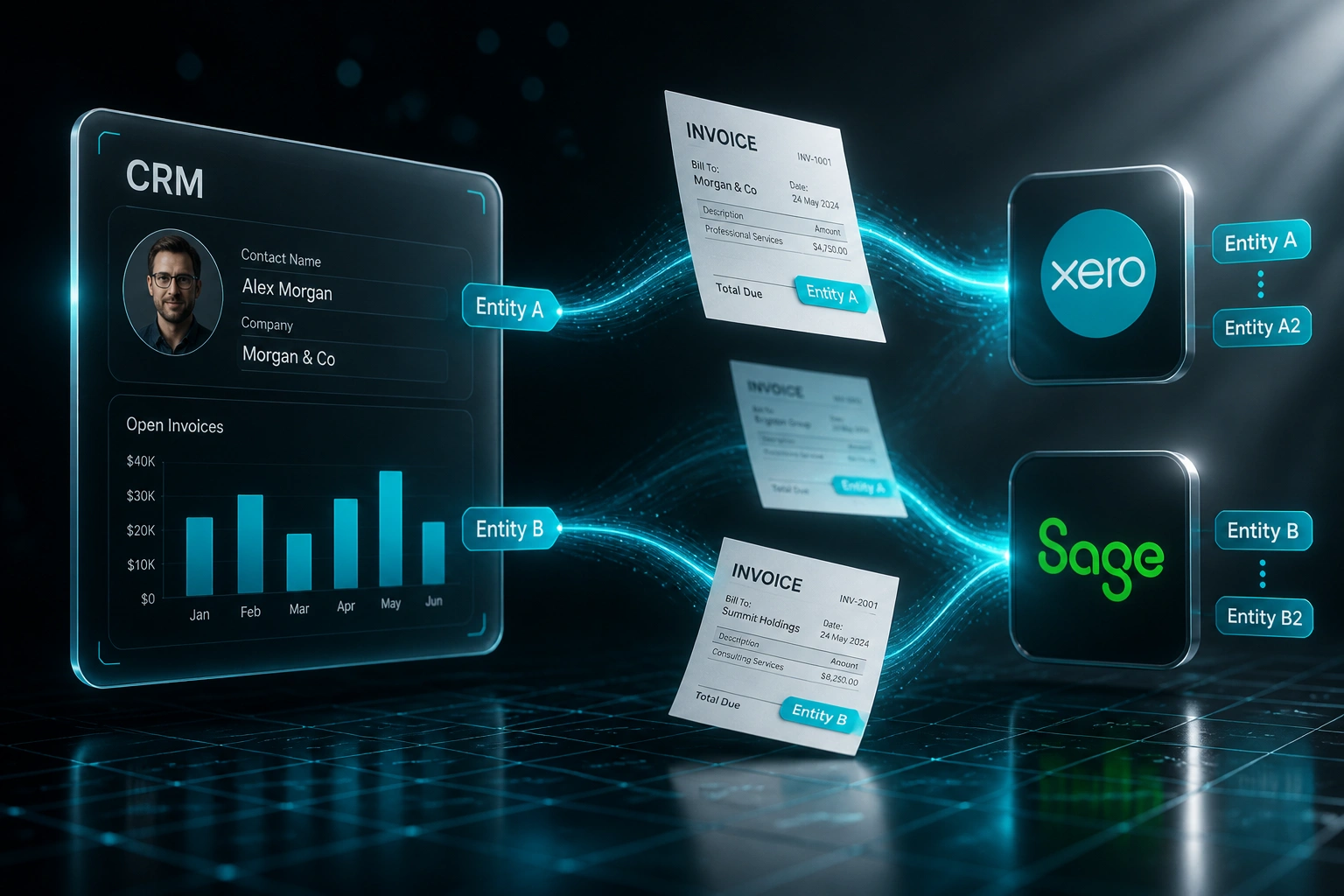
Deal closes → entity chosen → invoice lands in the right organisation. No finance re-assignment between CRM and the books.
Deal Closes in CRM
Sales marks Won with legal entity, product line, or billing company already on the deal
Organisation Selected
Routing rules pick the correct Xero organisation or Sage company from the deal attributes
Invoice in Right Books
Draft invoice appears under that entity's VAT number, bank details, and chart of accounts
Group Close Cleaner
Consolidation starts from correct entity books, not a pile of wrong-VAT credit notes
Everything You Need for Group Accounting Routing
Deal-Level Entity Routing
Legal entity, operating company, and billing organisation live as required CRM deal fields. Won deals cannot leave the pipeline without a routing decision.
Multi-Org Invoice Creation
When a deal closes, the integration opens the correct Xero organisation or Sage company and creates the invoice there, with that entity's VAT number and bank details.
VAT & Tax Identity Lock
Each accounting organisation carries its own VAT registration. Routing rules lock the tax invoice to the entity that actually supplied the goods or services.
Wrong-Entity Guardrails
If a deal attribute conflicts with the chosen organisation, finance gets flagged before the invoice is sent, not after the client rejects it.
Intercompany Awareness
Group deals that bill across subsidiaries map to the right books, so recharge and elimination work starts from clean entity-level invoices.
Group Close Acceleration
When every invoice lands in the correct organisation from day one, consolidation stops hunting wrong-entity postings and month-end shortens.
Platforms We've Wired for Multi-Entity Routing
From 8 Hours/Week Routing to 1 Hour/Week
How a four-entity holding group stopped wrong-VAT invoices and shortened group close by four days.
The Manual Process
- Ops controller opened deals in HubSpot, then chose a Xero organisation by memory
- Six to eight invoices a month left under the wrong company VAT number
- Each wrong invoice meant a credit note, a reissue, and an intercompany tidy-up
- Group close sat at 12 days while entity mismatches were unwound
- External auditors flagged entity-level revenue cut-off as a recurring finding
The Automated Process
- Deal entity field routes the invoice into the matching Xero organisation in seconds
- Finance director reviews exceptions only, not every multi-company invoice
- Wrong-VAT invoices dropped to zero across a full quarter of parallel testing
- Group close moved from 12 days to 8 as entity books arrived clean
- Audit sampling pulled deal-to-invoice lineage with the correct legal entity every time
Before vs After Multi-Entity Routing
How It Works
From first conversation to live multi-company routing in 3–6 weeks.
Tell Us Your Setup
How many legal entities, which CRM, which Xero organisations or Sage companies, and how sales decides who bills today.
Free Scoping Call
30-minute call to map deal attributes to accounting organisations and design the routing matrix.
Build & Test
We wire entity routing into the CRM-to-accounting flow, test with real multi-company deals, and validate VAT identity on every sample invoice.
Go Live & Monitor
Switch off manual entity re-assignment. Monitoring flags only the deals that still need a human routing decision.
Frequently Asked Questions
How does multi-entity billing work when Xero has no native group company?
Xero requires a separate organisation (and subscription) per legal entity, with no native consolidation. We connect your CRM to every organisation you invoice from, and route each won deal into the correct file based on deal attributes such as legal entity, cost centre, or product line. Consolidation tools like Fathom or Syft still sit on top for group reporting.
Which CRMs and accounting systems support multi-company invoice routing?
We've built legal-entity routing with HubSpot, Pipedrive, Salesforce, Zoho CRM, and Monday.com into multiple Xero organisations, Sage Business Cloud companies, Sage Pastel, and Sage Evolution. If your CRM can store an entity field and your ledgers are separate organisations or companies, we can route between them.
What happens if sales picks the wrong entity on a deal?
Guardrails catch conflicts before the invoice sends: for example a product line that only belongs to Entity B, or a client contract that names a specific VAT number. Finance reviews the exception instead of discovering the mistake when the client or SARS does.
Will this help with SARS VAT and group audit findings?
Yes. Wrong-entity tax invoices create output-tax and input-tax mismatches that SARS can treat as understatements, with understatement penalties from 5% to 200% of the shortfall depending on behaviour. Routing invoices to the entity that actually made the supply keeps VAT numbers, serials, and books aligned for audit.
How do you handle intercompany sales between our own entities?
Intercompany deals get their own routing rules so each side posts in the correct organisation. That does not replace your consolidation eliminations, but it stops the common failure where an external customer invoice lands in the wrong books and forces credit notes plus intercompany cleanup.
How much does multi-entity CRM-to-accounting routing cost?
Simple one-way routing into two organisations starts from around R25,000. Bidirectional setups with three or more entities, VAT identity locks, and exception alerts typically range from R40,000 to R80,000. Groups already spending eight or more hours a week on manual entity assignment usually see ROI within 2–4 months.
Stop Invoicing from the Wrong Company
If your holding structure has two or more legal entities and finance still decides which books get each invoice, you are paying for a risk that group accounting already knows by name.
Tell us how many companies you invoice from, which CRM owns the pipeline, and where wrong-entity bills still slip through. We'll show you exactly how deal-attribute routing would work for your group.