Syncing Product Catalogues Between CRM and Accounting: One Price List, Two Systems
Your sales team quotes from the CRM. Your finance team invoices from accounting. When products, prices, and SKUs drift apart, every won deal risks a wrong invoice, a credit note, and an awkward call to the customer.
We build the catalogue sync that keeps quotes and invoices on the same product truth.
Sound Familiar?
These are the exact issues ops and finance leads face when the product catalogue drifts between CRM and accounting:
- Sales quotes from the CRM price list while finance invoices from an outdated accounting catalogue
- SKU codes diverge: CRM SKU-NC450 does not match the item code finance expects in Xero or Sage
- Price updates land in one system and sit stale in the other for weeks
- VAT or tax codes on products drift, so the same SKU bills at different rates across quotes and invoices
- Multi-price lists (trade, retail, VIP) get out of sync and quietly leak margin on every won deal
Multi-price lists, ERP item master changes, and VAT code mismatches make dual catalogues fragile. Research across B2B manufacturers finds that 20–40% of order exceptions start in master data, and pricing exceptions alone cost R1,900–R5,700 each once sales, finance, and ops are involved. Manual catalogue entry still carries a 0.5–1% error rate per data point, which is how a price update in accounting never reaches the CRM quote.
What Catalogue Sync Actually Does
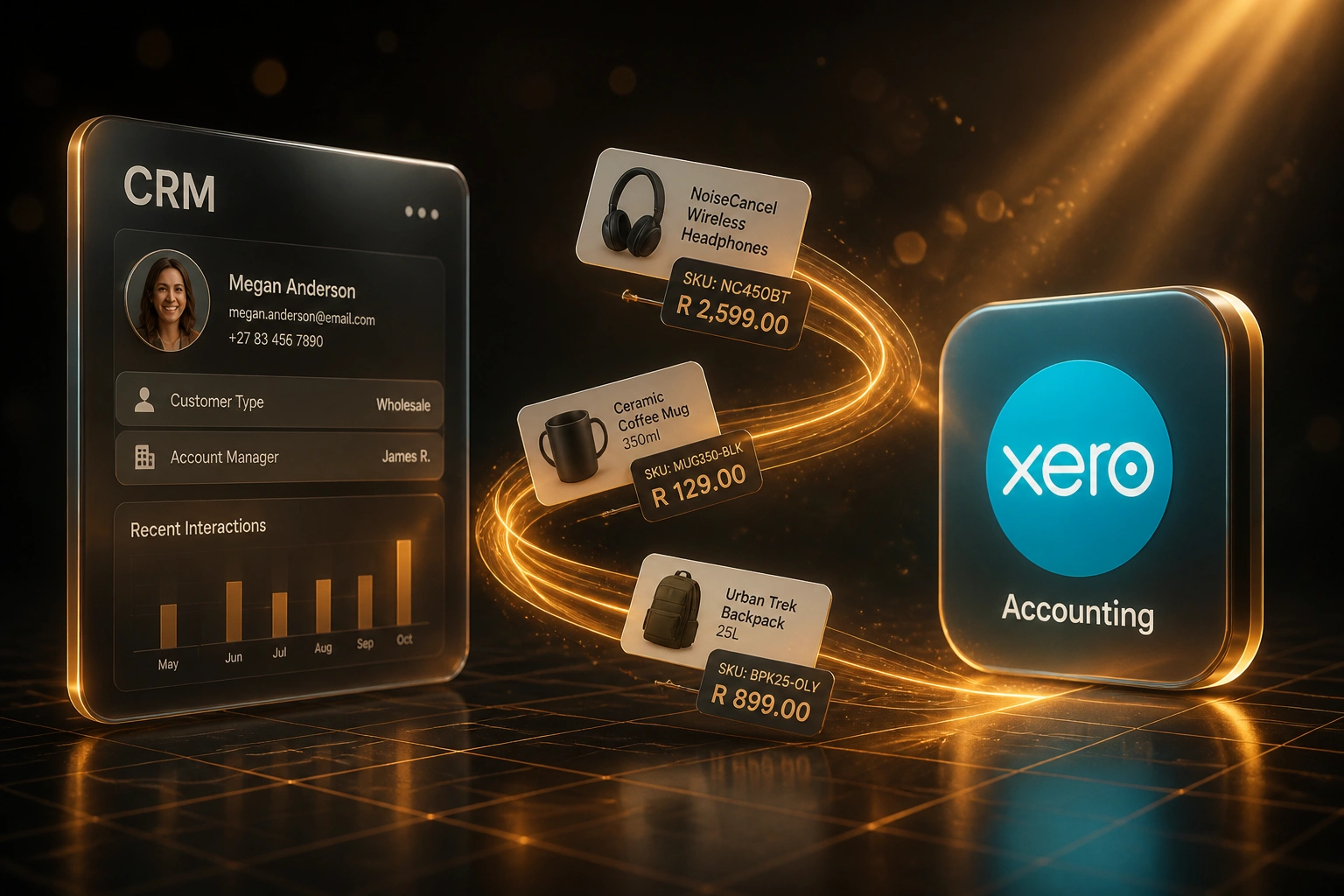
Product changes in the master → SKU and price update in the CRM → quotes and invoices stay consistent.
Product Master Updates
Finance adds a SKU, changes a list price, or adjusts a tax code in Xero, Sage, or QuickBooks
Catalogue Syncs to CRM
Name, SKU, price lists, unit, and tax treatment land on the matching CRM product
Sales Quotes Current Prices
Deals pull the synced catalogue, so the quote matches what accounting will invoice
Invoice Matches the Quote
No SKU scramble, no price correction call, no margin surprise at month-end
Everything You Need for Reliable Catalogue Sync
Product Master Sync
New and updated products in your accounting item master appear in the CRM catalogue automatically, with name, SKU, unit, and description intact.
SKU Mapping Layer
CRM product codes map cleanly to accounting item codes. Aliases and legacy SKUs resolve without manual lookup when a deal converts.
Price List Propagation
List prices and multi-tier price lists push from the source of truth into the CRM so quotes always use the current rate.
Tax Code Alignment
VAT and tax treatments travel with each product. Standard, zero-rated, and exempt SKUs keep the same code in both systems.
Drift Detection Alerts
When a CRM price or SKU no longer matches accounting, the sync flags it before a quote or invoice goes out with the wrong figure.
Catalogue Change History
Every price update, SKU remap, and product deactivate is logged so ops and finance can audit what changed and when.
Platforms We've Connected for Catalogue Sync
From 8 Hours/Week of Dual Catalogues to 90 Minutes
How a Johannesburg wholesale distributor stopped quoting one price while invoicing another across 850 SKUs and three price lists.
The Dual-Catalogue Grind
- Ops updated prices in Xero, then retyped the same SKUs into HubSpot by hand
- Trade, retail, and VIP lists drifted independently; sales often quoted the stale tier
- About 14 credit notes a month fixed price or SKU mismatches after the invoice went out
- Customers challenged invoices that did not match the signed quote
- Finance spent Fridays reconciling which catalogue was "right" for month-end
The Synced Catalogue
- Xero item master owns products; HubSpot receives SKUs, prices, and tax codes automatically
- All three price lists update together when a rate changes
- Price-mismatch credit notes dropped to near zero within the first month
- Quotes and invoices use the same SKU and list price every time
- Ops reviews exceptions only, instead of retyping the full catalogue
Before vs After Catalogue Sync
How It Works
From first conversation to live catalogue sync in 2–4 weeks.
Audit Both Catalogues
We compare CRM products against the accounting item master: SKUs, prices, tax codes, and which system owns the truth.
Free Scoping Call
30-minute call to pick the master, design SKU mapping rules, and plan how multi-price lists should propagate.
Build & Parallel Test
We build the catalogue sync, test price and SKU updates against live products, and run side-by-side with your current process.
Go Live & Monitor
Switch off dual maintenance. Drift alerts keep quotes and invoices on the same product truth after go-live.
Frequently Asked Questions
What is product catalogue sync between CRM and accounting?
It is an automated link that keeps products, SKUs, prices, and tax codes consistent across your CRM and accounting systems. When the product master changes in one place, the other updates so sales quotes and finance invoices use the same catalogue. It is about the product list itself, not about how individual invoice lines are laid out at send time.
How is this different from line item mapping?
Line item mapping decides whether each CRM deal product survives as its own invoice line. Catalogue sync decides whether the product, SKU, and price that sales quoted still match what accounting has on file. You need both: clean line fidelity on a stale price list still invoices the wrong amount, and a synced catalogue without line fidelity can still collapse multi-product deals into a lump sum.
Which system should be the product master?
Most finance-led teams keep the accounting item master (Xero, Sage, QuickBooks) as the source of truth and push products and prices into the CRM. Some sales-led teams reverse that. We design the sync so one system owns the catalogue and the other consumes it, with clear rules for overrides and inactive products.
How do you handle multi-price lists and SKU mismatches?
We map each CRM price list (trade, retail, VIP, currency) to the matching accounting price list or price level, then sync updates on a schedule or on change. Legacy or alias SKUs get an explicit mapping table so a deal using an old code still resolves to the correct accounting item without a credit note later.
Will sales or finance need to change how they work?
No. Sales keeps quoting from the CRM, and finance keeps invoicing from accounting. The change is that both catalogues stay aligned automatically. We run parallel testing so you can compare quoted prices against invoice prices before switching off dual maintenance.
How much does CRM-accounting product catalogue sync cost?
A focused one-way catalogue and price sync starts from around R20,000. Bidirectional setups with multi-price lists, SKU alias mapping, tax code alignment, and drift alerts typically range from R30,000 to R65,000. Teams correcting price mismatches every week usually see payback within one to three months from recovered margin and staff time alone.
Stop Quoting One Price and Invoicing Another
If your CRM catalogue and accounting item master are maintained by hand, you are leaking margin every time a price or SKU falls out of sync.
Tell us which CRM and ledger you run, how many SKUs you carry, and whether multi-price lists or tax codes are part of the mess. We will show you exactly how automated product sync would work for your business.