Purchase Order Integration Between CRM and Accounting: Stop PO Matching Rejects
Your B2B invoices keep bouncing because the customer's purchase order number is missing or wrong. Sales closed the deal; finance raised the invoice; customer AP put payment on hold until someone digs the PO out of an email thread.
We build the CRM-to-accounting PO integration that stops those payment holds and shortens days sales outstanding.
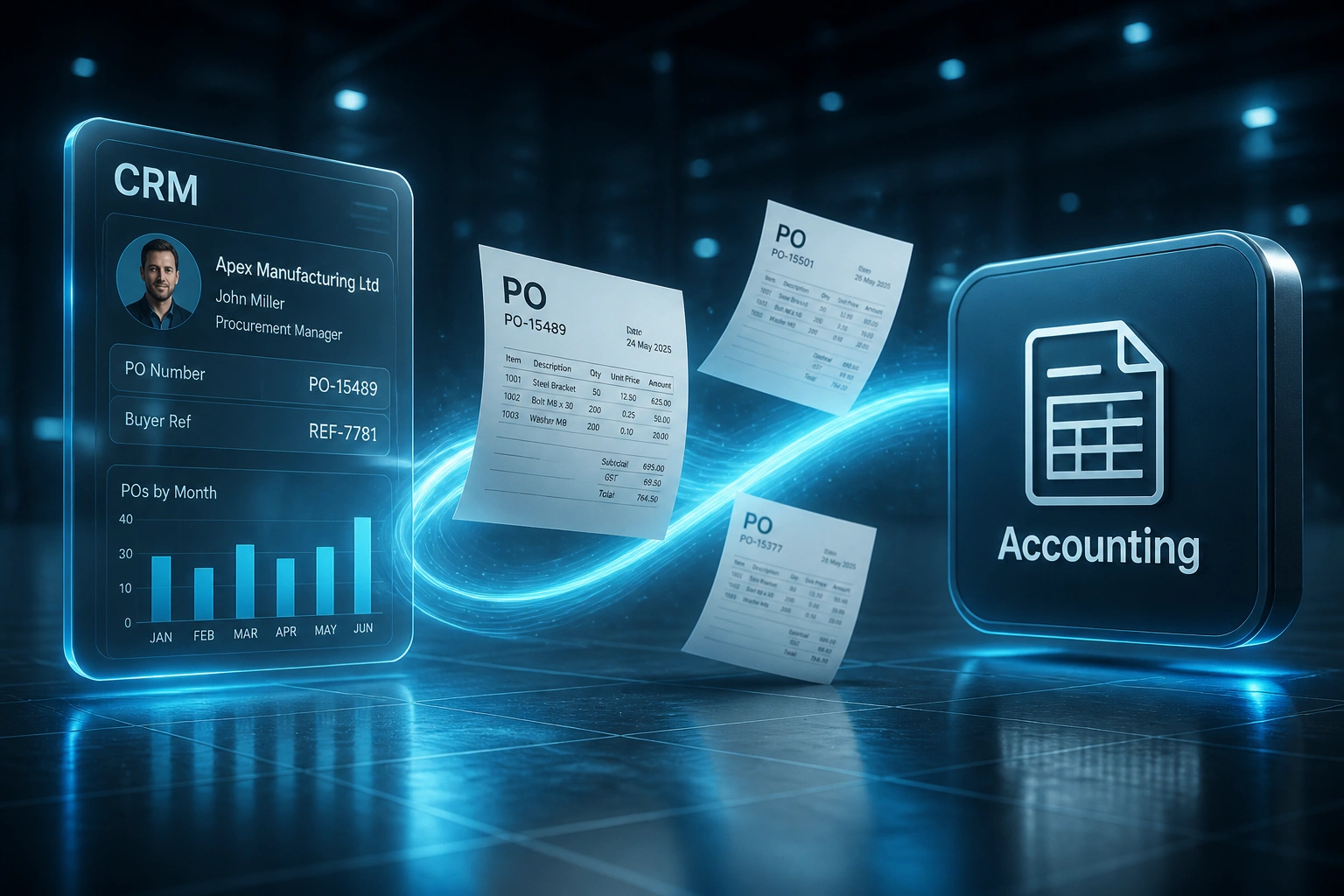
Sound Familiar?
These are the exact issues our clients faced before purchase order integration:
- Deals close in the CRM, but the customer's PO number never reaches the invoice
- Finance re-types PO numbers, PO values, and buyer references from emails or PDFs
- Customer AP rejects 15–25% of portal invoices on first pass, often for PO mismatches
- Sales ops spends 30–70 minutes chasing each rejected invoice back through the deal record
- DSO stretches by days every time an invoice sits on hold waiting for a corrected PO
Enterprise buyers are hardening "no PO, no pay" and e-invoicing portal rules. Around 61% of AP invoices are already PO-linked, and major markets are rolling out mandatory structured e-invoicing through 2026–2027. If your CRM still treats the purchase order as optional notes, more of your invoices will sit unpaid.
What Purchase Order Integration Actually Does
PO captured in CRM → invoice references match → AP approves → cash arrives. No human hunting for the number after the fact.
PO Captured in CRM
Sales records PO number, PO value, and buyer reference before the deal can close as Won
Invoice Created with PO
Accounting receives the draft invoice with PO fields mapped for AP matching
Customer AP Matches
Portal or three-way match finds the PO on first pass instead of rejecting the invoice
Payment Clears Faster
Fewer holds, shorter DSO, and sales ops stops firefighting rejected invoices
Everything You Need for Reliable PO Matching
PO Capture at Deal Close
Required CRM fields for PO number, PO value, and buyer reference. Deals cannot close as Won until the purchase order details are complete.
PO Fields on Every Invoice
When accounting creates the invoice, the PO number and buyer reference land in the right reference fields for customer AP matching.
PO Value Validation
Invoice totals are checked against the PO value captured in the CRM, so price variances get flagged before the invoice goes out.
Portal-Ready References
Buyer reference, cost centre, and site codes flow with the PO so AP portal submissions pass validation on the first try.
Reject & Hold Alerts
If a customer rejects an invoice for a PO issue, the CRM deal updates and sales ops gets the alert instead of discovering it weeks later.
Audit Trail for Matching
Every invoice links back to the CRM deal and the original PO fields, so finance can prove the match when AP queries it.
Platforms We've Connected for PO Integration
From 18% Rejects to 2%
How an industrial wholesaler stopped customer AP from holding invoices for missing purchase order numbers and shortened DSO by 11 days.
The Manual Process
- Sales closed deals in HubSpot without mandatory PO fields
- Finance hunted email threads for PO numbers before invoicing in Xero
- 18% of B2B invoices bounced from customer AP portals on first pass
- Each reject cost 40–60 minutes and added about a week to payment
- Sales ops and finance blamed each other for missing buyer references
The Automated Process
- PO number, PO value, and buyer reference required before Won
- Draft invoices in Xero carry the PO fields customer AP expects
- Reject rate dropped to about 2%, mostly genuine price variances
- Same-day invoicing with PO matching ready for portal submission
- Reject alerts land on the CRM deal so sales ops fixes the root cause
Before vs After PO Integration
How It Works
From first conversation to live purchase order integration in 2–4 weeks.
Tell Us Your Setup
Which CRM, which accounting system, and how your B2B customers require PO numbers on invoices.
Free Scoping Call
30-minute call to map PO capture fields, invoice reference mapping, and the customers causing the most rejects.
Build & Test
We wire PO fields into the CRM-to-accounting flow, test with real deal records, and validate against sample AP portal rules.
Go Live & Monitor
Switch off the email-to-invoice PO chase. Monitoring flags only the deals that still need human PO confirmation.
Frequently Asked Questions
How long does CRM-to-accounting purchase order integration take?
A standard PO capture and invoice reference sync takes 2–4 weeks from scoping to go-live. Simple one-way PO number mapping into Xero, Sage, or QuickBooks can be live within a week. Multi-customer portal rules with buyer references and value checks take closer to 4–6 weeks.
Which CRMs and accounting systems can you connect for PO matching?
We've built purchase order workflows with HubSpot, Pipedrive, Salesforce, Zoho CRM, and Monday.com into Xero, Sage Business Cloud, Sage Pastel, Sage Evolution, and QuickBooks. If your CRM can store custom fields and your ledger has an API, we can pass the PO through.
Will sales still have to collect PO numbers from buyers?
Yes, the buyer still issues the purchase order. What changes is that the CRM makes PO number, PO value, and buyer reference required before a deal can close, and accounting receives those fields automatically. The chase moves earlier in the sales process, where it belongs, instead of after the invoice is rejected.
How do you handle PO value mismatches and partial shipments?
During setup we map tolerance rules (for example, flag invoices that exceed the PO value by more than a set percentage) and support partial invoicing against a single PO. Finance reviews flagged variances before send, so customer AP is not the first to notice.
What about customers that mandate e-invoicing or AP portals?
Enterprise buyers increasingly enforce "no PO, no pay" and structured portal submissions. We map the fields those portals require (PO number, buyer reference, line matching) so invoices clear validation on first pass instead of bouncing for missing purchase order data.
How much does purchase order integration between CRM and accounting cost?
Simple one-way PO number syncs start from around R15,000. Bidirectional setups with value validation, buyer references, and reject alerts typically range from R25,000 to R60,000. Teams processing 40+ B2B invoices a month usually see ROI within 2–3 months from fewer rejects and shorter DSO alone.
Stop Losing Cash to Missing PO Numbers
If customer AP is rejecting invoices because the purchase order never made it from the CRM to accounting, you are funding their process with your working capital.
Tell us which CRM and accounting system you run, which buyers enforce PO-mandatory portals, and how many invoices bounce each month. We will show you exactly how purchase order integration would work for your B2B sales ops and finance team.