Retainer Billing from CRM: Monthly Invoicing for Service Businesses
Your retainer clients should be billed on day 1. Instead, someone rebuilds the invoice from a CRM export mid-month, overages get forgotten, and unused hours rollover lives in a spreadsheet. That delay and leakage hits cash flow every single cycle.
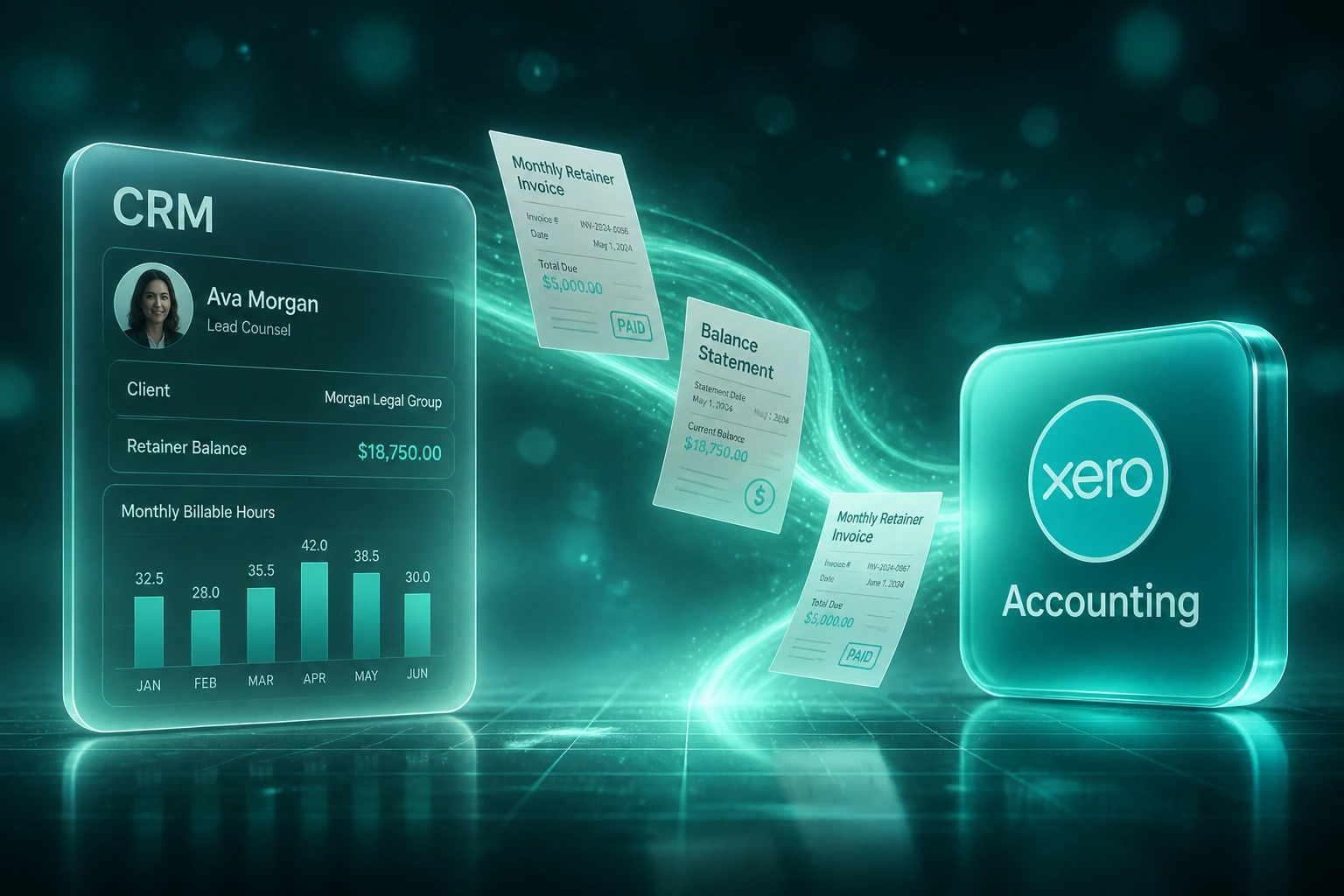
We wire CRM retainer agreements to accounting so every month's invoice lands on day 1 with the right balance, overages, and VAT.
Sound Familiar?
These are the exact issues managing partners and ops leads describe before retainer management is automated:
- Retainer invoices go out on day 8 or later because someone has to rebuild them from a CRM export and a spreadsheet
- Overage hours sit unbilled until a quarterly review, then get written down because the client was never warned
- Unused hours rollover and expiry are tracked in a shared sheet that is always a week behind
- Finance cannot see retainer balances without pinging the account lead, so VAT and line items get guessed
- Month-end reconciliation takes days because CRM hours, retainer agreements, and accounting invoices never match
56% of professional services firms still chase late payments, and 35% list automated invoicing as their top billing wish (Harvest, State of Professional Services 2025). Retainer clients who wait until mid-month for an invoice are already behind the payment clock.
What Retainer Management Automation Actually Does
Agreement renews → hours tracked → monthly invoice sent → balance updated. No human rebuilding the bill.
Retainer Lives in CRM
Agreement, included hours, overage rate, and rollover rules sit on the client record
Hours Draw the Balance
Time entries decrement the retainer. Overages and unused hours are calculated against your rules
Day-1 Invoice in Accounting
Base fee, overages, VAT, and terms appear as a draft invoice on the 1st of every month
Balance Syncs Back
Payment and remaining hours update in the CRM so ops always knows who is current
Everything You Need for Reliable Service Retainer Billing
Day-1 Monthly Invoicing
On the 1st of every month, each active retainer agreement in the CRM generates a draft invoice in accounting with the correct base fee, VAT, and payment terms. No calendar reminders, no rebuild.
Retainer Balance Sync
Hours drawn, hours remaining, and prepaid balances stay in sync between CRM and accounting. Ops and finance see the same number without chasing each other.
Overage Capture
When logged hours exceed the contracted retainer, the overage line is calculated at the agreed rate and added to the next invoice, or flagged for approval before it ships.
Rollover and Expiry Rules
Use-it-or-lose-it, capped rollover, or 30-to-60-day expiry windows are enforced automatically. Unused hours never silently accumulate into an unmanageable liability.
Agreement-to-Invoice Mapping
CRM retainer products map to the right accounting account codes, tracking categories, and tax treatments so every monthly invoice is SARS-ready on first draft.
Retainer Portfolio Dashboard
See every active retainer, balance remaining, overage risk, and next invoice date in one view. Managing partners stop discovering leakage at quarter-end.
Platforms We've Connected for Retainer Billing
From Day-8 Invoices to Day-1 Retainer Billing
How a 25-person Johannesburg consultancy stopped rebuilding monthly invoices by hand and recovered unbilled overages across 22 retainer clients.
The Manual Process
- Ops lead exported hours from the CRM and rebuilt each invoice in accounting
- Average send date was day 8 of the month; some retainers slipped past day 12
- Overage hours were spotted at quarter-end, then written down after client pushback
- Unused hours rollover lived in a shared spreadsheet that lagged by a week
- Finance spent 12 hours a month on retainer invoicing alone
The Automated Process
- Every active retainer generates a draft invoice in accounting on day 1
- Base fee, overages, VAT, and payment terms pull from the CRM agreement
- Balances and unused hours update automatically after each draw
- Account leads approve exceptions; everything else ships without rebuild
- Finance reviews the full book in about 90 minutes
Before vs After Retainer Billing Automation
How It Works
From first conversation to live monthly invoicing in 2–4 weeks.
Map Your Retainers
Tell us which CRM and accounting system you use, how retainer agreements are structured, and where monthly invoicing breaks down.
Design Billing Rules
30-minute scoping call to define overage rates, rollover and expiry policies, VAT treatment, and which fields drive each invoice line.
Build and Validate
We build the integration, test with your real retainer book, and run parallel for a billing cycle so every draft matches your expectation.
Go Live and Monitor
Switch off the manual rebuild. Monitoring and alerts keep day-1 invoicing reliable, with exception handling for paused or disputed retainers.
Frequently Asked Questions
Which CRM and accounting combinations work for retainer billing?
We have built retainer billing automations for HubSpot, Pipedrive, Salesforce, Zoho CRM, and Monday.com on the CRM side, paired with Xero, QuickBooks, Sage (Business Cloud and Pastel), NetSuite, and FreshBooks on the accounting side. If both systems have an API, we can connect them. The CRM holds the retainer agreement and hours; accounting receives the monthly invoices and balance updates.
Can it handle different retainer models for different clients?
Yes. Hour-bank retainers, deliverable retainers, availability retainers, and hybrid base-plus-overage models can run side by side. Each client agreement carries its own monthly fee, included hours, overage rate, and unused-hours policy. The integration applies the correct rules per agreement when it builds the invoice.
How do unused hours, rollover, and expiry get handled?
We encode your contract rules: use-it-or-lose-it at month-end, capped rollover (for example up to 25% of the monthly allocation), or a short expiry window of 30 to 60 days. Balances update in the CRM after each draw, and the next invoice or balance statement reflects what remains. That stops informal rollover from turning into an unmanageable capacity liability.
What happens when a retainer has incomplete data at month-end?
Validation rules check for required fields (billing address, VAT number, active agreement, approved overage) before the invoice is created. If anything is missing, the account lead is notified immediately and the invoice stays in draft until the data is complete. No half-built invoices go out on day 1.
How long does setup take from first call to live monthly invoicing?
A standard retainer billing automation takes 2 to 4 weeks from scoping to go-live. Simpler flat monthly fee syncs can be live within 2 weeks. Complex portfolios with mixed overage rules, multi-entity VAT, and rollover policies take 4 to 6 weeks. We always run a parallel billing cycle before switching off the manual process.
What does this cost and when do we see ROI?
Simple one-way monthly invoice syncs start from around R15,000. Full retainer management with balance tracking, overage capture, and rollover rules typically ranges from R25,000 to R60,000. Most firms with 15 or more active retainers see full ROI within 6 to 10 weeks from recovered overages and staff time alone.
Stop Rebuilding Monthly Retainer Invoices by Hand
If your team still waits for a calendar reminder to invoice retainer clients, you are leaving overages unbilled and cash sitting later than it should.
Tell us which CRM and accounting system you use, how your retainer agreements are structured, and where monthly invoicing breaks down. We will show you exactly how day-1 retainer billing would work for your book.