Usage-Based Billing: Metered CRM Data to Accounting Invoices
Your product already tracks API calls, storage, and seats. At month end, finance still exports those meters into Excel and rebuilds invoices in Xero by hand. That gap costs days of cycle time, leaks revenue through underbilling, and frustrates customers who want usage transparency.
We automate the meter-to-invoice handoff so consumption billing closes on time.
Sound Familiar?
These are the exact issues our clients faced before metered billing automation:
- Usage lives in the CRM or a meter, but finance still builds invoices in Excel and Xero at month end
- API calls, storage GB, and seat counts never quite match the line items that land on the invoice
- Underbilling slips through quietly: missed overages, rounded-down meters, and late usage events
- Customers now expect itemised usage transparency, and disputes eat days of finance time
- The billing cycle stretches to five or more days while someone reconciles exports by hand
Buyers are forcing the shift. Nearly half of companies that adopted usage-based pricing did so in the last two years, and 39% of CIOs now prefer consumption models over seats. If your meters are live but invoices are still handmade, the commercial risk compounds every billing cycle.
From CRM Meters to Accounting Invoices
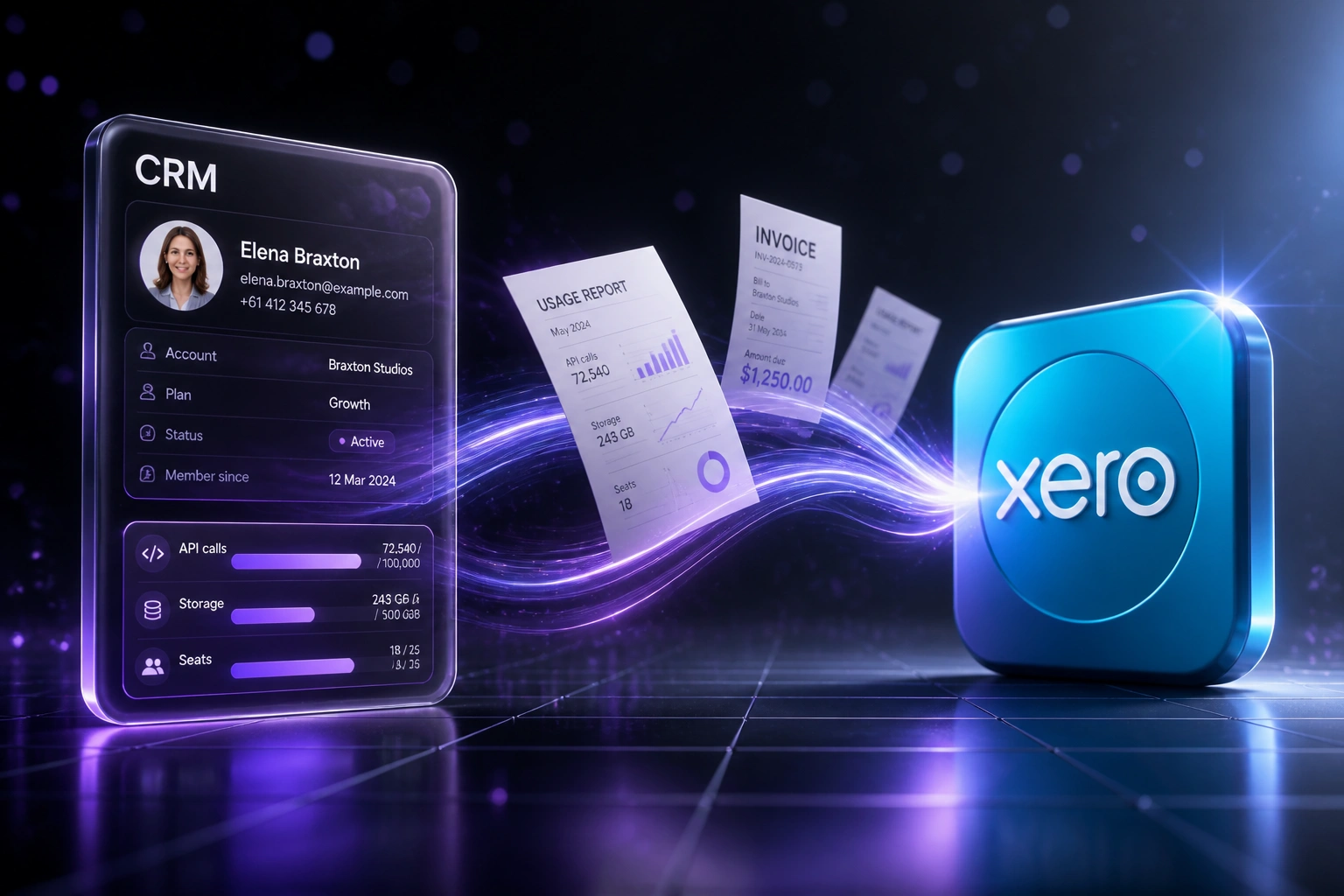
Usage accrues → rated at cycle end → invoice created → status synced back. No spreadsheet rebuild.
Usage Accrues in CRM
API calls, storage GB, seats, and events accumulate against each customer record or meter
Rated at Cycle Close
Allowances, tiers, and overage rates apply automatically to the period totals
Invoice Lands in Ledger
Draft invoice appears in Xero or QuickBooks with line items, VAT, and account codes
Status Synced Back
CRM shows invoiced and paid status so account managers answer usage questions instantly
Everything You Need for Reliable Metered Billing
Metered Usage Aggregation
API calls, storage, seats, and custom consumption events roll up by customer and billing period, ready for rating at cycle end.
Automated Usage Invoices
At billing cycle close, rated usage becomes draft invoices in Xero or your ledger with correct line items, VAT, and account codes.
Overage and Allowance Logic
Included allowances, tiered rates, and overage rules apply automatically so finance is not recalculating bands in a spreadsheet.
Leakage and Variance Alerts
When metered totals diverge from invoiced amounts beyond a threshold, finance is alerted before invoices go out.
CRM Meter Field Mapping
Map CRM usage fields and meter sources to accounting products, tax rates, and tracking categories once, then reuse every cycle.
Usage Transparency Sync
Push invoice and payment status back to the CRM so account managers can answer usage questions without chasing finance.
Platforms We've Connected for Metered Billing
From a 5-Day Billing Cycle to Same-Day Invoices
How a 25-person API platform stopped underbilling leakage and retired the month-end usage spreadsheet.
The Manual Meter Process
- Finance exported CRM usage fields into Excel every month-end
- 18 hours rebuilding API-call, storage, and seat line items per cycle
- Allowances and overages recalculated by hand, with frequent rounding gaps
- Average five business days from period close to invoices sent
- Customers disputed usage totals because CRM and invoice never matched
The Automated Meter Process
- Billing cycle close rates CRM meters and creates draft Xero invoices
- Finance reviews and approves in under an hour
- Allowance and tier rules applied consistently every account
- Same-day invoicing after period close, every cycle
- Usage and invoice status visible in CRM without chasing finance
Before vs After Metered Billing Automation
How It Works
From first conversation to live metered billing in 3 to 5 weeks.
Map Your Meters
Which CRM or meter holds usage, how you rate API calls, storage, and seats, and where invoices are built today.
Design the Rating Rules
30-minute scoping call to agree allowances, tiers, overages, VAT treatment, and which ledger receives the invoices.
Build and Parallel-Run
We build the meter-to-invoice pipeline, test against recent cycles, and run parallel so every rand matches your expectation.
Go Live and Monitor
Switch off the spreadsheet build. Monitoring flags variance, missed meters, and sync failures before customers see them.
Frequently Asked Questions
What is usage-based or metered billing from CRM to accounting?
Usage-based billing (also called metered or consumption billing) charges customers for what they actually use: API calls, storage GB, seats, messages, or other events. We connect the meters living in your CRM or product to your accounting system so those totals become accurate invoice line items at the end of each billing cycle, without a finance person rebuilding them in Excel.
Which CRM, meter, and accounting systems can you connect?
We have built meter-to-invoice flows for HubSpot, Pipedrive, Salesforce, Zoho CRM, and Monday.com, as well as custom product meters and Stripe Billing usage events. On the accounting side we work with Xero, QuickBooks, Sage, and similar ledgers. If each system exposes an API, we can join meter totals to rated invoices.
How do you stop underbilling and revenue leakage?
Industry research puts billing-related leakage at 1 to 5% of revenue, with metering-to-invoice gaps alone often costing 1 to 3% of usage revenue. We reconcile metered totals against invoiced amounts every cycle, apply your allowance and tier rules consistently, and alert finance when variance crosses a threshold so underbilling is caught before cash is left on the table.
Will this replace Stripe Billing, Chargebee, or our CRM?
No. Your team keeps the CRM, meter, and ledger they already use. We automate the handoff: aggregate usage, rate it against your pricing rules, create draft invoices in accounting, and sync status back. Manual review stays available until you trust the numbers, then we retire the spreadsheet rebuild.
How long does a usage-based billing integration take?
A standard meter-to-invoice integration takes 3 to 5 weeks from scoping to go-live. Simple one-way usage syncs into Xero can be live within 2 weeks. Complex setups with multi-tier pricing, mid-cycle plan changes, multi-currency, and several meter sources typically take 5 to 7 weeks. We always parallel-run against recent billing cycles before switching off the manual process.
How much does metered CRM-to-accounting automation cost?
Focused one-way usage-to-invoice syncs start from around R25,000. Full metered billing integrations with allowances, tiers, variance alerts, and bidirectional status sync typically range from R40,000 to R75,000. Most SaaS or services teams spending a week each month on usage invoicing recover the investment within one to two billing cycles from staff time and stopped underbilling alone.
Stop Building Usage Invoices by Hand
If your meters are accurate but your invoices still start in a spreadsheet, you are paying for a problem that metered CRM-to-accounting automation already solves.
Tell us which CRM or meter holds usage, how you rate API calls, storage, and seats, and which ledger issues invoices. We will show you exactly how consumption billing would close for your business.