Bad Debt Write-Off Workflow Between CRM and Accounting
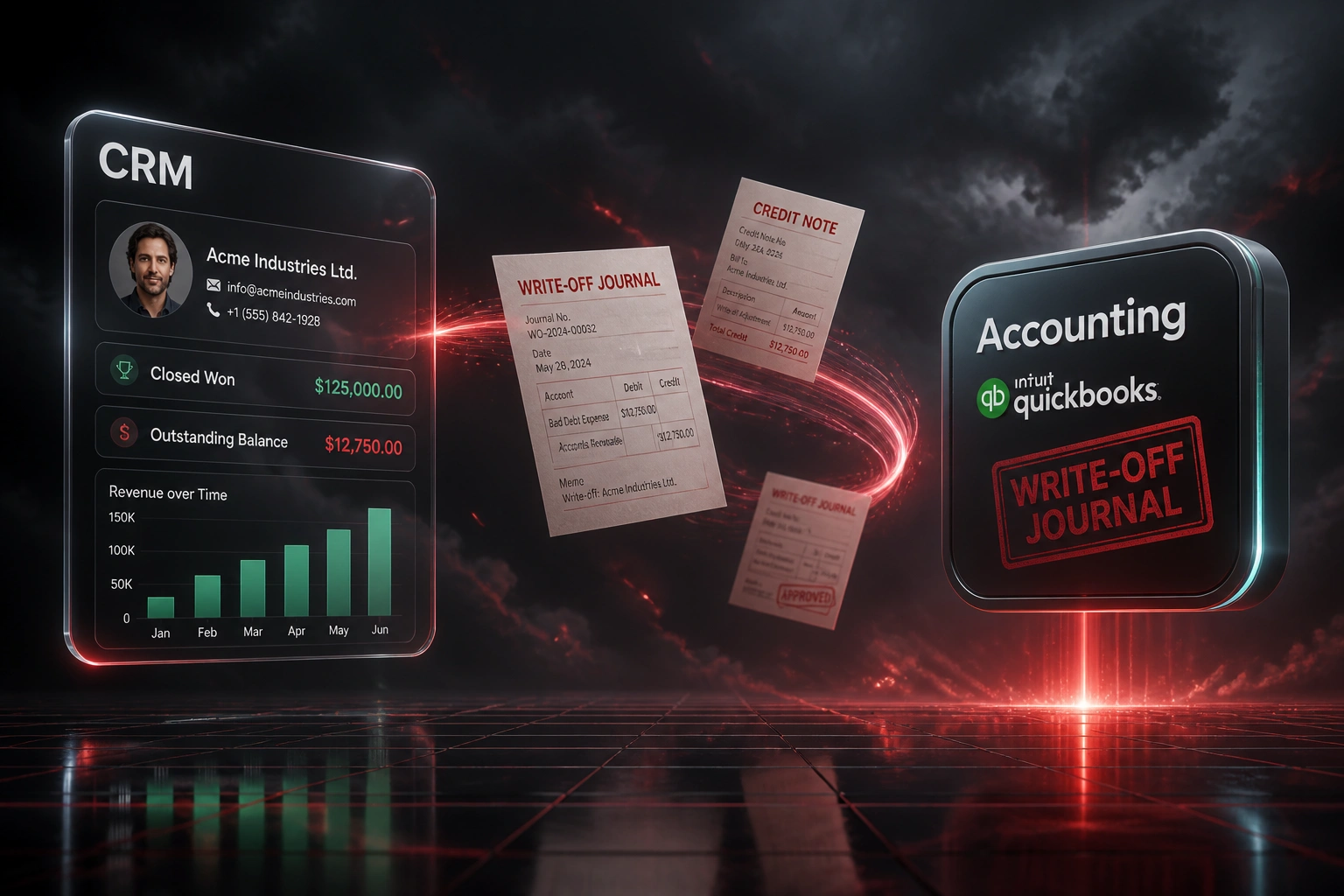
You write the debt off in accounting. The CRM still shows the deal as Open or Won. Sales keeps chasing a dead account while your pipeline forecast pretends the cash is coming.
We build one write-off workflow that closes the deal, posts the journal, and stops the chase.
Sound Familiar?
These are the exact issues credit controllers and finance leads bring us before a write-off workflow:
- Finance writes off bad debt in Xero or QuickBooks, but the CRM deal still shows as Open or Won
- Sales keeps calling and emailing accounts that credit control has already closed
- Pipeline forecasts stay inflated because written-off deals never leave the board
- Write-off journals and CRM status updates happen on different days, so AR and pipeline never match
- Month-end needs a spreadsheet to reconcile which written-off invoices still sit open in the CRM
Stale CRM pipeline inflates forecasts and damages relationships. Once debt is past 90 days, recovery often falls below 30%. Past 180 days, about three in four debts never recover. Chasing an account after the write-off journal has already posted burns goodwill and burns staff hours you will not get back.
What the Bad Debt Write-Off Workflow Actually Does
Write-off approved → journal posted → CRM closed → collections stopped. One decision, both systems updated.
Write-Off Approved
Credit control marks the invoice or deal as irrecoverable after collections are exhausted
Journal Posted
Bad debt expense and AR contra (or credit memo) land in Xero, QuickBooks, or Sage with the invoice link
CRM Deal Closed
Deal stage flips to Written Off, amount and reason logged, pipeline forecast drops the false revenue
Outreach Stops
Dunning, tasks, and sales follow-ups halt so nobody phones a customer already written off
Everything You Need for a Reliable CRM Write-Off
One-Click Write-Off Trigger
Credit control marks a receivable as irrecoverable. The workflow posts the bad debt expense journal and closes the CRM deal in the same step.
Accounting Journal Automation
Debit bad debt expense, credit AR (or the AR contra), with the correct account codes, tax treatment, and invoice reference for Xero, Sage, or QuickBooks.
CRM Deal Closure
The related deal moves to Written Off or Lost Bad Debt, with the write-off amount, date, and reason logged on the record for audit.
Collections Outreach Stop
Dunning sequences, overdue tasks, and sales follow-ups stop automatically so nobody chases a debt that finance has already written off.
Approval & Evidence Pack
Optional dual control before posting, plus a trail of collection attempts so Section 11(i) claims have the evidence SARS expects.
Forecast Hygiene
Pipeline and aged-debtor reports drop written-off balances together, so board packs stop mixing hope with cash that will never arrive.
Platforms We've Wired for Write-Off Workflows
From 5 Hours/Week to 20 Minutes
How a Johannesburg B2B distributor stopped dual-system write-offs and ended sales chasing R380,000 of already-written-off debt.
The Manual Process
- Credit controller posted the journal in Xero, then emailed sales to close the HubSpot deal
- 25–40 minutes per write-off across two systems, plus chasing missing deal links
- Sales still dialled accounts that finance had written off weeks earlier
- Pipeline still showed R380,000 of dead deals as open revenue
- Month-end needed a spreadsheet to match write-off journals to CRM stages
The Automated Process
- Approve write-off once → journal posts and CRM deal closes within seconds
- Collections sequences and sales tasks stop automatically
- Pipeline forecast drops written-off amounts the same day
- Evidence of collection attempts stays attached for Section 11(i) support
- Month-end write-off list matches AR and CRM without a reconciliation sheet
Before vs After the Write-Off Workflow
How It Works
From first conversation to live write-off workflow in 2–4 weeks.
Tell Us Your Setup
Which CRM, which ledger, how you approve write-offs today, and where sales still chases dead accounts.
Free Scoping Call
30-minute call to map the write-off workflow, journal mapping, and which statuses should stop collections.
Build & Test
We build the integration, test with real write-off cases, and run parallel for a week so journals and CRM statuses match.
Go Live & Monitor
Switch off the dual-system admin. Monitoring alerts you if a journal posts without a CRM close, or the reverse.
Frequently Asked Questions
How long does a CRM and accounting write-off workflow take to set up?
A standard write-off workflow takes 2–4 weeks from scoping to go-live. Simple one-way journal posting with CRM close can be live within about two weeks. Setups with dual approval, multi-entity ledgers, or custom collections stop rules take closer to 4–6 weeks.
Which CRMs and accounting systems can you connect?
We have built write-off workflows across HubSpot, Pipedrive, Salesforce, Zoho CRM, and Monday.com into Xero, QuickBooks Online, and Sage (Business Cloud, Pastel, and Evolution). If your CRM and ledger both have an API, we can connect them.
Will this disrupt how credit control works today?
No. Your team still decides when a debt is irrecoverable. The automation handles the dual update: journal in accounting, deal status in CRM, and a hard stop on collections outreach. We run parallel testing before switching off the manual checklist.
How do you handle the accounting journal correctly?
Native write-off paths differ by platform. Xero's system Journals endpoint is read-only, so we post via Manual Journals or the credit-note path your accountant prefers. QuickBooks Online works best with a Bad Debt item and credit memo applied to the invoice, not a raw journal that fails to show on AR reports. We follow your chart of accounts and tax treatment.
Does this help with SARS Section 11(i) bad debt deductions?
The workflow creates a formal write-off in the books in the year you claim it, which Section 11(i) requires, and can attach evidence of collection attempts to the CRM and ledger records. Your tax advisor still owns the claim. Fewer than 30% of qualifying South African businesses correctly claim this deduction, often because the accounting write-off and the evidence trail never meet.
How much does a bad debt write-off workflow cost?
Simple one-way syncs that close the CRM deal when a journal posts start from around R20,000. Full bidirectional workflows with approval gates, collections stop rules, and multi-entity journals typically range from R30,000 to R65,000. Most credit teams processing more than a handful of write-offs a month see ROI within 2–3 months against staff time and false collections alone.
Stop Chasing Debt You Have Already Written Off
If credit control posts journals in one system while sales still works open deals in another, you are paying twice: once in staff time, and again in damaged customer relationships.
Tell us which CRM and ledger you use, how write-offs are approved today, and where the chase still continues after the journal. We will show you exactly how a single bad debt write-off workflow would run for your team.