Year-End Reconciliation Between CRM Pipeline and Financial Statements
You dread financial close because the CRM pipeline never matches the statements. Timing differences, missing invoices, and twelve months of drift turn February into a multi-week scramble while auditors wait for pipeline-to-GL evidence.
We build the continuous sync and year-end reconciliation workflow that turns close into a controlled process.
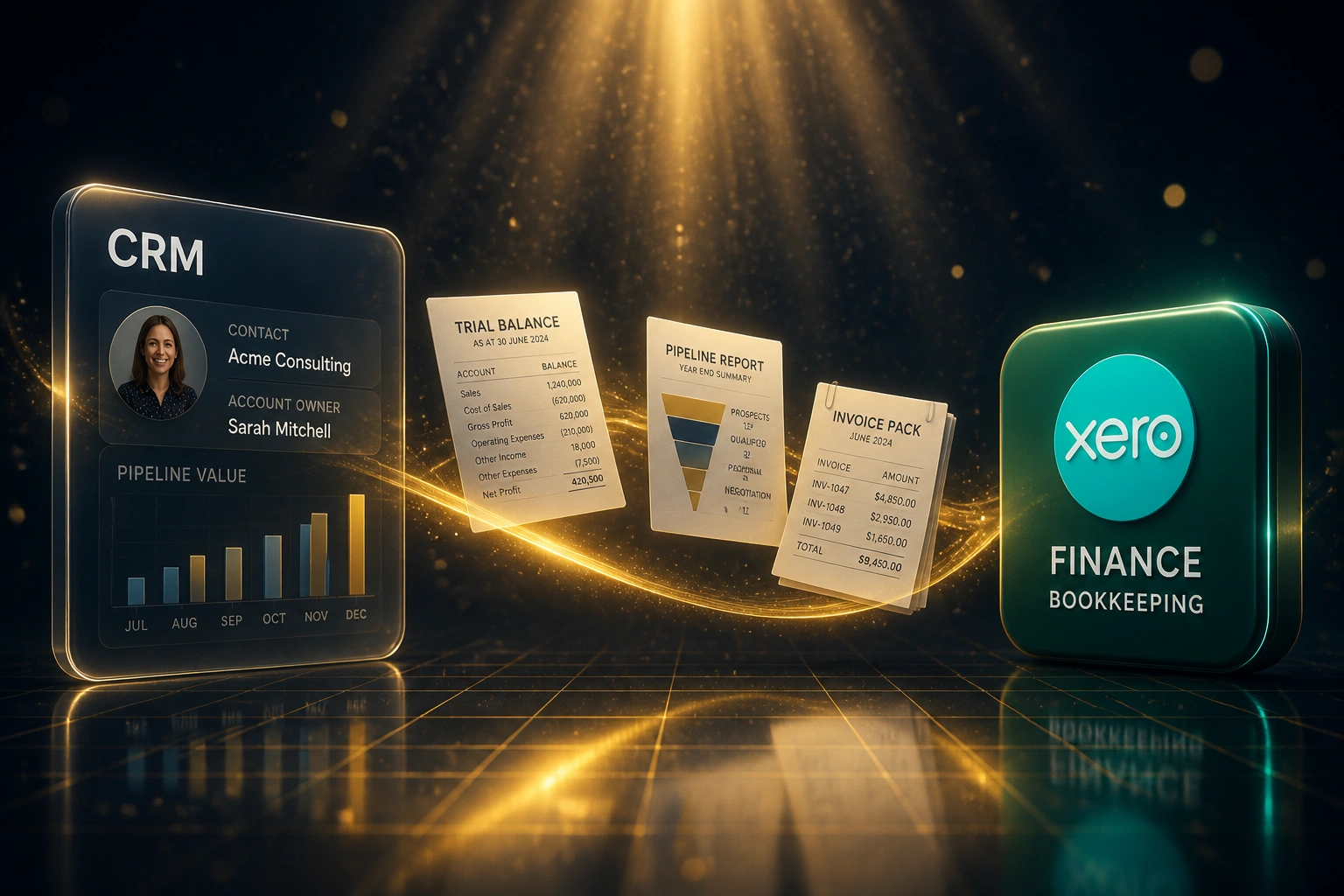
Sound Familiar?
These are the exact issues CFOs and finance leads face every year-end:
- CRM closed-won for the year never matches the revenue line on the financial statements
- February and March become a multi-week scramble of spreadsheets, emails, and late nights
- Timing differences hide in plain sight: deals closed in CRM before invoices hit the ledger
- Auditors ask for pipeline-to-GL evidence and your team rebuilds it under deadline pressure
- Sales and finance argue about whose number is right while the year-end close slips another day
Audit season does not wait. When auditors or SARS request pipeline-to-GL cut-off evidence, a finance team that still rebuilds the bridge in spreadsheets burns overtime and delays the financial close. Seventy-three percent of finance professionals already work overtime during close, averaging eleven extra hours per cycle.
What the Year-End Reconciliation Actually Does
Continuous sync all year → cut-off bridge at year-end → explained variance → audit-ready close.
Deals Sync Continuously
Closed-won CRM deals, invoices, and credit notes stay aligned with accounting through the year
Year-End Cut-Off Runs
At financial year-end, every deal is matched to invoices and recognised revenue as of the cut-off date
Timing Gaps Explained
Deals closed before invoices posted are tagged as timing differences, not unexplained variance
Close Ready for Audit
Pipeline vs financial statements is a controlled pack finance can defend under auditor sampling
Everything You Need for a Controlled Financial Close
Year-End Cut-Off Bridge
Every closed-won deal is matched to invoices and recognised revenue at the financial year boundary, so pipeline vs actuals is a controlled schedule, not a surprise.
Timing Difference Ledger
Deals closed in CRM before the invoice posts in accounting are tagged as explained timing gaps, not mystery variance, ready for the auditor pack.
Continuous CRM-Accounting Sync
Won deals, invoices, credit notes, and payment status stay aligned all year, so year-end starts from a clean base instead of twelve months of drift.
Audit-Ready Evidence Pack
One-click deal-to-invoice-to-GL lineage for SARS, external auditors, and board packs, with as-of timestamps that survive sampling questions.
Exception Queue for Close Week
Only unexplained gaps reach finance during financial close. Matched items stay quiet so the CFO spends days on judgment, not hunting missing invoices.
February Close Calendar
Pre-close checklists, cut-off rules, and variance thresholds run before year-end so SA February closes (and calendar year-ends) stop turning into March chaos.
Systems We've Connected for Year-End Close
From a 19-Day Year-End Scramble to a 6-Day Controlled Close
How a 45-person Johannesburg professional services firm stopped dreading February and recovered R620,000 in year one.
The Year-End Chaos
- CRM closed-won showed R14.2M; financial statements showed R12.9M (9% gap)
- Finance rebuilt the pipeline-to-GL bridge in spreadsheets for three weeks
- Timing differences: 38 deals closed in CRM in late February before invoices posted
- External auditors requested cut-off evidence; the pack took four late nights
- CFO and financial manager averaged 14 overtime hours each week through close
The Controlled Close
- Continuous CRM-accounting sync kept deals and invoices aligned all year
- Year-end cut-off bridge explained every rand of pipeline vs statements variance
- Timing differences tagged automatically; only six exceptions needed judgment
- Audit evidence pack generated in under an hour from deal-to-GL lineage
- Finance spent close week on judgments and tax, not hunting missing invoices
Before vs After Year-End Reconciliation
How It Works
From first conversation to live year-end workflow in 3–5 weeks.
Tell Us Your Setup
Which CRM, which accounting stack, and how painful last year's pipeline vs statements reconciliation was.
Free Scoping Call
30-minute call to map cut-off rules, year-end calendar, and the biggest audit and close pain points.
Build & Test
We build the sync and year-end reconciliation workflow, then test against a full prior year of deals and invoices.
Go Live & Monitor
Switch off the spreadsheet bridge. Monitoring flags cut-off exceptions before auditors ask for them.
Frequently Asked Questions
Why do CRM pipeline numbers never match year-end financial statements?
They measure different moments. CRM typically records gross deal value at closed-won. Accounting records net recognised revenue after invoice timing, credit notes, discounts, and cut-off. Mid-market firms commonly carry a 4–12% variance between pipeline and recognised revenue when those definitions are never reconciled at deal level before financial close.
Is year-end reconciliation the same as ongoing board-pack reconciliation?
Related, but different. Ongoing reconciliation explains CRM vs P&L variance for monthly board packs. Year-end reconciliation focuses on financial close: cut-off assertions, audit evidence for pipeline-to-GL, and the February or calendar year-end scramble when twelve months of timing gaps surface at once. Many clients need both.
How long does a typical mid-market year-end close take without this?
Industry benchmarks put mid-market year-end close at two to four weeks, with APQC reporting a median annual close of about 18 calendar days. Manual reconciliation alone often consumes 30–40% of that cycle. Continuous sync plus a year-end workflow is designed to turn that scramble into a controlled close measured in days, not weeks.
Will this help when auditors or SARS ask for pipeline-to-GL evidence?
Yes. Auditors test revenue cut-off by tracing source documents to ledger dates. We build deal-to-invoice-to-GL lineage with as-of timestamps so your team produces an evidence pack instead of rebuilding spreadsheets under audit pressure.
Which CRMs and accounting systems can you connect for year-end close?
We have built CRM-accounting bridges for HubSpot, Pipedrive, Salesforce, Zoho CRM, and Monday.com into Xero, Sage, QuickBooks, Zoho Books, and NetSuite. If both systems have an API or a reliable export, we can connect them and layer the year-end reconciliation workflow on top.
How much does year-end CRM-accounting reconciliation cost?
Continuous sync with a year-end cut-off workflow typically starts from around R30,000. Multi-entity, multi-currency setups with full audit evidence packs usually fall between R45,000 and R80,000. Teams burning two to three weeks on year-end pipeline vs statements usually recover the build cost within one close cycle when overtime, external accountant fees, and delayed reporting are counted.
Stop Dreading Year-End Pipeline vs Statements
If every financial close still starts with a spreadsheet bridge between CRM and the ledger, you are spending money and reputation on a problem that continuous sync and a year-end workflow already solve.
Tell us which CRM and accounting stack you run, when your financial year ends, and how last year's reconciliation went. We'll show you exactly how a controlled close would work for your business.