CRM for B2B vs B2C: Different Architectures for Different Sales
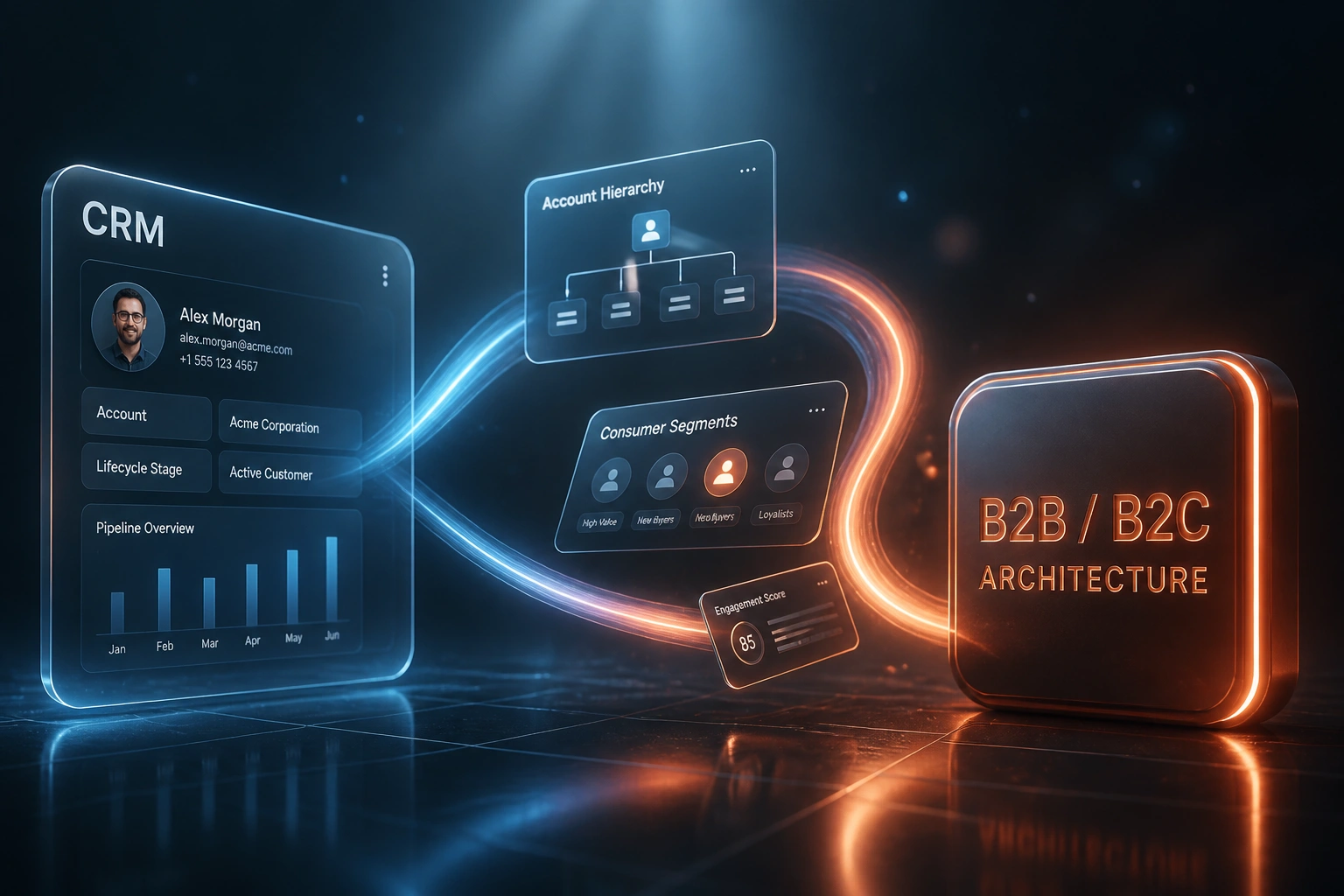
Your company sells both ways, or just switched motion, and one CRM model is forcing the wrong process. B2B needs account hierarchies, buying committees, and long-cycle forecasting. B2C needs volume, segmentation, and lifecycle automation. One size does not fit all.
We configure the right CRM architecture, or a dual model, so pipeline and marketing stop fighting each other.
Sound Familiar?
These are the exact issues hybrid go-to-market companies face when CRM architecture mismatches the sales motion:
- B2B reps force buying committees into a contact-level CRM built for consumer volume
- Marketing floods the pipeline with B2C-style leads that sales cannot forecast or qualify
- Account hierarchies, parent-child orgs, and partner relationships live in spreadsheets
- Lifecycle campaigns fire on enterprise accounts the same way they fire on retail buyers
- After an acquisition or dual GTM launch, one CRM model is crushing the other motion
Hybrid GTM companies outgrowing a single-model CRM, or forced to re-platform after acquisition, are the urgency trigger. Ninety-one percent of B2B purchases stall somewhere in the process. When your CRM cannot model committees or account hierarchies, that stall becomes invisible until the quarter is already lost.
What the Right CRM Architecture Actually Does
Diagnose the mismatch → design B2B and B2C models → configure → align pipeline and marketing.
Map Each Sales Motion
Account cycles, committee size, and consumer volume paths documented separately
Design Dual Architecture
Hierarchies and forecast stages for B2B; segments and lifecycle for B2C
Configure and Migrate
Objects, automation, and history moved without forcing one motion into the other
Aligned Revenue Teams
Sales forecasts accounts; marketing runs volume. Shared identity where it helps
Account-Based CRM Meets Lifecycle CRM
Account Hierarchy CRM
Parent accounts, subsidiaries, and partner trees sit in the B2B CRM so reps sell to the organisation, not a lonely contact card.
Buying Committee Tracking
Roles, influence maps, and multi-threaded opportunities capture the 6–13 stakeholders typical of complex B2B deals.
Long-Cycle Forecasting
Stage criteria, weighted pipeline, and committee progress replace consumer conversion maths that break on 84-day median cycles.
High-Volume Segmentation
B2C cohorts, behavioural tags, and lifecycle stages handle consumer volume without polluting enterprise account records.
Lifecycle Marketing Automation
Browse, cart, onboarding, and win-back journeys run on the consumer model while B2B nurture stays account-aware.
Dual-Model Governance
Shared customer identity where it helps, hard separation where motions clash, so pipeline and marketing stop fighting each other.
Platforms We Configure for Dual Sales Motions
From 34% Forecast Error to 8%
How a Johannesburg hybrid brand (B2B wholesale plus D2C ecommerce) stopped one CRM model from breaking both sales motions after an acquisition.
One Contact-Centric CRM
- Enterprise deals flattened into individual contacts with no account hierarchy
- Buying committees of 8–13 people tracked as random notes
- Consumer lifecycle emails blasted wholesale buyers the same as retail shoppers
- Quarterly forecast miss averaged 34% because stages mirrored B2C conversion math
- Sales and marketing blamed each other for "bad leads" that were really the wrong architecture
Dual-Model CRM Architecture
- B2B side: account hierarchies, committee roles, and long-cycle stage criteria
- B2C side: volume segments, behavioural tags, and lifecycle journeys
- Shared identity only where a buyer existed in both motions
- Account-based selling plays on wholesale; automation volume on D2C
- Weekly forecast reviews finally matched closed-won reality
Before vs After the Right CRM Architecture
How It Works
From first conversation to live dual-model architecture in 6 to 14 weeks for most hybrid GTM teams.
Map Both Sales Motions
Where B2B accounts, committees, and cycles differ from B2C volume, segments, and lifecycle journeys today.
Design the Architecture
Single CRM with two objects, dual instances, or hybrid model. Fixed scope and quote before build starts.
Configure and Migrate
We build hierarchies, segments, automations, and migrate history so each motion keeps the data it needs.
Go Live and Align Teams
Train sales and marketing on the right model for their motion, then monitor forecast and campaign quality.
Frequently Asked Questions
Do we need two CRMs, or can one system serve B2B and B2C?
Often one platform works if the data model is deliberate: account-based objects and long-cycle stages for B2B, contact-level segments and lifecycle automation for B2C. Forcing both motions into a single contact-centric layout is what breaks forecasting. We design the architecture first, then configure HubSpot, Salesforce, or a dual setup around it.
What is the real difference between B2B CRM and B2C CRM architecture?
B2B CRM centres on accounts, buying committees, and multi-month forecasting. B2C CRM centres on volume, segmentation, and lifecycle marketing. The median B2B SaaS cycle sits around 84 days with roughly 13 stakeholders in complex purchases, while B2C often closes in minutes to days with one or two buyers. Same vendor logo, completely different operating system.
We sell both ways after an acquisition. Where should we start?
Start with the motion that is bleeding most: usually enterprise forecast accuracy or consumer campaign volume. We map shared identity (so one person who buys both ways is not duplicated blindly), then separate stages, ownership, and automation so neither motion inherits the wrong process.
How long does a B2B vs B2C CRM architecture project take?
A focused architecture redesign with hierarchy, committee fields, and segment separation typically takes 6 to 12 weeks. Full dual-model builds with migration, lifecycle automation, and team training usually run 3 to 5 months, phased so one motion can go live while the other is still being refined.
Will this disrupt our current sales and marketing teams?
We design around how each team already sells and markets, then remove the forced workarounds. Parallel running keeps the old views available until forecast accuracy and campaign metrics prove the new model. Training is role-specific: account executives learn hierarchy and committees; growth marketers learn segments and lifecycle.
How much does the right CRM architecture cost in South Africa?
Architecture design and configuration for a hybrid go-to-market typically ranges from R80,000 to R250,000+, depending on platform, data cleanliness, and how deep dual-model automation needs to go. Against failed CRM programmes that research puts in the R4.1M–R12.4M impact band for mid-market firms, getting the model right usually pays back inside the first year.
Stop Forcing One CRM Model Onto Two Sales Motions
If your B2B forecast and B2C lifecycle keep colliding in the same system, you are paying for a mismatch that architecture can fix.
Tell us how you sell today, where the motions clash, and whether an acquisition or dual GTM launch created the pressure. We will show you the right CRM architecture for account-based selling and consumer volume.