CRM for Manufacturing: Distributors, Orders and Forecasting
When your distributor network lives in spreadsheets and email, industrial sales CRM that only tracks B2B leads will not save you. Lost forecasts, blind partner stockouts, and channel conflicts cost real margin every quarter.
We build the manufacturing CRM that tracks partners, stocked SKUs, order pipelines, and demand forecasts in one place.
Sound Familiar?
These are the exact issues manufacturing clients faced before a purpose-built channel CRM:
- Distributor stock levels live in emailed spreadsheets, so the factory only learns about a stockout when the partner phones in a panic
- Order pipelines sit in sales reps' inboxes, with no shared view of what channel partners have committed for the next quarter
- Two distributors chase the same end customer because territories and deal registration were never enforced in one system
- Demand forecasts are last year's shipments plus gut feel, so production either overbuilds slow SKUs or starves fast movers
- Channel managers spend Fridays reconciling partner orders by hand instead of coaching distributors on pipeline
Supply chain visibility is no longer optional. Manufacturers who still forecast from last year's shipments while distributors hold silent stockouts are funding expedites, overtime, and channel conflict out of margin that a connected industrial sales CRM would protect.
What Manufacturing CRM Actually Does
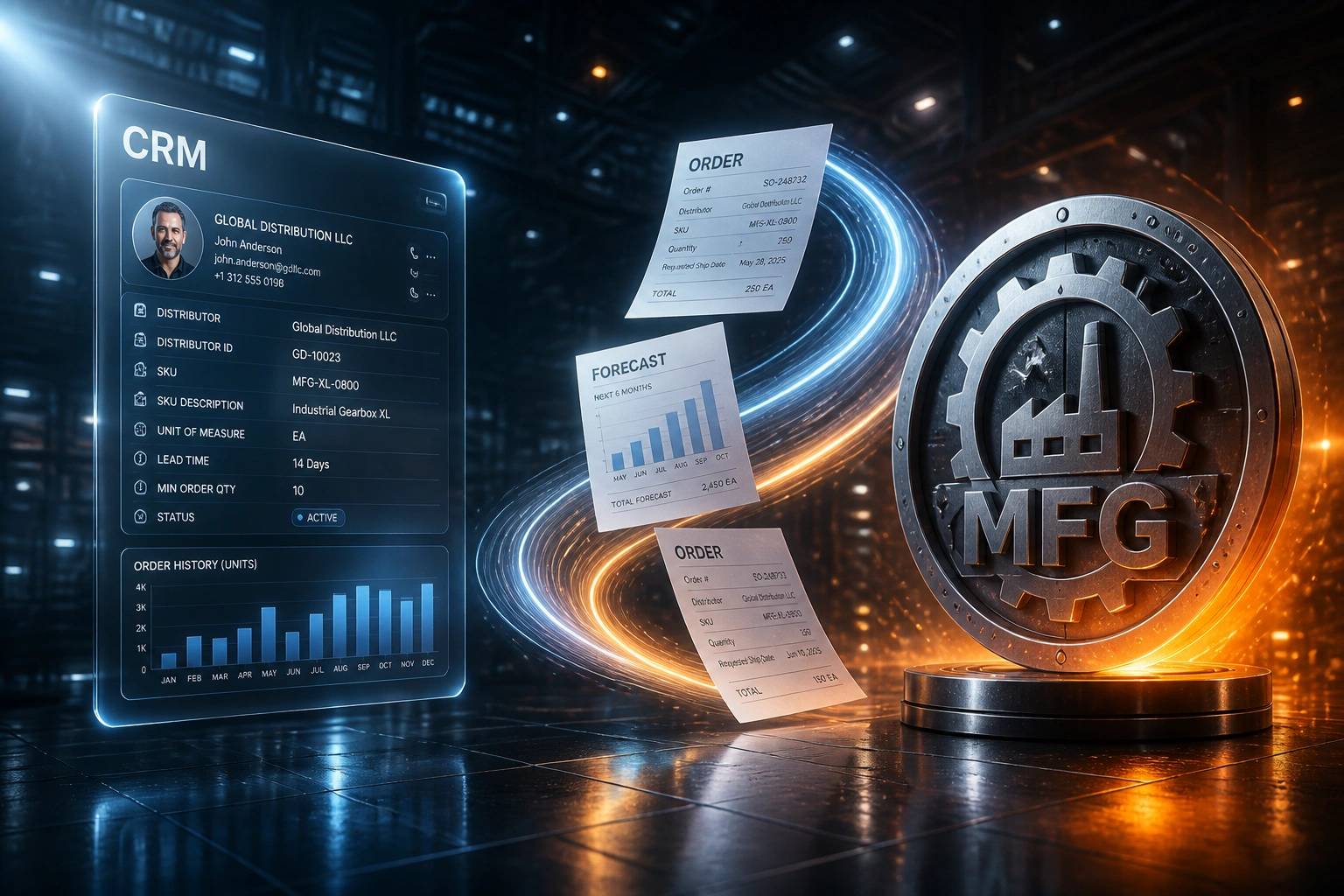
Partner updates stock and pipeline → forecast rolls up → orders land cleanly → production plans against real demand.
Distributor Signals Demand
Partner logs stocked SKUs, open orders, and forecasted volume in the shared channel CRM
Forecast Rolls Up
Demand by SKU and territory updates for sales directors and planners in one view
Order Pipeline Syncs
Committed orders and deal registrations surface conflicts before two partners quote the same plant
Factory Plans Cleanly
Production and replenishment follow channel signal, not emailed guesswork
Everything a Distributor CRM Needs to Protect Margin
Distributor and Partner Records
Every channel partner, territory, stocked SKU list, and credit term lives in one place. Sales directors see who covers which region without opening three spreadsheets.
Order Pipeline Tracking
Distributor purchase orders, backorders, and committed volume sit in a shared pipeline so manufacturing and sales plan from the same numbers, not competing email threads.
Demand Forecast Roll-Up
Partner forecasts and historical order velocity feed a single demand view by SKU and territory, so production plans against real channel signal instead of last year's shipments.
Deal Registration and Territory Rules
Partners register opportunities before they clash. Territory and product-line rules flag conflicts early, so you protect margins instead of apologising after two distributors quote the same plant.
Stocked SKU Visibility
See what each distributor holds, what is on order, and where coverage is thin. Spot a silent stockout before it becomes a lost industrial sale and a panicked expedite.
Channel Performance Reporting
Dashboards channel managers actually open: fill rate by partner, forecast accuracy by SKU family, pipeline coverage by territory, and win/loss on registered deals.
Systems We've Connected for Industrial Sales Teams
From Blind Channel Forecasts to 34% Better Demand Accuracy
How a Gauteng industrial components manufacturer with 35 distributors cut channel admin, stopped silent stockouts, and recovered R2.4 million in year one.
The Spreadsheet Channel
- Channel manager spent 12 hours a week chasing stock and order updates by email
- Demand forecast was last year's shipments plus sales gut feel, accuracy around 55%
- Manufacturer could see only about 15% of distributor pipeline opportunity
- Territory clashes discovered after two partners had already quoted the same plant
- Stockouts on fast movers triggered expedited freight and overtime while slow SKUs piled up
The Connected Manufacturing CRM
- Distributors update stocked SKUs, orders, and forecasts in one shared partner workspace
- Demand roll-up by SKU and territory feeds planning every week, not every quarter
- Deal registration and territory rules flag conflicts before quotes go out
- Channel managers coach pipeline instead of rebuilding spreadsheets on Friday afternoons
- Sales directors see partner coverage and forecast accuracy without asking anyone
Before vs After Manufacturing CRM
How It Works
From first conversation to live manufacturing CRM in 10 to 16 weeks for a focused MVP.
Map Your Channel
Distributors, territories, order flow, forecast cadence, and the spreadsheets your channel team already fights with every week.
Scope the Manufacturing CRM
Partner records, order pipeline, demand roll-up, and deal registration, with a fixed quote and timeline before build starts.
Build, Migrate, Train
We build the system, migrate partner and SKU history, and train sales directors, channel managers, and key distributors on day-one workflows.
Go Live and Refine
Cut over with parallel running on live orders and forecasts, then tighten reporting and territory rules once the network is comfortable.
Frequently Asked Questions
How is manufacturing CRM different from a generic B2B sales CRM?
Generic CRMs track leads and deals. A manufacturing CRM tracks distributors, stocked SKUs, order pipelines, demand forecasts, and deal registration across the channel. Off-the-shelf sales tools force workarounds that leave channel managers reconciling partner stock in spreadsheets while production plans blind.
Can it connect to our ERP and distributor portals?
Yes. We design the CRM to sit beside your ERP and any existing partner portal. Orders, SKU masters, and inventory snapshots sync where APIs exist. Where partners still work in spreadsheets, we give them a simple intake that lands cleanly in the same pipeline your sales team already uses.
Will this replace our forecasting or MRP system?
No. The CRM owns channel demand signal, partner commitments, and order pipeline. MRP and production planning stay where planners are productive. We feed cleaner partner forecasts and order velocity into planning so the factory is not guessing from last year's shipments alone.
How long does a manufacturing CRM take to build?
A focused MVP covering distributor records, order pipeline, basic demand roll-up, and deal registration typically ships in 10 to 16 weeks. Deeper ERP sync, partner portals, and multi-country territory rules usually take 4 to 6 months, phased so channel managers can start using the partner board earlier.
What happens to our existing distributor and order data?
We plan a structured migration from spreadsheets, shared drives, and email: clean duplicate partners, map open orders and historical shipments, and validate territories before cutover. Parallel running on live distributor orders reduces risk while the channel team settles into the new workflow.
How much does a purpose-built manufacturing CRM cost in South Africa?
Most manufacturing CRM builds we scope land between R180,000 and R450,000+, depending on distributor count, SKU complexity, and ERP integrations. A focused partner-and-pipeline MVP sits toward the lower end. Manufacturers recovering even a few avoided stockouts or channel conflicts typically see payback well inside the first year.
Stop Running Distributor CRM in Spreadsheets
If your manufacturing sales team still tracks partners, orders, and forecasts across email and Excel, you are funding stockouts and channel conflict that a purpose-built industrial sales CRM already solves.
Tell us how many distributors you run, how forecasts reach the factory today, and where stockouts or territory clashes hurt most. We will show you exactly how a manufacturing CRM would work for your network.