CRM Migration Planning: The Complete Checklist
You have already decided to change CRM, or the board told you to. The risk is not picking the wrong platform. It is under-planning the switch, then paying in dual licences, rework hours, and a quarter of broken forecasts.
We run the CRM migration plan that keeps stakeholders aligned, data clean, integrations mapped, and rollback ready.
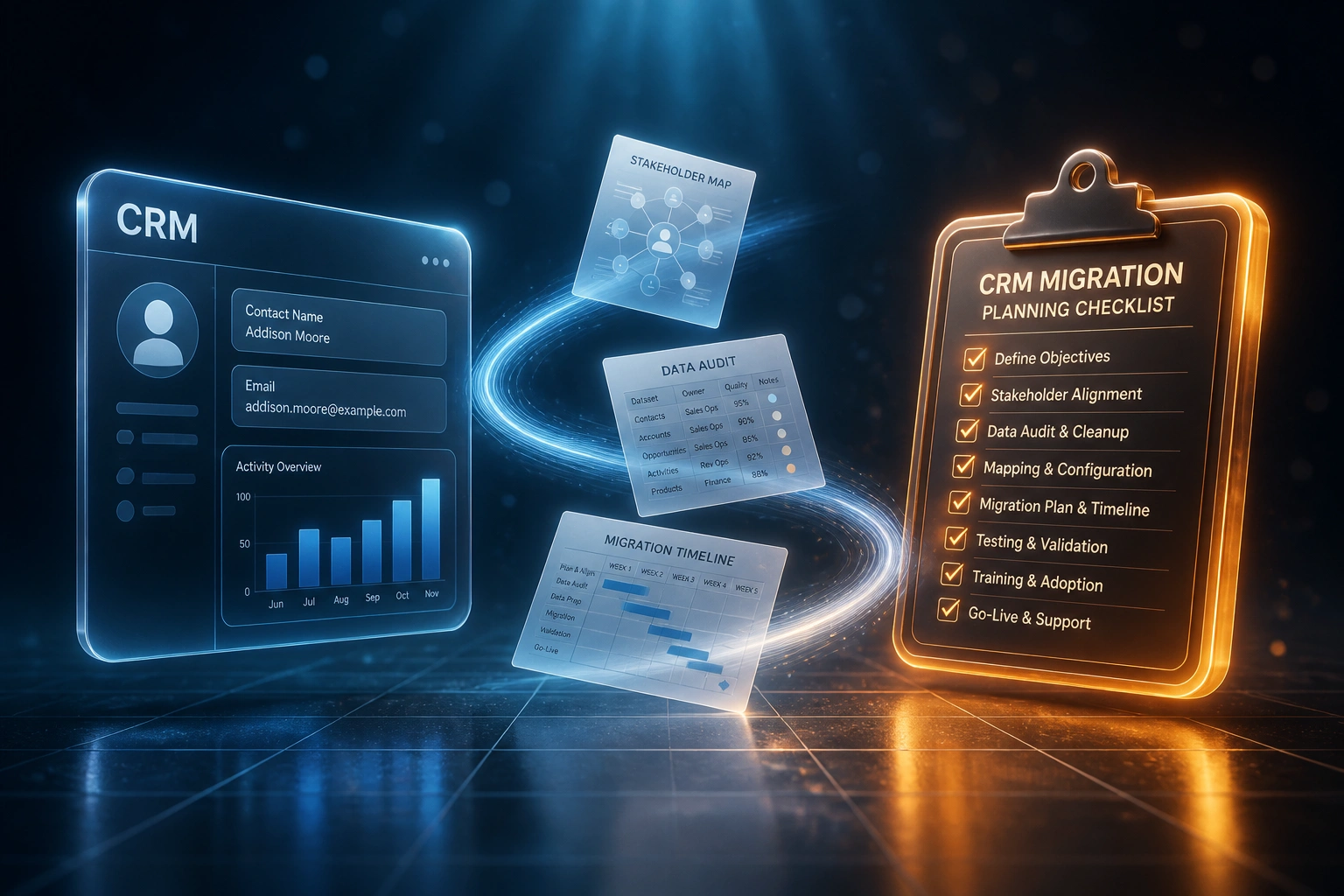
Sound Familiar?
These are the exact issues our clients faced when CRM transition planning was treated as optional:
- The board approved a CRM switch, then nobody owned the migration plan beyond a go-live date on a slide
- Sales, finance, marketing, and IT each assume someone else mapped fields, integrations, and historical deals
- Dual licences run for months because cutover keeps slipping, while both platforms bill at full seat rates
- Forecast accuracy collapses during the transition: pipeline stages remap wrong, and board packs stop matching reality
- There is no rollback path, so a bad cutover means rebuilding under pressure with the old CRM already half empty
SaaS seat prices are rising while legacy plans disappear. Salesforce lifted Enterprise and Unlimited list prices by an average of 6% on 1 August 2025, with order-form uplifts often 8% to 10% a year. Broader SaaS research in H1 2026 put forced legacy-plan migrations at about a 24% average price jump. Waiting another renewal without a migration checklist usually means paying more to stay stuck, then rushing the switch under budget pressure.
What Proper CRM Transition Planning Looks Like
Align stakeholders → audit data → map integrations → cut over with rollback ready. No surprise dual-licence months.
Align Stakeholders
Sales, finance, marketing, ops, and IT agree on outcomes, owners, and go/no-go gates
Audit and Map
Clean data, map fields and stages, inventory every integration that must be rebuilt
Parallel Run
Both CRMs live for a capped window while spot checks prove forecasts and workflows
Cut Over Safely
Go live with rollback documented, then cancel old seats on the planned date
Everything on the Migration Checklist, Done
Stakeholder Alignment Workshop
Sales, finance, marketing, ops, and IT agree on objectives, owners, and success criteria before a single record moves.
Data Audit and Cleanup Plan
Duplicates, orphaned deals, stale contacts, and field chaos get scored and fixed before load, not discovered after go-live.
Integration Mapping Inventory
Every connected tool (accounting, email, quoting, support, marketing) is listed, owners assigned, and rebuild effort priced.
Phased Timeline with Parallel Run
A realistic calendar with dual-run weeks, cutover gates, and freeze windows so dual licences do not become a permanent tax.
Rollback and Contingency Plan
Documented revert triggers, backups, and communication so a failed cutover does not strand the team mid-pipeline.
Adoption and Forecast Continuity
Stage mapping, training by role, and forecast checks so commit accuracy returns in days, not a quiet quarter of guessing.
Platforms We Plan Migrations Across
From 14 Weeks of Dual CRM to Five
How a 22-seat services firm stopped a seat-price-driven switch from becoming a second failed project, and recovered R410,000 in year one.
The Under-Planned Switch
- Board set a go-live date with no stakeholder owners or success criteria
- Field mapping rebuilt twice after finance and sales disagreed on stage definitions
- Three integrations (Xero, quoting, support) discovered only after parallel run started
- Dual licences stretched from a hoped-for 6 weeks to 14 weeks at about R28,000 per month
- Weighted forecast drifted for a full quarter; board packs needed a manual spreadsheet patch
The Checklist-Led Migration
- Stakeholder workshop locked owners, stage rules, and go/no-go gates in week one
- Data audit cleared duplicates and orphaned deals before the first load
- Integration inventory priced rebuilds up front; no mid-flight surprises
- Parallel run capped at five weeks with weekly forecast spot checks
- Rollback documented and unused; old seats cancelled on the planned renewal date
Before vs After a Real Migration Checklist
How It Works
From first conversation to a controlled cutover in 8 to 16 weeks.
Migration Discovery
Current CRM, seat count, integrations, data volume, and why you are switching. We surface the planning gaps early.
Checklist and Scope Call
30-minute call to align stakeholders, score data risk, map integrations, and set dual-run and rollback boundaries.
Plan, Audit, and Rehearse
Written CRM migration plan, field mapping, cleanup runs, integration rebuilds, and a dry-run load before anyone cuts over.
Cut Over with Rollback Ready
Parallel run, gate checks, go-live, then cancel old seats on schedule. Rollback stays available until sign-off.
Frequently Asked Questions
Why do CRM migrations fail even when the new software is fine?
Independent research puts CRM failure near 55% when measured against planned objectives (Johnny Grow, 2025), with Gartner historically around 50% and Forrester near 47%. Gartner also reports that about 83% of data migration projects fail or exceed budgets and timelines. The pattern is missing planning: unclear owners, dirty data loaded as-is, integrations discovered late, and no rollback. Bad software is rarely the root cause.
What belongs on a CRM migration planning checklist?
Stakeholder alignment and success criteria, a data audit with cleanup rules, field and stage mapping, an inventory of every integration to rebuild, a dual-run timeline with freeze windows, training by role, forecast continuity checks, and a documented rollback path. Skip any of those and you usually pay in dual licences, rework hours, and a quarter of unreliable pipeline numbers.
How long should we dual-run the old and new CRM?
Well-planned mid-market switches typically dual-run for four to eight weeks, then cancel old seats. Unplanned migrations stretch that to three or four months because mapping and integrations keep breaking. At roughly R16.54 to the dollar (August 2026), a 50-seat Salesforce-class overlap near $8,250 per month is about R136,500 per month in licence overlap alone. Every extra month of dual-run is pure waste.
What does a failed or under-planned CRM migration cost?
Mid-market rescue analyses put direct sunk costs for a failed CRM implementation around $105,000 to $240,000 (about R1.7 million to R4.0 million at R16.54), with remediation often another $75,000 to $155,000 (about R1.2 million to R2.6 million). Re-implementation commonly consumes 60% to 80% of the original spend because you are rebuilding against scepticism and technical debt, not a clean slate.
How long does a planned CRM migration take with WebFootprint?
Most planned migrations we run take 8 to 16 weeks from discovery to cutover, including stakeholder workshops, data audit, mapping, integration rebuilds, and a controlled parallel run. Simple contact-and-deal moves land toward the shorter end. Heavy custom objects, years of activity history, and many integrations push toward four months, still with dual-run capped by design.
How much does CRM migration planning and delivery cost?
Focused planning plus a clean mid-market cutover typically lands between R80,000 and R250,000 depending on record volume, custom fields, and how many integrations must be rebuilt. Against dual-licence months, 200 to 400 hours of internal rework, and the risk of a R1.7 million-plus failed project, most clients see payback inside one or two dual-run months avoided.
Do Not Let a CRM Migration Fail for Lack of a Checklist
If you are about to change CRM without stakeholder alignment, a data audit, integration mapping, a capped dual-run, and a rollback plan, you are gambling with dual licences and forecast accuracy.
Tell us which CRM you are leaving, which you are joining, how many seats you run, and which systems must stay connected. We will show you the migration checklist and timeline that fit your business.