Post-Migration CRM Validation: Testing Data Integrity Before You Call It Done
The import finished. Counts look roughly right. Someone is already asking when the old CRM seats can cancel. That is the moment migrations quietly fail: data integrity problems hide until a board forecast, a client call, or a workflow misfires three weeks later.
We run the post-migration testing suite that proves nothing was lost or corrupted before you cut over for real.
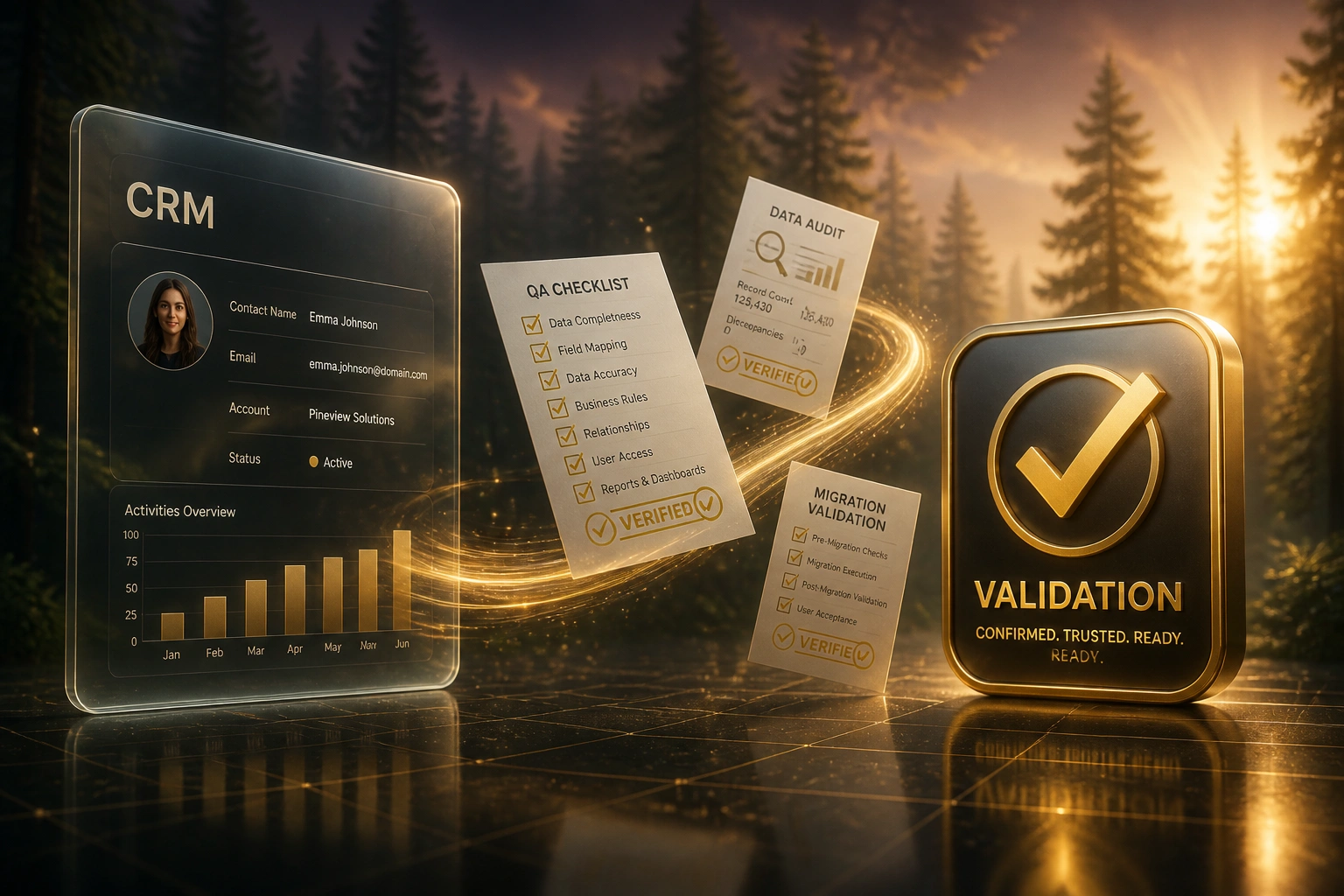
Sound Familiar?
These are the exact risks CEOs and CRM owners bring us when an import is treated as a finished migration:
- The import finished overnight, so leadership declared the migration done before anyone checked relationships or field values
- Record counts look close enough, but orphaned deals and broken contact-to-account links only show up when a rep opens a live account
- Board pipeline numbers drift from the old CRM within three weeks because stage values and ownership never got sampled
- Dual CRM licences get cancelled on day two to save cost, then rollback becomes impossible when corruption surfaces
- Edge cases (accents, HTML notes, null emails, multi-select custom fields) pass a clean sample and fail on the full load
Cancelling dual CRM licences before validation removes your rollback path. Teams that cut seats the morning after import save a few weeks of licence cost and risk months of remediation when associations, stages, or custom fields prove corrupted.
What Post-Migration Testing Actually Checks
Counts first, then samples, then relationships, then edge cases. Sign-off only when every gate passes.
Reconcile Record Counts
Every object matched to the frozen source baseline, with intentional exclusions listed
Sample Field Values
Risk-based samples plus full diffs on strategic accounts and open pipeline
Prove Relationships
Deal, contact, company, and activity links verified, not assumed from totals
Sign Off Go-Live
Written pack, dual-licence hold, then cancel the old CRM with confidence
Everything in the Migration Validation Suite
Record Count Reconciliation
Object-by-object totals for contacts, companies, deals, activities, and custom objects, reconciled against the pre-cutover baseline with expected exclusions documented.
Field Value Sampling
Risk-based samples across every object type, plus full field-level diffs on strategic accounts and top-of-pipeline deals so mapping bugs cannot hide in averages.
Relationship Integrity Checks
Deal-to-account, contact-to-company, and activity attachments verified. A matching row count means nothing if associations broke in transit.
Edge Case and Encoding QA
Special characters, HTML in notes, null required fields, truncated multi-selects, and silent import skips caught before users touch the system.
Pipeline and Report Parity
Stage totals, ownership, and board-pack reports compared to the frozen source snapshot so the first forecast after go-live is still trustworthy.
Written Go-Live Sign-Off
Binary go/no-go criteria, dual-licence hold until the audit window closes, and an audit pack your CEO can put in front of the board.
CRMs We Validate After Migration
From "Import Done" to Signed-Off Go-Live in 48 Hours
How a 45-seat professional services firm caught 3,200 orphaned deals and stage drift before cutting dual CRM licences.
Declared Done Too Early
- Migration vendor reported a successful full import and matching contact totals
- Leadership planned to cancel the old CRM on day two to stop dual licence spend
- No frozen baseline of pipeline totals or relationship counts existed for comparison
- A clean 40-record sample looked fine; edge cases and associations were never tested
- Board forecast prep was scheduled for the following Monday with no integrity gate
Validation Before Cutover
- Count reconciliation passed contacts, then failed on deal-to-account associations
- Field sampling exposed stage-name mismatches that would have skewed the board pack
- 3,200 orphaned deals flagged and remapped before any seats were cancelled
- Written go/no-go pack delivered inside 48 hours with binary sign-off criteria
- Old CRM held read-only for 72 hours, then cancelled at renewal with rollback still possible
Before vs After Migration Validation
How It Works
From first conversation to signed-off go-live, usually inside one working week for mid-market volumes.
Freeze the Baseline
We snapshot record counts, pipeline totals, and key reports in the source CRM before any cutover talk of "done".
Scope the Validation Suite
30-minute call to pick objects, sample sizes, relationship rules, and the go/no-go thresholds that protect dual licences.
Run Counts, Samples, Relationships
Full reconciliation, field sampling, association checks, and edge-case QA against the live import, with defects treated as systemic until proven otherwise.
Sign Off, Then Cut Licences
Written go-live pack, 72-hour dual-licence hold, then cancel the old CRM only when integrity is proven.
Frequently Asked Questions
Isn't a successful import enough to declare migration done?
No. Research on CRM migrations finds that about 40% hit significant issues, and up to 60% of those problems stem from inadequate testing rather than the import job itself. Row counts can match while associations, stage values, and consent flags drift. Import completion is a technical milestone. Validation is the business go-live gate.
What does post-migration CRM validation actually cover?
Four layers: record count reconciliation against a frozen baseline, risk-based field value sampling (plus full diffs on high-stakes records), relationship integrity across deals, contacts, companies, and activities, and edge-case QA for encoding, nulls, truncations, and silent skips. We finish with pipeline and report parity so the board forecast still means something.
How long should we keep dual CRM licences after cutover?
Keep the source CRM licensed and accessible until the post-migration audit window closes. Risk guidance for major system transitions treats dual-system cost during validation as standard mitigation, not waste. A practical floor is the 72-hour post-migration audit before you cancel seats. Cutting licences the morning after import removes your rollback path.
How long does a validation suite take?
A focused shadow-style pass on 500 to 1,000 representative records can take two to three hours and still surface mapping bugs that a clean 50-record sample misses. Full production validation after cutover typically lands in one to three working days depending on object count and volume, with a written sign-off pack at the end.
What if we already cancelled the old CRM?
You lose easy rollback, but validation still pays. We reconcile against any frozen export you kept, quantify corruption, and prioritise fixes that unblock sales and board reporting. Going forward, we recommend a 90-day artefact hold on exports and job logs even after seats cancel.
How much does post-migration validation cost?
Focused validation suites for mid-market CRMs typically land between R20,000 and R55,000. Larger multi-object environments with heavy custom fields sit higher. Against post-go-live remediation that routinely costs three to ten times pre-cutover cleanup, most clients recover the fee inside the first avoided cleanup cycle.
Do Not Cut Dual Licences on an Unproven Import
If your team is about to declare the migration done because the load finished, pause. Post-migration testing is cheaper than discovering corruption in a board forecast.
Tell us which CRMs you moved between, how many objects and records are in scope, and when dual licences are due to cancel. We will outline the validation suite and the go/no-go criteria that protect your cutover.