Cross-Reference Verification: Validating Records Against External Sources
Your CRM and ERP look tidy. Required fields are filled. Internally, nothing is blank. Then a payment fails, a credit decision collapses, or an auditor asks why a deregistered company still sits on the books. Internal-only validation is not enough when the real world has moved on.
We build automated cross-reference checks against trusted external sources so bad records never poison onboarding, credit, delivery, or audits.
Sound Familiar?
These are the exact issues our clients faced before external cross-reference verification:
- CRM and ERP customer records look complete, but CIPC shows the company deregistered or in liquidation
- Supplier VAT numbers pass a format check while SARS Vendor Search rejects them as inactive or unknown
- Bank details look valid by check digit, then AVS fails and debit orders or supplier payments bounce
- Ops spends hours a week clicking through BizPortal, SARS, and bank portals for the same three checks
- Credit and onboarding decisions run on stale director lists that no longer match Home Affairs or CIPC
FICA KYC and POPIA accountability expect evidence that company and personal records match independent sources. Manual BizPortal, SARS, and AVS screenshots do not scale when onboarding volume rises, and failed debit orders from bad banking details keep bleeding admin fees until Account Verification Service sits in the create path.
What Cross-Reference Verification Actually Does
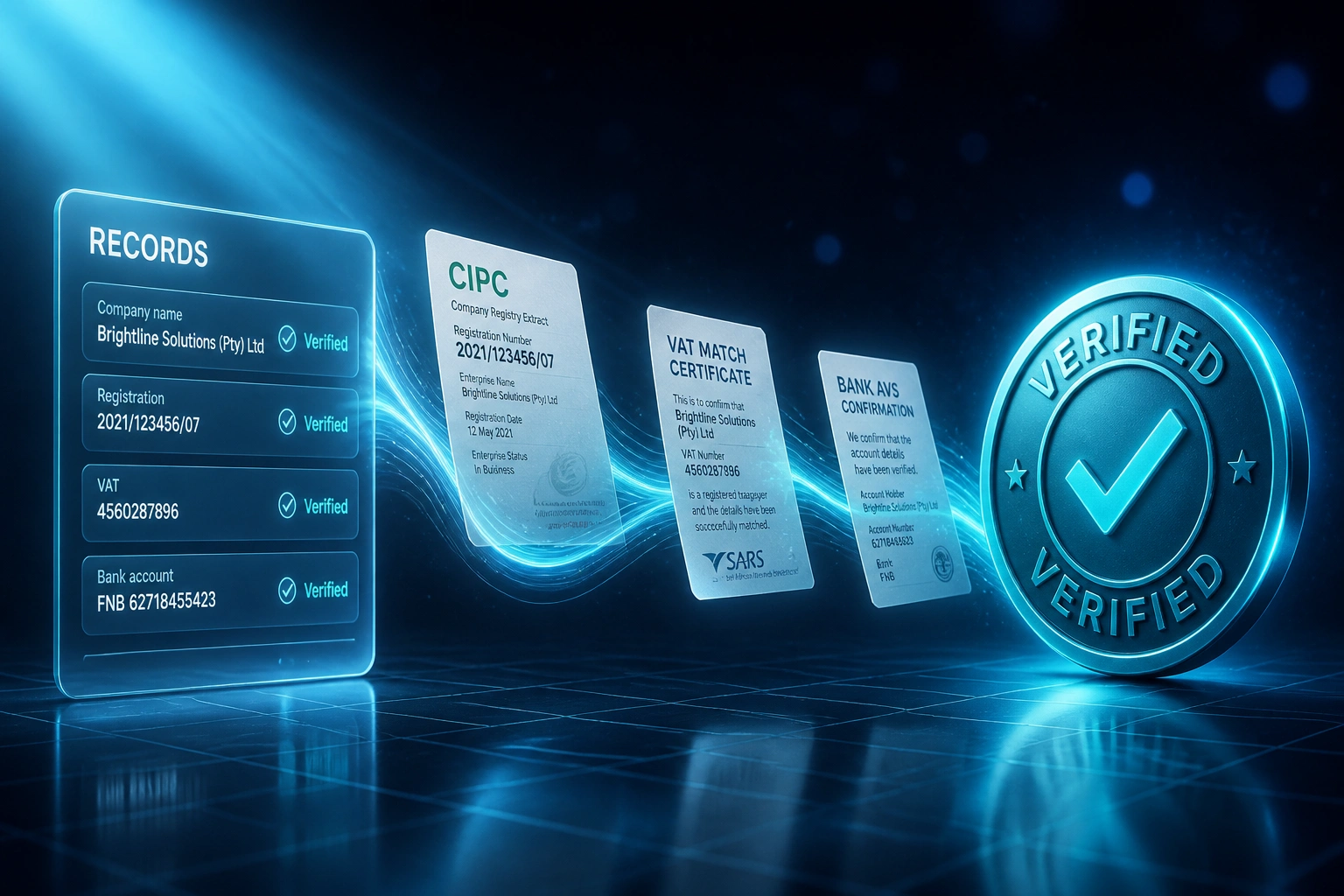
Record saved → external sources checked → match stamped or exception raised. No more three-portal scavenger hunts.
Record Created or Updated
A customer or supplier is saved in your CRM or ERP with registration, VAT, and bank fields
External Sources Queried
CIPC status, SARS VAT, bank AVS, and optional bureau or DHA checks run automatically
Match or Exception
Clean matches get a verified stamp. Mismatches and inactive entities enter a review queue
Ops and Audit Ready
Credit, AP, and compliance work from verified masters with source evidence on file
Everything You Need for Reliable External Validation
CIPC Company Status Checks
Every customer or supplier registration number is checked against CIPC for legal status, directors, and trading state before the record is trusted for credit, delivery, or payment.
SARS VAT Cross-Reference
Claimed VAT numbers are validated against the SARS VAT Vendor Search, so inactive or mismatched vendors never enter AP or invoicing as if they were live.
Bank AVS Confirmation
Account holder name, ID or registration number, and account status are verified through Account Verification Service before debit orders or supplier EFTs leave the building.
Director and Identity Match
Active directors and authorised signatories are matched to CIPC appointments and, where required, DHA identity status so departed or deceased parties no longer approve deals.
Bureau and Industry Registers
Where risk warrants it, we add credit-bureau and industry-register lookups so onboarding and credit decisions sit on the same verified master record, not a spreadsheet guess.
Exception Queues and Audit Trail
Clean matches write a verified stamp back to the CRM or ERP. Exceptions land in a review queue with source evidence for POPIA accountability and FICA examiner packs.
Systems We've Wired for External Checks
From 14 Hours/Week to 2.5 Hours/Week
How a national wholesale distributor stopped trusting internally clean supplier records and started verifying every one against CIPC, SARS VAT, and bank AVS.
The Manual Process
- Credit and ops staff opened BizPortal, SARS Vendor Search, and bank AVS for every new supplier
- Average 18 minutes per record across three portals, with screenshots pasted into a shared drive
- Roughly 50 new or changed suppliers a week, plus ad-hoc re-checks when payments failed
- Deregistered entities and mismatched bank accounts still entered the ERP when someone skipped a step
- Failed debit orders and returned EFTs generated bank fees and AP rework every month
The Verified Process
- Supplier create and update triggers automated CIPC, VAT, and AVS cross-reference checks
- 91% of records auto-clear with a verified stamp written back to the ERP
- Exceptions land in a queue with source evidence for credit to resolve once
- Bulk re-verification of the live book caught 47 deregistered or mismatched suppliers before the next payment run
- Debit-order and EFT failures from bad banking details dropped sharply once AVS sat in the create path
Before vs After External Validation
How It Works
From first conversation to live external checks in 3–6 weeks.
Map Your Trust Gaps
Which customer and supplier fields you rely on today, which external sources matter (CIPC, SARS, AVS, bureau), and where bad records already hurt cash or compliance.
Free Scoping Call
30-minute call with your COO, ops, or compliance lead to size the book, prioritise create-time vs bulk re-verification, and design exception handling.
Build & Parallel Test
We wire the cross-reference checks into your CRM or ERP, run them against a live sample, and compare outcomes to your current manual lookups.
Go Live & Monitor
New records verify automatically. Bulk remediation clears the backlog. Monitoring keeps match rates and source outages visible to ops.
Frequently Asked Questions
How is cross-reference verification different from checksum or file integrity checks?
Checksum pipelines prove a file was not corrupted in transit or storage. Cross-reference verification proves a business record still matches the real world: company status on CIPC, VAT status at SARS, bank ownership via AVS, and director identity. Your CRM can be byte-perfect and still hold a deregistered company with a stale VAT number.
Which external sources can you check against?
Typical South African builds cover CIPC (registration, status, directors), SARS VAT Vendor Search, bank Account Verification Service (AVS), and where needed Home Affairs DHA identity checks plus credit-bureau or industry registers. We match the source set to your risk and FICA profile, not a one-size checklist.
Will this slow down customer and supplier onboarding?
Most automated registry and AVS checks complete in seconds. Records that pass write a verified stamp and continue. Only mismatches, inactive entities, or source timeouts enter a human exception queue, so your team stops re-checking every clean record by hand.
How does this help with FICA, KYC, and POPIA?
FICA expects accountable institutions to verify juristic persons against reliable independent sources. POPIA accountability needs evidence that personal and company data you process is accurate and kept up to date. Automated cross-reference checks plus an audit trail of sources and timestamps give examiners and the Information Officer something stronger than a spreadsheet of manual portal screenshots.
Can you re-verify our existing customer and supplier book, not only new records?
Yes. Most clients run a bulk pass over the live master to catch deregistrations, director changes, and banking mismatches that crept in over years, then keep create and update hooks verifying every new change. Priority usually follows credit exposure and payment volume.
How much does cross-reference verification cost?
Focused create-time checks for CIPC, VAT, and AVS on one CRM or ERP typically start around R35,000. Broader builds with bulk re-verification, director matching, bureau lookups, and exception workflows usually land between R55,000 and R120,000. Against McKinsey's finding that 82% of organisations spend one or more days a week fixing master data issues, most mid-market teams see payback inside one quarter.
Stop Trusting Records That Only Look Clean Internally
If your customer and supplier masters have never been checked against CIPC, SARS VAT, and bank AVS at scale, you are carrying risk that format validation cannot see.
Tell us which systems hold the masters, which external sources matter for your risk profile, and where failed payments or audit findings already hurt. We will show you how automated cross-reference verification would work for your book.