Customer Reactivation Sequences: Bring Dormant Accounts Back to Life
Your CRM shows dormant accounts stacking up every week. Nobody has an automated path to wake them, so high-LTV customers go quiet while you keep paying for new acquisition that cannot match reactivation economics.
We build the value-segmented reactivation sequences that recover that revenue.
Sound Familiar?
These are the exact issues our clients faced before we automated reactivation:
- Dormant accounts pile up in the CRM while nobody owns a weekly reactivation review
- One flat discount blast goes to every lapsed buyer, burning margin on low-value segments
- Commerce and CRM disagree on who is truly dormant versus seasonally quiet
- High-LTV customers get the same offer as one-time buyers who never engaged
- Someone purchases mid-sequence and still receives the next incentive email
Every week you wait past the 30-day dormancy mark costs roughly 2–3 percentage points of reactivation rate. A customer quiet for 30 days is three to four times more likely to return than one quiet for six months. Paid acquisition costs keep climbing while that dormant LTV sits idle.
What the Reactivation Sequence Actually Does
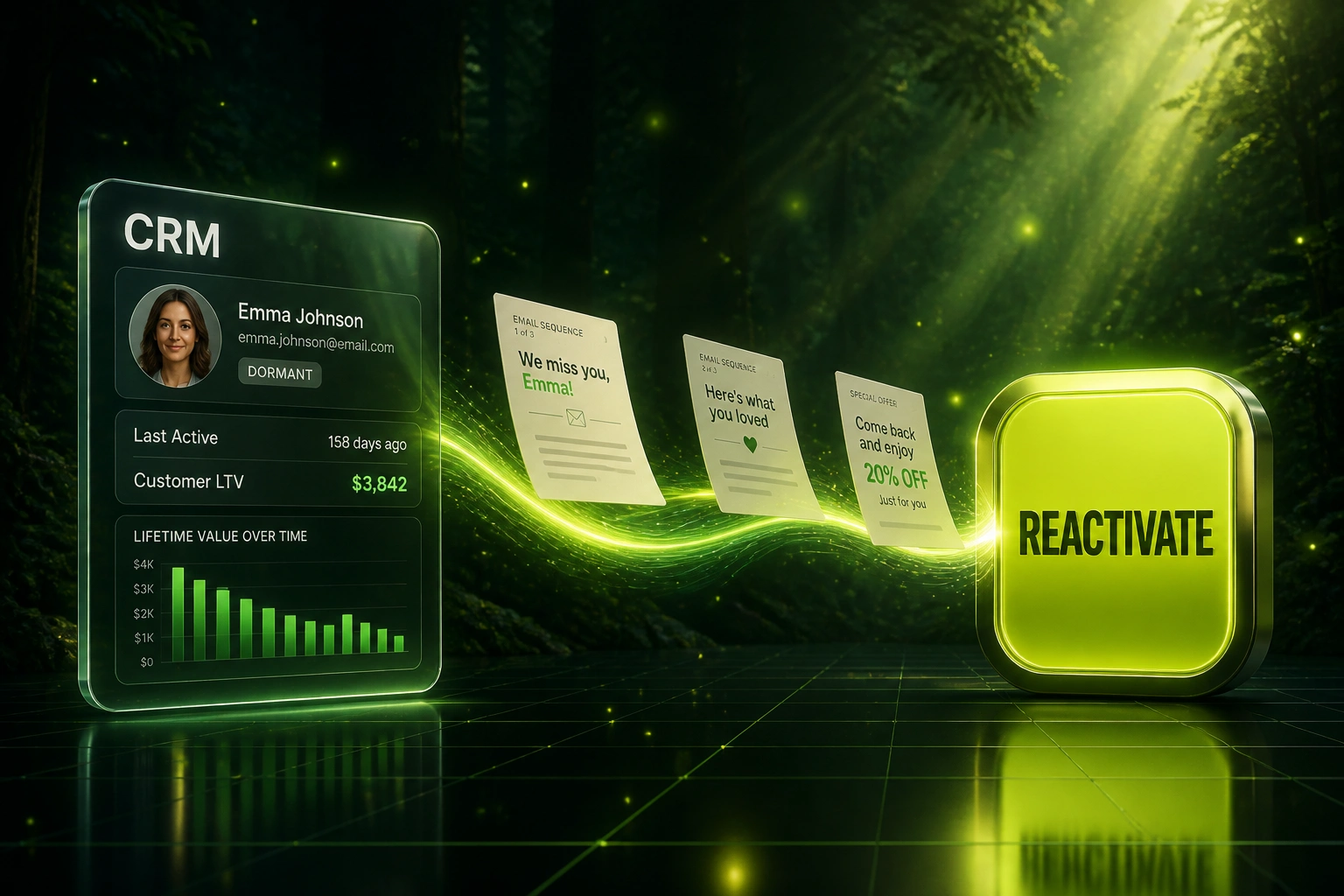
Detect dormancy → segment by value → run the incentive ladder → pause the moment they return.
Detect Dormancy
CRM and commerce signals flag accounts that have passed your repurchase interval
Segment by Value
RFM and LTV scoring assign each dormant account to the right incentive depth
Run the Ladder
Personalised reactivation email and WhatsApp steps escalate from soft nudge to capped offer
Pause on Return
Purchase or renewal exits the sequence instantly and logs recovered revenue
Everything You Need for Reliable Re-Engagement Automation
Dormancy Detection Rules
Trigger from CRM last-activity, last order, or product-usage signals at 2–3× your median repurchase interval, not a generic 90-day guess.
RFM & LTV Segmentation
Score dormant accounts by Recency, Frequency, and Monetary value so high-LTV cohorts get a deeper ladder and low-value segments get a light touch or sunset.
Incentive Ladder Sequences
Multi-step reactivation email and WhatsApp flows that start soft, escalate incentives by segment, and reserve the deepest offer for the final step.
Pause-on-Purchase Logic
The moment an order lands or a subscription renews, the sequence stops. No awkward "we miss you" after they already came back.
Channel Orchestration
Email for depth, WhatsApp or SMS for urgency on opted-in high-value accounts, with shared journey state so channels never collide.
Sunset & Deliverability Guardrails
Non-responders exit to a re-permission ask or suppression list, protecting sender reputation while your active list stays clean.
Platforms We've Wired into Reactivation Sequences
From 4% Flat Blasts to 19% Sequence Reactivation
How a Gauteng ecommerce brand recovered R2.8M from dormant accounts in 90 days with value-segmented reactivation sequences.
The Manual Process
- Customer success exported a 90-day dormant list once a month
- Marketing sent one flat 15% off reactivation email to everyone
- High-LTV buyers and one-time purchasers got the same incentive
- Customers who purchased mid-blast still received follow-up discounts
- No WhatsApp path for opted-in VIP dormant accounts
The Automated Sequence
- Dormancy fires from Shopify last-order and HubSpot last-activity at 2× repurchase interval
- RFM tiers route VIPs to a deeper ladder and low-value segments to a soft sunset
- Four-step email sequence with WhatsApp on step three for opted-in high-LTV contacts
- Any order instantly pauses the remaining steps and tags recovered revenue
- Non-responders exit to suppression after the final ask
Before vs After Reactivation Automation
How It Works
From first conversation to live reactivation sequences in 2–4 weeks.
Map Your Dormancy Signals
Which CRM fields, order events, and product signals define "asleep" for your repurchase cycle.
Free Scoping Call
30-minute call to design RFM tiers, incentive depth by value, and the pause-on-return rules.
Build & Test
We build the sequences, test with a dormant cohort, and validate that purchases correctly exit the flow.
Go Live & Monitor
Sequences run on autopilot. Dashboards track reactivation rate, revenue recovered, and list hygiene.
Frequently Asked Questions
How is a reactivation sequence different from a one-off win-back campaign?
A reactivation sequence is always-on ops: dormancy detection from CRM and commerce signals, value-based segmentation, and a multi-step incentive ladder that pauses the moment someone returns. A win-back campaign is a scheduled, offer-led blast to a lapsed list. We build the sequence layer so dormant accounts are handled continuously, not only when someone remembers to pull a list.
How do you decide who is dormant?
We anchor dormancy to your median repurchase or engagement interval, typically triggering at roughly 2–3× that window, then refine with CRM last-activity and commerce last-order fields. A furniture buyer at 90 days is not dormant; a weekly grocery subscriber at 90 days almost certainly is.
Will high-value customers get different incentives than one-time buyers?
Yes. RFM and LTV scoring drive incentive depth. Historically valuable dormant accounts earn a richer ladder; low-value or one-time buyers get lighter offers or an earlier sunset. That protects margin while concentrating spend where recovery ROI is strongest.
Which channels do you support for reactivation?
Email is the backbone for most sequences. For opted-in contacts in South Africa we often add WhatsApp or SMS on later steps for high-LTV segments, because multi-channel reactivation consistently outperforms email-only. Everything shares one journey state so a purchase or reply stops the remaining touches.
How long does a reactivation sequence build take?
A focused dormancy-detect → segment → ladder → pause build typically takes 2–4 weeks from scoping to go-live. Complex multi-brand catalogues or multi-ESP setups take closer to 4–6 weeks.
How much does a customer reactivation sequence cost?
Simple one-way email ladders start from around R15,000. Value-segmented multi-channel sequences with CRM and commerce triggers typically range from R25,000 to R60,000. Most clients with a meaningful dormant pool see payback within one or two reactivation cycles.
Stop Leaving Dormant Revenue on the Table
If dormant accounts keep accumulating while your team only runs occasional win-back blasts, you are paying acquisition prices for growth you already own.
Tell us which CRM and commerce stack you run, how you currently define dormancy, and where high-LTV accounts go quiet. We will show you exactly how a value-segmented reactivation sequence would work for your business.