Customer Success Automation: Scale CS Without Scaling Headcount
Your ARR is climbing. Your CSM book is not getting smaller. Manual check-ins, health monitoring, and escalations cannot keep pace, so strategic work loses to admin and burnout.
We build the success workflows that run the routine so your team only touches high-value moments.
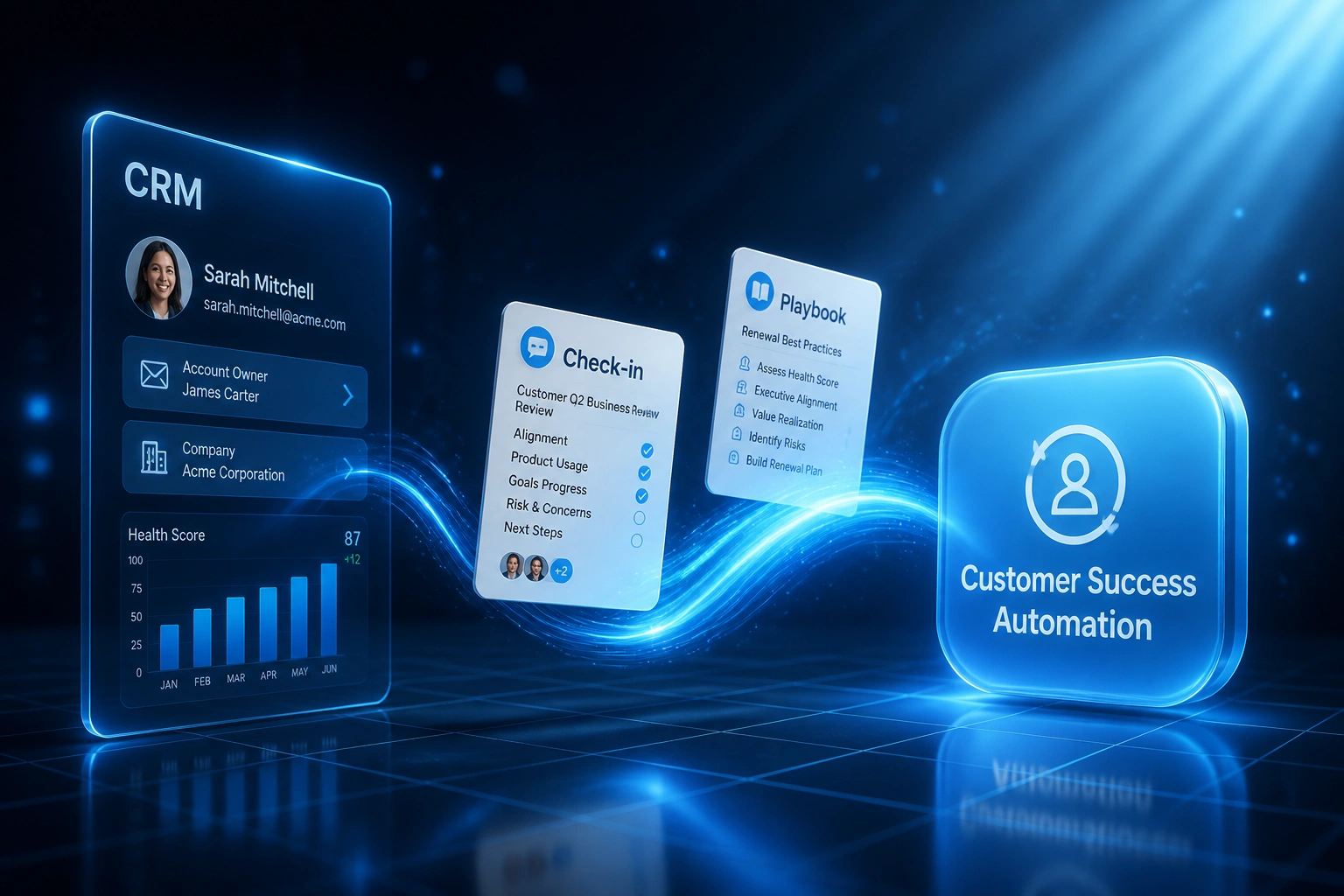
Sound Familiar?
These are the exact issues Heads of CS and COOs bring us when CS scaling stalls:
- ARR is growing faster than CS headcount, so every CSM absorbs more accounts without more hours in the week
- Scheduled check-ins slip when the book gets heavy, and customers only hear from you when something is already wrong
- Health signals live in product, billing, and support tools, but nobody turns a red score into a playbook task the same day
- Escalations route by whoever notices Slack first, not by severity, ARR, or renewal window
- QBR prep still means a late-night scrape of usage charts, ticket history, and CRM notes for every account
ARR per CSM is up about 20% since 2022 while account loads jumped 50% (Gainsight Benchmarks). Hiring alone cannot close that gap. Without CS automation, missed check-ins and late escalations become logo churn while your best people burn out.
What Customer Success Automation Actually Does
Signal → playbook → routed task → human only when judgment matters. Routine CS work stops living in calendars and Slack threads.
Signal Fires
Cadence date, health drop, payment flag, or renewal window triggers the workflow
Playbook Opens
Check-in sequence, save play, or escalation path starts with owners and due dates
Work Routes
CRM tasks, Slack alerts, and QBR prep packs land with the right CSM or lead
Humans Engage
CSMs spend time on QBRs, saves, and expansions instead of chasing admin
Everything You Need for CS Efficiency at Scale
Scheduled Check-In Cadence
Cadence rules fire check-in tasks and messages by segment and renewal window so routine touches happen on time without a CSM remembering every date.
Health-Triggered Playbooks
When health drops, usage stalls, or payments slip, the matching playbook opens tasks, owners, and next steps automatically in the CRM.
Escalation Routing
Severity, ARR, and renewal proximity decide who gets the alert. Critical accounts reach a lead or manager without waiting for a Monday review.
QBR Prep Nudges
Thirty to sixty days before a business review, the system gathers usage, support, and commercial highlights into a prep pack so CSMs start from a draft, not a blank slide.
Task Creation Across Systems
Playbook steps write CRM tasks, Slack or email alerts, and follow-up reminders so success workflows do not die in a spreadsheet.
Capacity Without Linear Hiring
Routine CS work runs in the background so one CSM covers more accounts while human time stays on high-value conversations, expansions, and saves.
Platforms We Wire Into Success Workflows
From 32 Accounts to 55 Without a New Hire
How a mid-market SaaS CS team automated check-ins, health playbooks, and escalations so four CSMs absorbed ARR growth without linear hiring.
The Manual CS Operating Mode
- Four CSMs carrying about 32 mid-market accounts each, with ARR growth outpacing hiring
- Check-ins lived in personal calendars; quiet accounts went weeks without a touch
- Health dips surfaced in Slack after the fact, not as owned playbook tasks
- QBR prep took half a day per account of chart scraping and CRM archaeology
- Escalations depended on who was online, not on severity or renewal proximity
The Automated Success Workflows
- Cadence rules fire check-ins by segment; missed touches trigger a follow-up task automatically
- Amber and red health open the matching save playbook with owner, due date, and context
- Critical escalations route to a CS lead within minutes, with ARR and renewal window attached
- QBR prep packs assemble usage, tickets, and commercial notes 45 days out
- Same four CSMs now cover about 55 accounts each without a fifth hire
Before vs After CS Automation
How It Works
From first conversation to live success workflows in 3–6 weeks.
Tell Us Your Setup
Book size per CSM, which CRM and CS tools you use, and which check-ins, escalations, and QBR steps still run by hand.
Free Scoping Call
30-minute call with your Head of CS or COO to map segments, playbooks, and the first automations that free the most hours.
Build & Test
We wire check-in cadences, health playbooks, escalation rules, and QBR prep, then run parallel with your team for a full cycle.
Go Live & Monitor
Manual reminders switch off. We tune triggers and routing as account loads and retention metrics move.
Frequently Asked Questions
How is customer success automation different from a health score dashboard?
A health dashboard shows risk. Customer success automation is the operating system that acts on that risk: scheduled check-ins, health-triggered playbooks, escalation routing, QBR prep nudges, and task creation so CSMs spend time on high-value moments instead of chasing routine work. Many clients run both together.
Will this replace Gainsight, Totango, or ChurnZero?
Not necessarily. If you already own a CS platform, we connect it to your CRM, product, and support tools and fill the gaps those suites leave: custom playbooks, South African stack quirks, and routing rules your team actually follows. If you are not ready for a full CS suite, we build the success workflows you need on the tools you already pay for.
How many more accounts can one CSM cover with CS automation?
Industry loads have already risen from about 26 to 40 accounts per CSM between 2022 and 2024 (Gainsight Benchmarks). Low-touch and automated motions commonly support 100+ accounts. Clients who automate check-ins, playbooks, and escalations typically lift mid-market capacity by 40–70% without adding headcount, provided segments and playbooks are clear.
How long does CS automation take to implement?
Most programmes take 3–6 weeks from scoping to go-live: cadence design, health triggers, escalation matrix, QBR prep pack, and a parallel week with your CSMs. A single high-pain playbook (for example at-risk escalation only) can be live in about two weeks.
Will CSMs feel replaced by automation?
No. Automation removes the admin that burns people out: chasing check-in dates, assembling QBR decks, and hunting for who should own an escalation. Humans keep renewals, executive relationships, expansion conversations, and judgment calls. That is how you scale CS without scaling burnout.
How much does customer success automation cost?
Focused success workflow builds typically range from R35,000 to R85,000 depending on how many systems and playbooks you need. Against a South African CSM salary averaging about R450,000 a year (PayScale), deferring even one hire usually pays for the project many times over within the first quarter of recovered capacity and retained revenue.
Stop Hiring Linearly Against ARR Growth
If your CSMs are drowning in check-ins, health chase work, and QBR prep while the book keeps growing, you have a systems problem, not a headcount problem.
Tell us your CSM-to-account load, which tools hold health and usage, and which success workflows still run by hand. We will show you how customer success automation would free capacity without a hiring binge.