Disaster Recovery Planning for Business Systems: Tested Failover, Not Theatre
You have lived through CRM or accounting downtime. Sales freezes, invoices stall, payments pile up, and the "DR plan" turns out to be a PDF nobody rehearsed. Business continuity only works when failover has been drilled.
We build and drill the failover so your integrations resume without data loss.
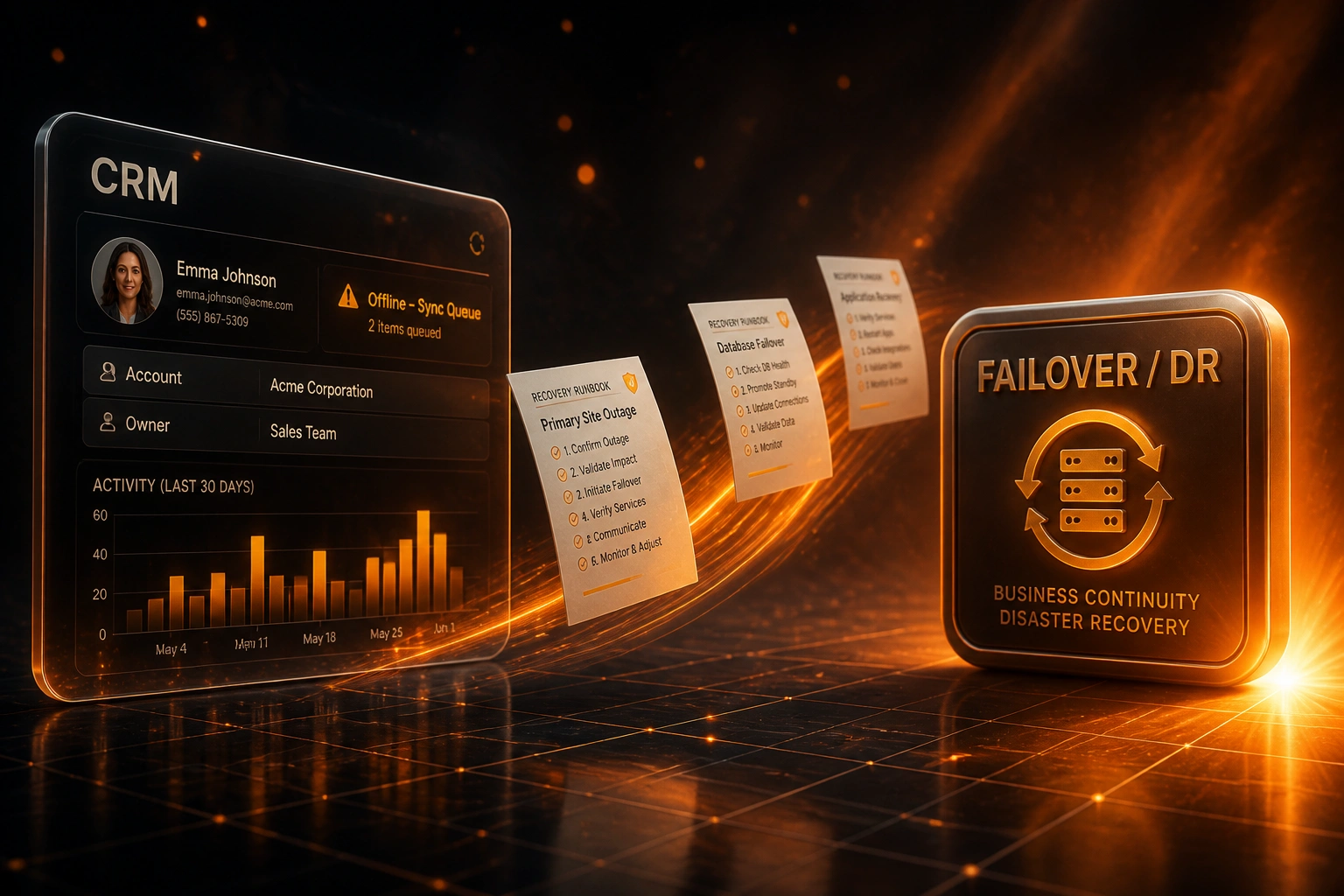
Sound Familiar?
These are the exact continuity gaps our clients faced before we built and drilled failover:
- The disaster recovery plan is a PDF nobody has opened since onboarding
- CRM, accounting, and payment syncs stall during load shedding or a cloud outage, with no queue to catch up
- Nobody can name the RTO or RPO for HubSpot, Xero, or the payment gateway
- Failover was never drilled, so the first real outage becomes improvisation under pressure
- After the systems come back, finance spends days reconciling deals, invoices, and payments that drifted apart
The July 2024 CrowdStrike outage cost Fortune 500 firms about R89 billion in direct losses (Parametrix / US$5.4 billion at ~R16.54). Peak retail season and the next cloud-region or load-shedding stack are not the time to discover your failover has never been rehearsed.
What Business Continuity Actually Looks Like
Outage hits → queue holds → failover drills → systems resume in order. No improvisation on the trading floor.
Outage Detected
CRM, accounting, or payment path goes offline: load shedding, API failure, or cloud incident
Sync Queue Holds
Deals, invoices, and payments queue safely instead of vanishing mid-flight
Failover Runs
Runbook steps fire: confirm impact, switch path, verify services against RTO/RPO
Systems Catch Up
Queue drains in order. CRM, accounting, and payments reconcile before you call it closed
Everything You Need for Continuity Across Connected Systems
RTO and RPO Targets
Agreed recovery time and recovery point objectives for CRM, accounting, and payments, written into the runbook so ops knows what "good" looks like.
Backup Sync Queues
When HubSpot, Xero, or a payment provider drops offline, transactions queue safely and replay in order once connectivity returns. No silent data loss.
Tested Failover Paths
Primary and secondary routes for critical integrations. We design and prove failover, not just document it.
Recovery Runbooks
Step-by-step playbooks for outages: who confirms impact, who initiates failover, who verifies CRM and accounting parity, who communicates to the business.
Failover Drills
Scheduled rehearsals that treat the plan like a fire drill. Untested DR is theatre. We break it on purpose so production does not.
Post-Incident Reconciliation
After recovery, automated checks confirm deals, invoices, and payments still match across systems before you call the incident closed.
Systems We Cover in Continuity Work
From 11 Hours Offline to 18-Minute Failover
How a Cape Town distributor stopped losing orders when HubSpot and Xero went dark during stacked load shedding and an API outage.
The Untested Plan
- DR document existed; nobody had run a failover drill in 18 months
- Stage 6 load shedding plus a CRM API outage left HubSpot unreachable for 11 hours
- Deals and invoice syncs failed mid-flight with no backup queue
- Finance spent three days reconciling Xero against the CRM by hand
- Similar incidents that quarter cost roughly R480,000 in delayed and lost orders
The Drilled Failover
- RTO of 30 minutes and RPO under 5 minutes agreed and written into the runbook
- Backup sync queue held CRM and accounting traffic during the next outage
- Failover drill proven before peak season; live failover completed in 18 minutes
- Queue drained in order; deal and invoice parity confirmed automatically
- Ops lead followed a six-step runbook instead of improvising on WhatsApp
Before vs After Tested Failover
How It Works
From first conversation to a drilled failover in 3–5 weeks.
Map Critical Systems
Which CRM, accounting, and payment paths must survive an outage, and what downtime already costs you.
Free Scoping Call
30-minute call with your CEO or ops lead to set RTO/RPO targets and identify the highest-risk failure points.
Build and Drill
We implement queues, failover paths, and runbooks, then run a live failover drill with your team before go-live.
Live Continuity
Monitoring, alerting, and a rehearsal cadence so the plan stays accurate as your stack changes.
Frequently Asked Questions
What does disaster recovery for business systems actually cover?
It is continuity for the integrations that keep revenue moving: CRM, accounting, and payments. We define RTO and RPO targets, build backup sync queues, document failover runbooks, and drill the plan so an outage does not become a multi-day scramble.
How is this different from cloud backups or a vendor SLA?
Backups restore files. Vendor SLAs cover their uptime, not your cross-system sync. Business continuity for integrations is about what happens when HubSpot, Xero, or a payment gateway is unreachable, and how deals, invoices, and payments catch up without data loss.
Does this help with South African load shedding?
Yes. Load shedding and unstable connectivity are common outage triggers here. Queue-based sync and rehearsed failover mean CRM and accounting catch up when power and connectivity return, instead of losing transactions mid-flight.
How often should we run a failover drill?
At least twice a year for critical paths, and after any major stack change. Industry surveys show about 65% of organisations fail their first DR test, and roughly 23% never test at all. Rehearsal is how you find broken steps before a real outage does.
Will drills disrupt live trading?
No. We design drills against secondary paths and controlled windows so production keeps running. The goal is proof under realistic conditions, not a surprise shutdown of your sales day.
How much does a business systems DR programme cost?
Focused continuity for one CRM-to-accounting sync path typically starts around R35,000. Full RTO/RPO design, queues, runbooks, and drills across CRM, accounting, and payments usually lands between R55,000 and R120,000. Against six-figure hourly downtime exposure, most mid-market teams see payback inside a single avoided multi-hour outage.
Make Disaster Recovery Something You Can Prove
If your continuity plan has never survived a drill, the next outage will write the review for you.
Tell us which CRM, accounting, and payment systems keep revenue moving, what an hour of downtime costs you, and when you last tested failover. We will show you what a rehearsed recovery path looks like for your stack.