E-commerce Tax Automation for South Africa: Correct VAT on Every Basket
Your store sells food, books, digital goods, and standard merchandise in the same cart. Flat tax settings miscalculate VAT, B2B and export customers get the wrong treatment, and invoices that look wrong destroy trust before SARS ever opens an audit.
We build the automated tax rules that calculate correctly at checkout and sync tax lines to Xero or Sage.
Sound Familiar?
These are the exact issues South African ecommerce finance and ops teams bring us:
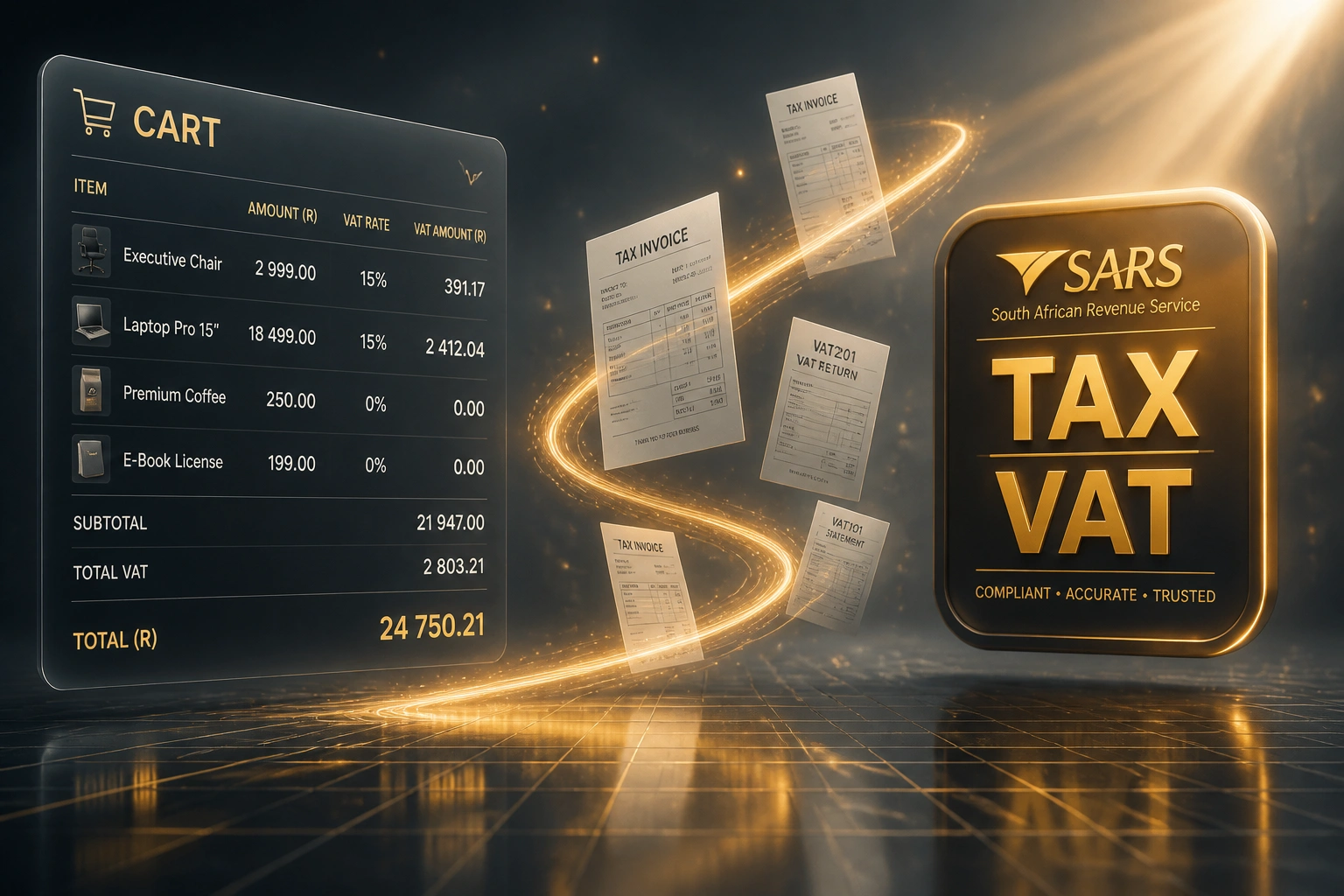
- Mixed baskets charge 15% VAT on zero-rated food or books, or miss it on standard goods
- B2B customers with valid VAT numbers still get charged VAT at checkout
- Export orders to foreign customers get taxed as domestic supplies
- Shopify and WooCommerce apply a flat rate that does not match SARS product categories
- Finance spends days rebuilding VAT201 from order exports because tax lines in Xero and Sage do not match the store
Incorrect VAT on tax invoices and VAT201 returns invites SARS audits, understatement penalties from 10% upward, and customers who stop trusting your brand. Flat Shopify or WooCommerce tax settings cannot specialise for mixed SA product categories, B2B vendors, and exports on their own.
What Ecommerce Tax Calculation Actually Does
Cart builds → VAT rules fire → tax invoice issued → ledger tax lines match. No manual tax coding between store and accounting.
Customer Checks Out
Mixed basket hits Shopify or WooCommerce with product, customer type, and ship-to country
VAT Rules Apply
Each line gets 15%, zero-rated, exempt, B2B, or export treatment per SARS-aligned rules
Tax Invoice Issued
Compliant tax invoice shows rate breakdown, VAT numbers, and correct totals in Rand
Sync to Xero / Sage
Tax lines and codes land in the ledger so VAT201 prep matches checkout reality
Everything You Need for Reliable VAT Automation
SARS-Aligned Tax Rules
Product categories map to standard-rated (15%), zero-rated, and exempt treatments so every checkout line follows the VAT Act, not a flat store rate.
Mixed Basket Calculation
Food, books, digital goods, and standard merchandise in one cart each get the correct VAT. Totals and tax invoices stay accurate for the customer and for SARS.
B2B Exemption Handling
Valid vendor VAT numbers trigger the right treatment at checkout. Invalid or missing numbers fall back to standard-rated so you do not under-collect by accident.
Export Zero-Rating
Ship-to country and export documentation drive 0% on qualifying international orders, with an audit trail ready for SARS verification.
Accounting Tax Line Sync
Correct VAT amounts and tax codes post into Xero or Sage with each order, so VAT201 prep pulls from the ledger instead of spreadsheet rebuilds.
Compliant Tax Invoices
Section 20 fields, vendor and customer VAT numbers, and rate breakdowns land on every tax invoice. Shopify's default confirmation is not enough on its own.
Platforms We've Wired for SA Tax Calculation
From 18 Hours of VAT201 Prep to Under 2
How a Cape Town multi-category retailer stopped wrong VAT on mixed baskets and made Xero tax lines match every checkout.
The Manual Process
- Shopify charged flat 15% across food, books, digital, and standard goods
- Finance re-coded roughly one in eight orders before posting to Xero
- B2B and export orders needed spreadsheet overrides after the fact
- VAT201 prep took 18 hours each cycle matching store exports to the ledger
- Customer complaints when tax invoices showed VAT on zero-rated lines
The Automated Process
- Checkout rules apply 15% or 0% per line from the product tax map
- B2B VAT numbers and export ship-to drive the correct treatment automatically
- Tax invoices show a clean rate breakdown customers and SARS can trust
- Xero receives matching tax codes and amounts with every order
- Finance reviews exceptions only; VAT201 prep dropped under 2 hours
Before vs After VAT Automation
How It Works
From first conversation to live VAT rules in 2–4 weeks.
Map Your Tax Rules
Which products are zero-rated, how B2B and exports work, and which ledger tax codes Xero or Sage already use.
Free Scoping Call
30-minute call to design checkout rules, exception handling, and how tax lines sync into accounting.
Build & Parallel Test
We wire the tax engine and accounting sync, then run parallel against live orders until VAT matches your accountant's expectations.
Go Live & Monitor
Switch off manual tax coding. Alerts catch misclassified SKUs and failed syncs before the next VAT201.
Frequently Asked Questions
What is ecommerce tax automation for South Africa?
It is a rules engine on your Shopify or WooCommerce checkout that applies SARS-aligned VAT treatments per line item (15% standard, 0% zero-rated, exempt, B2B, and export), then syncs those tax lines into Xero or Sage so VAT201 returns match what customers were charged. It is not a flat 15% store setting and not a spreadsheet after the fact.
Does Shopify handle South African VAT correctly on its own?
Shopify can charge a 15% VAT rate and display VAT-inclusive prices, but it does not natively apply SARS product-category rules for mixed baskets, reliable B2B vendor treatment, or export zero-rating with supporting documentation. Its default order confirmation is also not a valid Section 20 tax invoice. Most SA stores need custom rules plus a proper tax invoice template or app.
How do you treat zero-rated versus standard-rated products?
During setup we map your catalogue to SARS categories: standard-rated at 15%, zero-rated items such as qualifying basic foodstuffs and exports, and exempt supplies where they apply. Each line in a mixed basket is calculated independently, then totals and tax invoice breakdowns reflect the correct mix.
Will tax amounts sync into Xero and Sage?
Yes. Every order posts with the correct VAT amount and tax code so output tax in the ledger matches checkout. Finance stops re-coding tax lines from CSV exports. We map to your existing Xero or Sage tax rates and account codes during scoping.
What happens if SARS audits our VAT?
Automated rules produce a consistent trail from product tax code to checkout line to ledger entry to tax invoice. That is the evidence auditors ask for when mixed baskets, exports, or B2B supplies look wrong. Manual tax coding rarely survives the same scrutiny.
How much does ecommerce VAT automation cost?
Focused checkout rule engines with one-way sync into Xero or Sage start from around R25,000. Setups covering mixed categories, B2B exemptions, export zero-rating, and bidirectional ledger reconciliation typically range from R40,000 to R75,000. Teams reclaiming a full day of VAT201 prep each cycle usually see payback within two to four months.
Stop Guessing VAT on Mixed Baskets
If your team is still overriding tax after checkout or rebuilding VAT201 from spreadsheets, you are paying for a compliance risk that automated tax rules already solve.
Tell us which storefront you run, how your catalogue splits across standard-rated and zero-rated goods, and whether B2B or export customers are part of the mix. We will show you exactly how ecommerce tax automation would work for your organisation.