EMP501 Annual Reconciliation: Twelve Months, One Controlled Close
Every year your payroll has to prove that twelve EMP201 months, the payments on the SARS statement, and every IRP5/IT3(a) total agree. Manual EMP501 reconciliation turns April into a forensic scramble, and a late or rejected return attracts penalties of 1% of annual PAYE, rising monthly to 10%.
We build the structured workflow that resolves variances before the SARS annual filing deadline.
Sound Familiar?
These are the exact issues our clients faced before a structured EMP501 workflow:
- April arrives and payroll still has twelve EMP201 months, a SARS statement of account, and IRP5/IT3(a) drafts that refuse to balance
- Mid-year joiners, leavers, fringe benefits, and corrected payslips create variances that only surface when the EMP501 is nearly due
- Certificate totals disagree with monthly EMP201 history, so someone spends nights hunting source-code differences in spreadsheets
- A rejected e@syFile submission counts as not filed, and the 31 May deadline keeps moving closer
- Employees cannot get clean IRP5s on time, which delays their ITR12 returns and lands complaints on the CFO's desk
SARS treats a rejected EMP501 as not submitted. Missing or invalid Income Tax Reference Numbers, unbalanced certificate totals, or incomplete EMP201 history can push you past 31 May and into the 1%–10% administrative penalty ladder.
What the EMP501 Reconciliation Workflow Actually Does
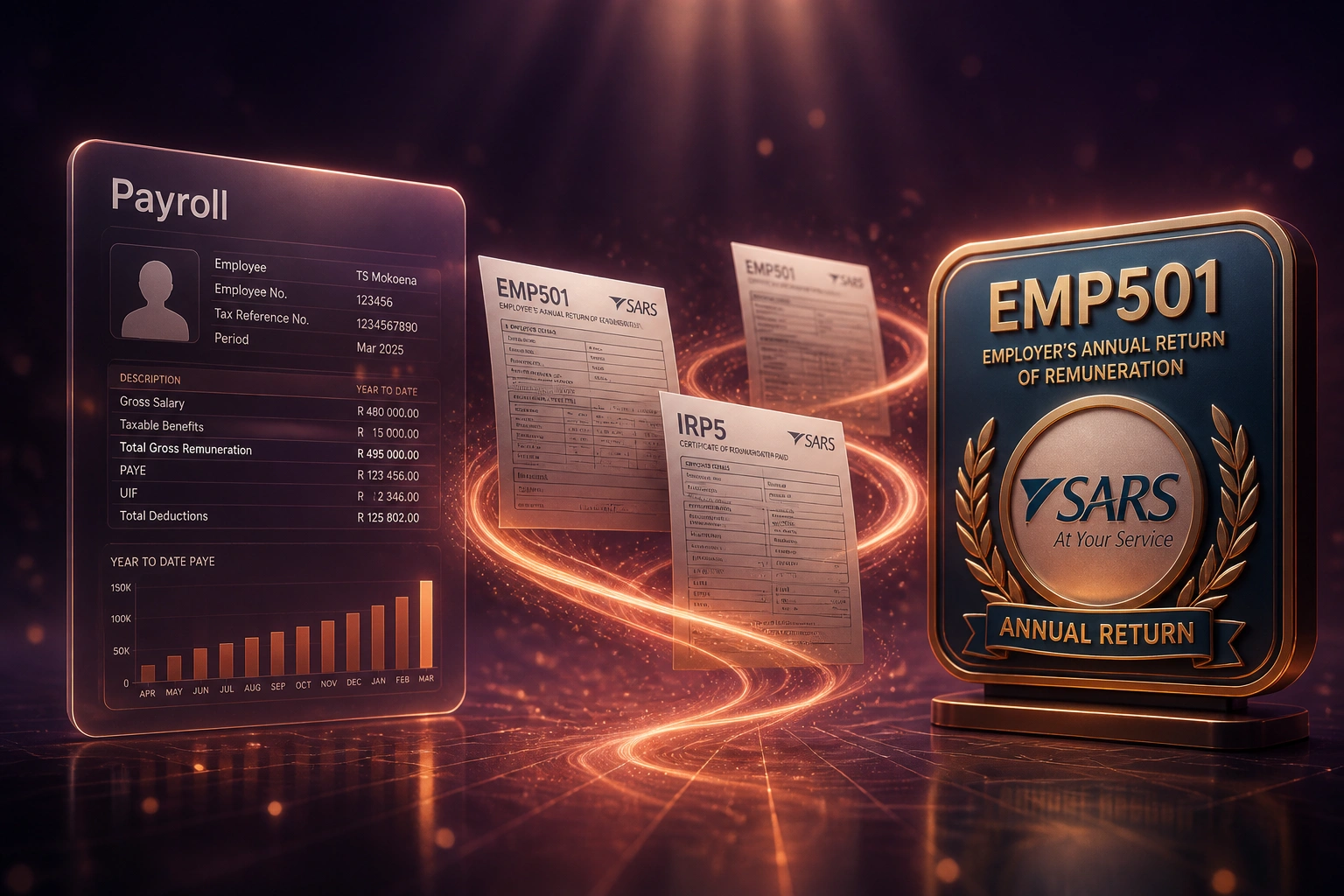
Tax year closes → twelve months roll up → certificates match → variances cleared. No spreadsheet archaeology in May.
Tax Year Closes
February payroll finalises; year-to-date liabilities and certificate drafts are locked from payroll
Twelve EMP201s Roll Up
Monthly PAYE, UIF, SDL, and ETI totals assemble against declared EMP201 history and payments
Certificates Matched
IRP5/IT3(a) aggregates are checked; joiners, leavers, and fringe-benefit variances queue for review
Submission Pack Ready
Validated EMP501 and certificates go to eFiling or e@syFile before the May deadline
Everything You Need for Annual Payroll Reconciliation
Twelve-Month EMP201 Rollup
Payroll year closes → all twelve EMP201 months assemble into a single EMP501 working pack, with PAYE, UIF, SDL, and ETI totals already aligned to declared liabilities.
IRP5 / IT3(a) Certificate Matching
Certificate totals are checked against EMP201 history and payments before anything reaches eFiling or e@syFile, so mismatches surface while there is still time to fix them.
Variance Exception Queue
Joiners, leavers, fringe benefits, and mid-year corrections appear as named exceptions. Finance reviews the outliers, not every employee line.
SARS Payment Cross-Check
Declared liabilities are matched to payments recorded on the SARS statement of account (excluding penalties and interest), closing the three-element reconciliation loop.
Multi-Payroll Mapping
SimplePay, Sage Payroll, PaySpace, or a custom HRIS map into the same annual reconciliation structure, including source codes and ETI claims.
Deadline-Ready Submission Pack
A validated EMP501 pack and certificate file are ready for eFiling or e@syFile well before 31 May, with an audit trail your FD can stand behind.
Payroll Systems We've Connected for EMP501
From 48 Hours to a Three-Hour Controlled Close
How a 180-employee Gauteng employer stopped treating EMP501 season like a crisis and filed two weeks before the SARS May deadline.
The Manual Process
- Payroll and finance rebuilt twelve EMP201 months in shared spreadsheets every April
- IRP5 drafts disagreed with monthly totals on fringe benefits and mid-year leavers
- Two e@syFile rejections for invalid tax reference numbers ate the last week of May
- FD stayed late resolving source-code variances the night before the deadline
- Employees chased the company for corrected certificates after auto-assessment season
The Structured Workflow
- Year-end payroll extract rolls twelve EMP201 months into one working pack overnight
- Variance queue lists only the employees whose certificates disagree with EMP201 history
- Tax reference and certificate checks run before anything hits e@syFile
- Finance reviews exceptions in a morning; the pack is ready days later, not weeks
- IRP5s issue on time, and employee ITR12 pre-population stays clean
Before vs After EMP501 Automation
How It Works
From first conversation to a live EMP501 workflow in 2–4 weeks.
Tell Us Your Setup
Which payroll system, how many employees, and where last year's EMP501 reconciliation got stuck.
Free Scoping Call
30-minute call to map your annual close, identify variance risk, and design the reconciliation workflow.
Build & Test
We build the workflow, test against a closed tax year, and run a parallel EMP501 pack before go-live.
Go Live & Monitor
Switch off the April scramble. Alerts keep the May filing window and interim October reconciliation visible.
Frequently Asked Questions
How long does an EMP501 annual reconciliation workflow take to set up?
A standard payroll-to-EMP501 reconciliation flow takes 2–4 weeks from scoping to go-live. Simpler one-way packs from a single payroll system can be live within a week. Multi-branch payrolls with ETI, fringe benefits, and prior-period corrections take closer to 4–6 weeks.
How does EMP501 relate to our monthly EMP201 filings?
EMP201 is the monthly declaration and payment of PAYE, UIF, and SDL. EMP501 is the bi-annual reconciliation that rolls those months up and matches them to payments and IRP5/IT3(a) certificate totals. A clean annual EMP501 depends on twelve months of EMP201 history that already agrees with payroll.
When is the EMP501 annual deadline?
The Employer Annual Declaration season typically runs from 1 April to 31 May. For the 2025/2026 tax year (1 March 2025 to 28 February 2026), SARS confirmed the deadline as 31 May 2026 via eFiling or e@syFile Employer. Employers with more than 50 employees must use e@syFile.
What are the penalties for a late or rejected EMP501?
Late submission attracts administrative penalties equal to 1% of your annual PAYE liability, rising by 1% for every month the return remains outstanding, up to a maximum of 10%. A rejected submission due to errors is treated as not submitted, so accuracy and timeliness both matter.
Which payroll systems can feed EMP501 reconciliation?
We've connected SimplePay, Sage Payroll, Sage Business Cloud Payroll, PaySpace, and custom HRIS exports. If your payroll can produce reliable year-to-date liability and certificate extracts, we can map them into an EMP501 working pack for eFiling or e@syFile.
How much does an EMP501 reconciliation workflow cost?
Simple one-way annual reconciliation packs start from around R15,000. Workflows with multi-payroll mapping, variance queues, and payment cross-checks typically range from R25,000 to R60,000. Against a single 1% late EMP501 penalty on a mid-size PAYE liability, most clients see payback within one filing season.
Stop Treating EMP501 Season Like a Crisis
If your payroll and finance teams still rebuild twelve months of EMP201 history by hand every April, you are paying for a scramble that a structured workflow already solves.
Tell us which payroll system you run, roughly how many employees you have, and where last year's EMP501 reconciliation broke down. We will show you exactly how a controlled annual close would work for your business.