Equipment Register: Build a Digital Record of Every Asset Your Business Owns
If your fixed-asset register is a stale spreadsheet, you do not truly know what you own. Depreciation drifts, insurance schedules lie, maintenance stays reactive, and year-end auditors (plus SARS capital-allowance queries) expose the gaps.
We build one living digital equipment register covering purchase, depreciation, maintenance, and assignment.
Sound Familiar?
These are the exact issues our clients faced before a living equipment register:
- Nobody can say with certainty what equipment the business owns, where it sits, or who is responsible for it
- Depreciation is recalculated in a fragile spreadsheet that diverges from the general ledger every quarter
- Maintenance is reactive because schedules are not tied to the asset record
- Insurance schedules and book values no longer match, so you overpay premiums or underinsure critical plant
- Year-end audits and SARS capital-allowance queries turn into weeks of forensic spreadsheet archaeology
Year-end is when the register fails in public. IAS 16 carrying-amount reconciliations and SARS BGR 7 wear-and-tear evidence must be ready on demand. A stale spreadsheet that cannot prove purchase cost, write-off method, or existence is an audit finding waiting to happen.
What Equipment Tracking Looks Like Day to Day
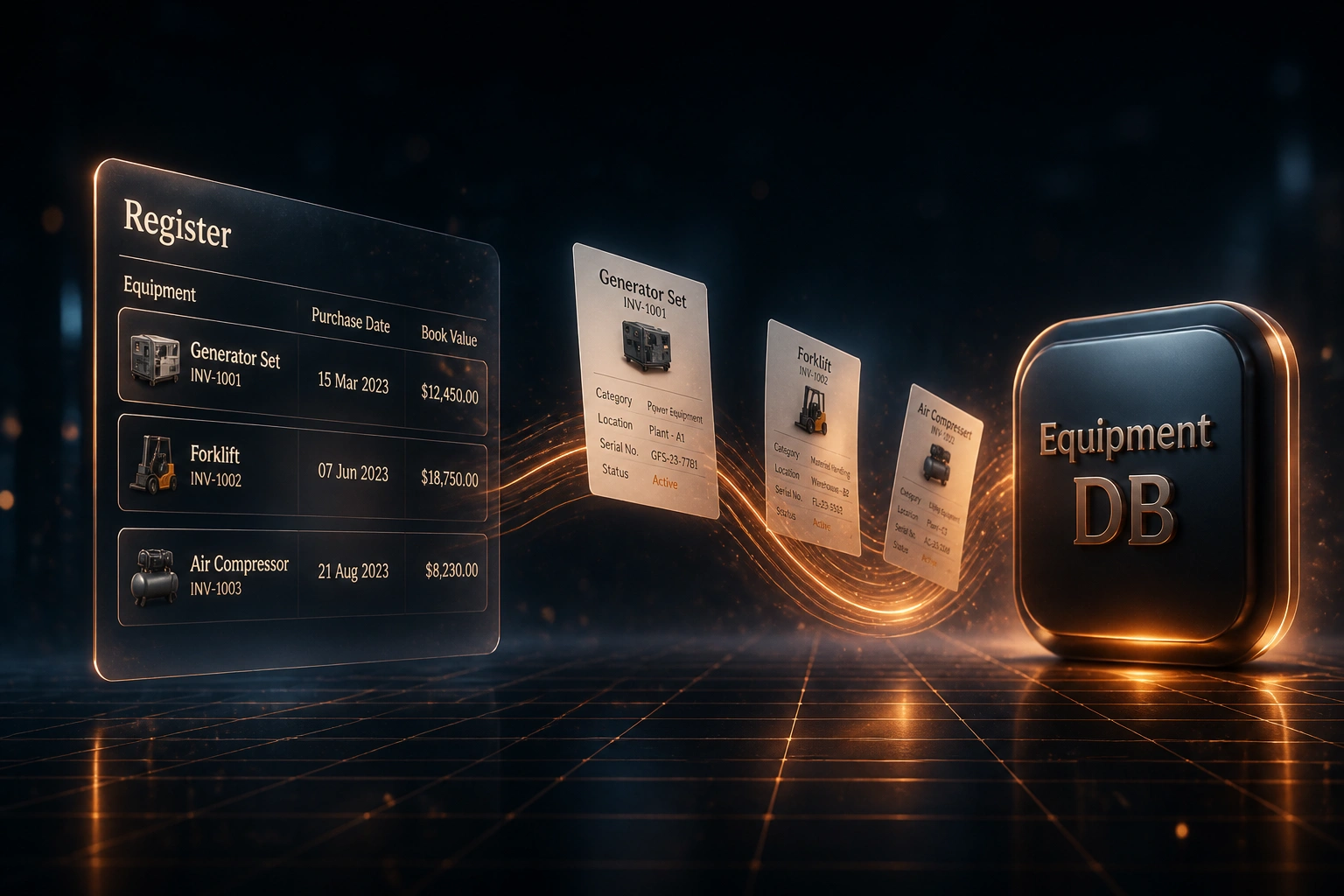
Asset purchased → registered with cost and life → depreciated and maintained → assigned to a custodian. One record, no double entry.
Asset Is Purchased
Invoice, serial, supplier, and capitalisation date captured at intake, not months later
Register & Depreciate
Cost, method, and useful life set; depreciation tracking runs automatically each period
Maintain & Assign
Service schedules and custodian assignments update on the same asset record
Audit-Ready Pack
Book value, write-offs, and existence evidence export for auditors, insurers, and SARS
Everything a CFO Needs in One Equipment Register
Living Equipment Register
Every asset gets a permanent digital record: description, serial, purchase date, cost, location, and custodian. No more orphaned rows in a shared workbook.
Depreciation Tracking
Straight-line or diminishing-value methods, useful lives aligned to IAS 16 and SARS BGR 7 write-off periods, with book value that finance can trust at month-end.
Maintenance Schedules
Service intervals, next-due dates, and work history sit on the same record as cost and depreciation, so ops and finance share one source of truth.
Assignment & Custody
Know who holds each asset, when it moved between people or departments, and who signed for it. Equipment tracking stops being a verbal handoff.
Audit & SARS Evidence Packs
Export purchase cost, write-off method, accumulated depreciation, and assignment history in the format auditors and SARS expect under BGR 7 record-keeping rules.
Accounting System Sync
Push additions, depreciation journals, and disposals into Xero, Sage, or your ERP so the fixed-asset subledger and the register stay reconciled.
Systems We Connect Around Your Register
From 22% Ghost Assets to an Audit-Ready Register
How a Gauteng manufacturing group replaced a decade-old spreadsheet with a living digital equipment register before year-end.
The Spreadsheet Register
- 1,140 line items in a shared Excel file with no ownership of updates
- Physical count found roughly 22% of listed assets missing or scrapped
- Controller spent 22+ hours a month reconciling depreciation to the GL
- Insurance schedule still included disposed plant from three years prior
- Prior-year audit letter flagged incomplete fixed-asset existence testing
The Living Register
- Cleansed register with purchase date, cost, method, and custodian on every active asset
- Ghost-asset rate below 3% after write-offs and physical verification
- Monthly depreciation journals push to Sage; finance reviews exceptions only
- Insurance renewal pack exported in one afternoon instead of two weeks
- SARS wear-and-tear supporting schedule generated from the same records
Before vs After a Digital Equipment Register
How It Works
From first conversation to a living register in 3–5 weeks for a focused asset base.
Share Your Current Register
Spreadsheet, ERP extract, or paper schedules. We assess completeness, ghost assets, and depreciation gaps.
Free Scoping Call
30-minute call with your FD or controller to define asset classes, write-off rules, maintenance needs, and go-live priorities.
Build & Migrate
We build the digital register, import cleansed data, configure depreciation and assignments, and run parallel against your spreadsheet.
Go Live & Reconcile
Switch off the stale workbook. Month-end depreciation and insurance schedules pull from one living system.
Frequently Asked Questions
How is an equipment register different from multi-site asset tracking or full lifecycle management?
This engagement centres on the register itself: purchase date, cost, depreciation method, maintenance schedule, and who the asset is assigned to. Multi-site location moves and end-of-life disposal workflows are separate programmes. Most SA mid-market teams need the living register first so finance, ops, and insurance finally agree on what the business owns.
Does this satisfy SARS and IFRS fixed-asset requirements?
IAS 16 expects disclosed depreciation methods, useful lives, and carrying-amount reconciliations. SARS Binding General Ruling 7 requires records supporting wear-and-tear write-offs to be readily available to the Commissioner. We structure purchase cost, method, write-off period, and accumulated allowances so those packs are exportable, not reconstructed under deadline pressure.
Will we still need our spreadsheet during the transition?
Yes, briefly. We run the new register in parallel for at least one month-end so depreciation totals and asset counts reconcile before you retire the workbook. After go-live, the spreadsheet becomes a read-only archive, not the system of record.
Can the register sync with our accounting system?
Yes. We commonly connect to Xero, Sage, QuickBooks, SAP, and NetSuite for additions, depreciation journals, and disposal postings. If you stay on a controlled export into the GL for a phase, we still keep the register as the detailed subledger of truth.
How long does an equipment register project take?
A focused register for a few hundred assets typically takes 3–5 weeks from scoping to go-live, including data cleanse and parallel month-end. Registers with thousands of line items, multiple depreciation books, or heavy maintenance scheduling sit closer to 6–8 weeks.
How much does a digital equipment register cost?
Focused registers with purchase, depreciation, assignment, and basic maintenance schedules typically start from around R35,000. Broader programmes with accounting sync, insurance schedule exports, and multi-department custody workflows usually fall between R55,000 and R95,000. Teams recovering ghost-asset insurance waste and cutting year-end audit hours often see payback inside one audit cycle.
Stop Running Asset Management from a Spreadsheet
If depreciation, insurance, and maintenance all disagree because nobody trusts the register, you are carrying avoidable audit risk and cash leakage every month.
Tell us how many assets you carry, which accounting system you use, and when your next year-end falls. We will show you what a digital equipment register would look like for your business.