Error Handling in Distributed Systems: When CRM, Payments, and Xero Disagree
Your CRM, payment gateway, and accounting each succeed or fail on their own clock. That is how you get deals marked won with no invoice, orphan charges, or two invoices for one order. Distributed errors and partial failure are not edge cases; they are the normal failure mode of modern integrations.
We design the coherent error-recovery layer that brings those systems back into one truth.
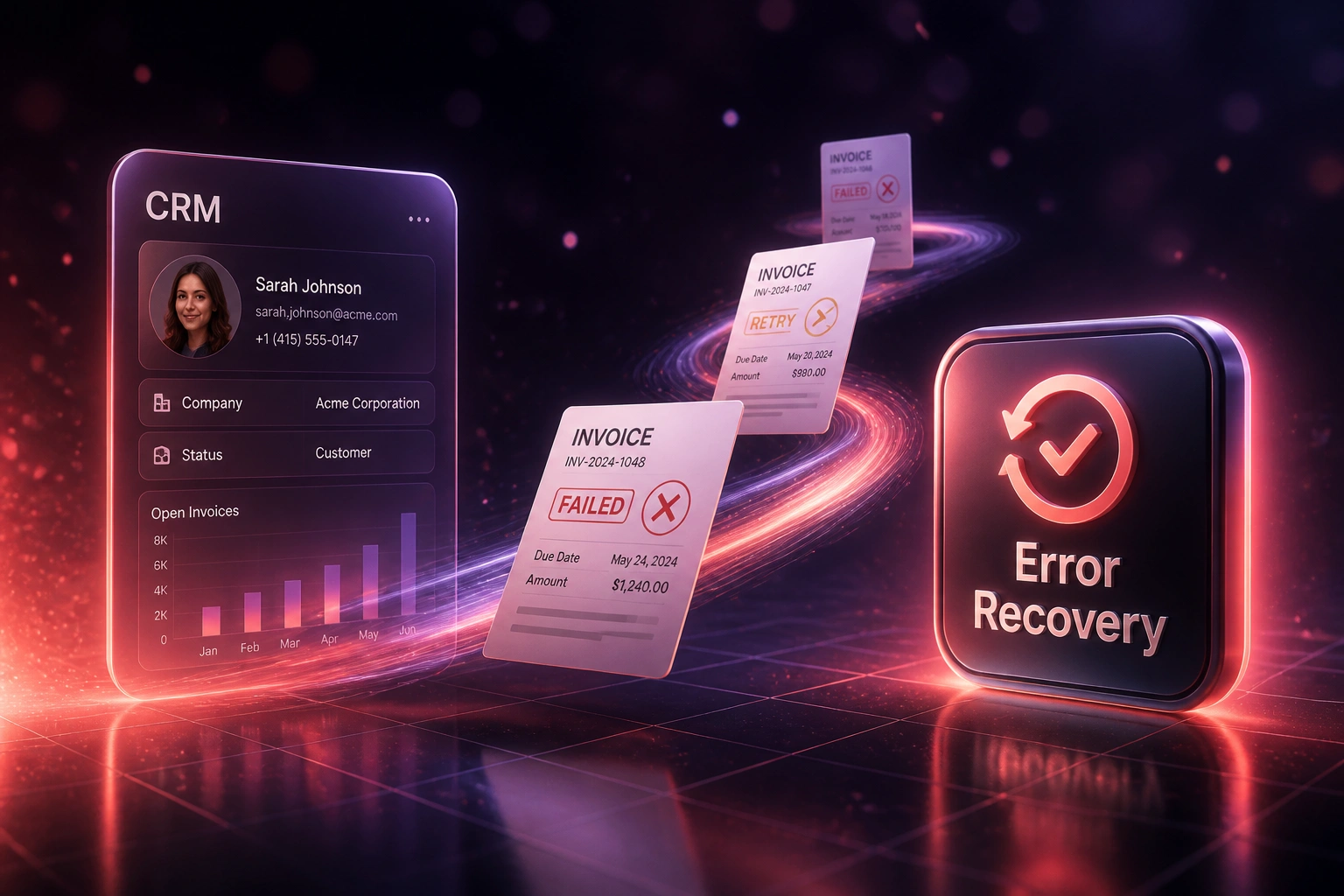
Sound Familiar?
These are the exact partial-failure patterns our clients faced before we built a coherent recovery layer:
- CRM marks a deal won, but Xero never got the invoice and nobody notices for days
- Payment gateway charges the client while the order sync fails, leaving orphan payments or double charges
- Timeouts look like failures, so ops re-runs the job and creates a second invoice or refund
- Partial failures leave CRM, payments, and accounting in three different states with no shared truth
- Finance and ops spend evenings matching spreadsheets because silent sync errors have no escalation path
Batch reconciliation often finds breaks only 24 to 72 hours later. Cutting mean time to detect from a day toward a couple of hours has been shown to cut remediation cost by around 60%. Waiting for month-end is how orphan invoices and double charges become customer incidents.
What Coherent Error Recovery Actually Does
Detect inconsistent state → decide complete, compensate, or escalate → reconcile until CRM, payments, and accounting agree.
Journey Starts
Deal closes, payment captures, or invoice request fires across CRM, gateway, and Xero
Partial Failure Caught
Timeouts and one-sided success are classified, not blindly retried into doubles
Compensate or Complete
Defined recovery finishes the path or cleanly undoes what already succeeded
Reconcile & Escalate
Queues and checks confirm systems match; ambiguous cases reach a human with context
Everything You Need for Distributed Error Recovery
Timeout & Ambiguity Handling
A timeout is not treated as a confirmed failure. We probe, confirm, or hold state until CRM, payments, and Xero agree before compensating.
Compensation Paths
When one system succeeds and another fails, defined undo steps reverse or complete the journey: void drafts, refund holds, or reopen deals cleanly.
Reconciliation Queues
Record-count and amount checks run on a schedule so silent drift between HubSpot, Stripe or PayFast, and Xero surfaces in minutes, not at month-end.
Human Escalation Ladders
Ambiguous cases land in an ops queue with context: which step failed, what already succeeded, and what action is safe. Alerts only when a person is needed.
Idempotent Cross-System Writes
Retries never create a second invoice, charge, or won-deal side effect. Every write carries a business key so recovery is safe.
End-to-End State Visibility
Ops sees the journey: deal → payment → invoice → paid, with blockers highlighted. No more guessing which system is lying.
Platforms We Wire Into the Recovery Layer
From 18 Hours/Week Cleanup to Under 2
How a 35-person services firm stopped orphan invoices and double payment updates across HubSpot, PayFast, and Xero.
Scattered Failure Handling
- Deals flipped to won while invoice create timed out; sales thought it was done
- PayFast webhooks retried blindly and sometimes wrote payment status twice
- Ops found mismatches only when finance chased a missing Xero invoice
- Average silent drift sat for a day or more before anyone noticed
- No shared view of which step in the journey had actually succeeded
Coherent Recovery Layer
- Timeouts hold state until confirmation; no blind re-runs into doubles
- Compensation voids draft invoices or reopens deals when payment fails mid-path
- Reconciliation queues flag CRM vs Xero vs payment mismatches within the hour
- Ambiguous cases escalate to ops with full journey context
- Month-end starts from an already-reconciled ledger, not a spreadsheet hunt
Before vs After Coherent Error Handling
How It Works
From first conversation to a live recovery layer in 3–5 weeks.
Map Partial-Failure Paths
Where CRM, payment gateway, and accounting can each succeed alone today, and what orphan invoices or double charges that creates.
Design the Recovery Layer
Timeouts, compensation rules, reconciliation checks, and escalation queues sized to your real order-to-cash flow.
Chaos-Test Inconsistent State
We deliberately fail mid-journey steps and prove the stack recovers, compensates, or escalates without silent drift.
Go Live & Monitor
Production ships with reconciliation dashboards and human escalation so ops sees broken journeys before finance does.
Frequently Asked Questions
What is distributed error handling, in plain English?
It is the layer that decides what happens when CRM, your payment gateway, and Xero do not all succeed together. Instead of hoping each retry or sync “sorts itself out”, we design timeouts, compensation, reconciliation, and human escalation so partial failures become managed exceptions, not orphan invoices or double charges.
How is this different from retries, circuit breakers, or sagas alone?
Retries recover transient blips. Circuit breakers stop cascading freezes. Sagas orchestrate multi-step undo. Distributed error handling ties those pieces into one coherent layer for your business journey: detect inconsistent state across systems, choose compensate vs complete vs escalate, and prove CRM, payments, and accounting converge. Most stacks need the whole layer, not one pattern in isolation.
How long do silent sync errors typically go unnoticed?
Without cross-system monitoring, data consistency issues take about 67 minutes on average to detect in studied distributed deployments, and batch reconciliation often surfaces breaks only 24 to 72 hours later. By then refunds, commission reports, and customer trust are already damaged. Organisations that cut detection toward a few hours resolve discrepancies far faster and cut remediation cost sharply.
What does manual cleanup of partial failures actually cost?
Mid-sized async integration estates often burn 15 to 20 hours a week on reconciliation and correction. At typical South African senior ops rates near R850 per hour, that is roughly R660,000 to R880,000 a year before counting double charges, delayed cash, or reputational cost. Industry figures put average undetected adjustment incidents near R40,000 each once converted from published USD benchmarks.
Will you replace our existing CRM, payment, and Xero integrations?
Usually we wrap a coherent error-handling and reconciliation layer around the paths you already run. Where a journey cannot safely recover mid-flight, we rebuild that path with durable state and compensation. Your teams keep using HubSpot, Pipedrive, Stripe or PayFast, and Xero; the recovery discipline sits underneath.
How much does a distributed error-handling layer cost?
Focused recovery and reconciliation for one critical order-to-cash path typically starts around R25,000. Multi-system layers with timeout handling, compensation, reconciliation queues, and escalation usually sit between R40,000 and R60,000+, depending on how many platforms and failure modes you need covered. Teams burning 15+ ops hours a week on silent drift usually see payback within two to four months.
Stop Paying for Partial Failures You Already Know About
If CRM, payments, and accounting can each succeed alone, you do not have a “sync glitch”. You have a missing error-handling layer.
Tell us which platforms you run, where inconsistent state shows up today, and how many hours ops burns on cleanup. We will show you what a coherent recovery design looks like for your stack, typically from R25,000 to R60,000+.