ETL Error Handling and Retry Logic: Keep Pipelines Flowing When Things Break
Your overnight pipelines fail quietly. Networks drop, APIs time out, files arrive malformed, and by morning the dashboards still look fine while the numbers are stale. Without ETL error handling, pipeline retry logic, and data pipeline monitoring, every silent failure costs more than the engineering to prevent it.
We build the resilience layer that retries, quarantines, and alerts before stale data reaches the boardroom.
Sound Familiar?
These are the exact issues our clients faced before we hardened their pipelines:
- Overnight ETL jobs fail or stall, and nobody knows until morning dashboards show yesterday's numbers
- API timeouts and malformed files kill a load mid-run, then the pipeline marks itself complete anyway
- Your team spends half the week firefighting data incidents instead of improving the business
- Business stakeholders spot bad figures before the data team does, eroding trust in every report
- There is no retry queue, no dead-letter path, and no alert when a transfer fails after hours
Silent failure is the expensive kind. Research shows business stakeholders discover data issues first 74% of the time, and large enterprises put roughly R820,000 of business impact at risk for every hour of data downtime. If your only alarm is a wrong number in a morning meeting, you are already late.
What Pipeline Retry Logic Actually Does
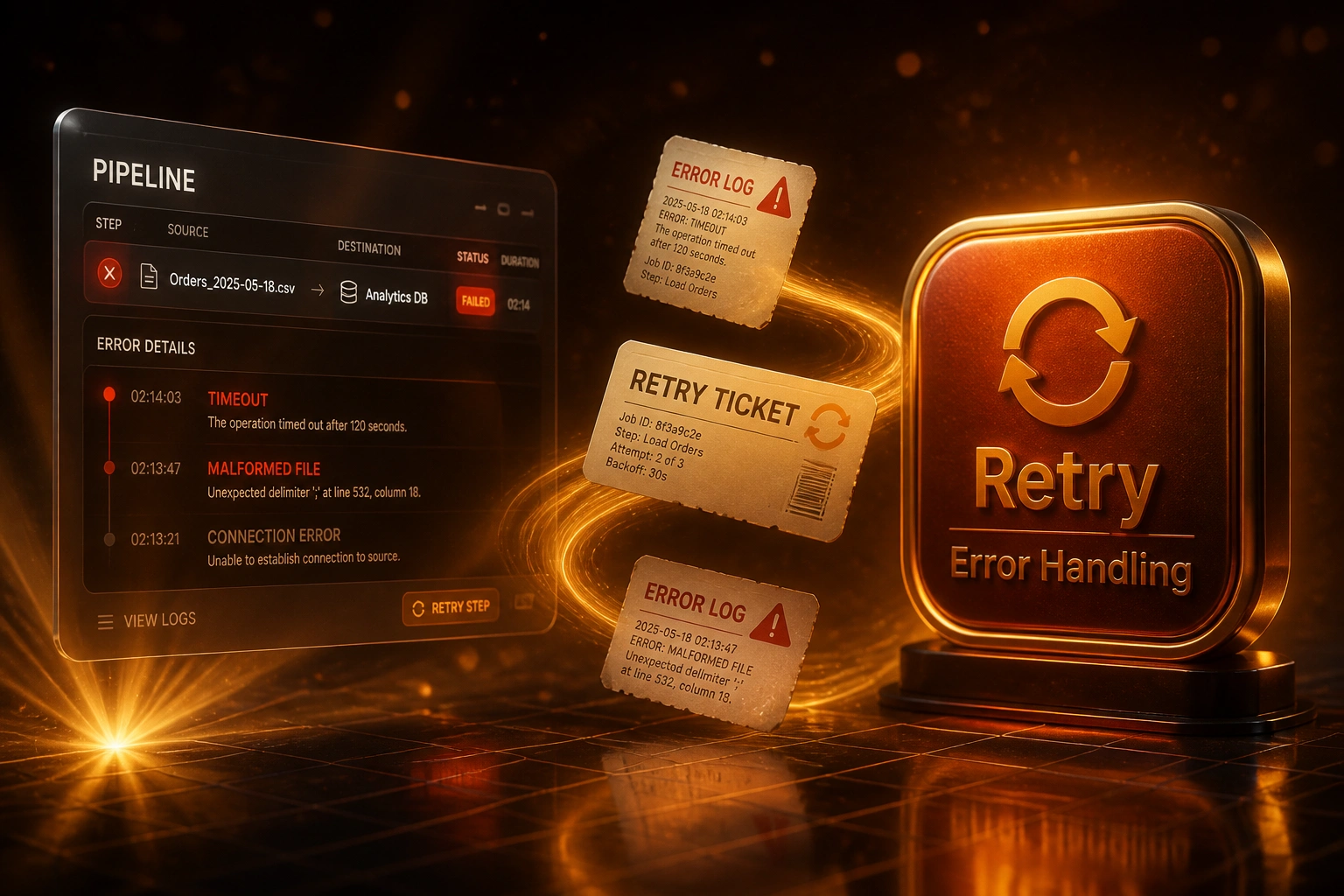
Failure classified → automatic retry → dead-letter if needed → alert your team. Nothing disappears overnight.
Pipeline Step Fails
Timeout, rate limit, malformed file, or warehouse write blocks a load mid-run
Retry with Backoff
Transient errors retry with exponential backoff and jitter so temporary outages recover themselves
Dead-Letter Queue
Permanent failures park with a clear reason so ops can fix the source and replay safely
Alert and Resolve
Slack, email, or SMS notifies the owner; monitoring keeps pipeline success above your threshold
Everything You Need for Reliable Data Pipeline Monitoring
Retry with Exponential Backoff
Transient timeouts, rate limits, and brief outages retry automatically with backoff and jitter. Temporary network blips stop becoming permanent data gaps.
Dead-Letter Queues
Malformed files, schema breaks, and permanent validation failures land in a review queue with the reason attached. Nothing is dropped silently.
Pipeline Monitoring and Alerts
Freshness, volume, and failure-rate checks page your ops or data lead within minutes. You find out before the board pack does.
Failure Classification
Transient errors retry. Permanent errors escalate. Your team stops wasting hours replaying jobs that can never succeed.
Safe Replay and Idempotency
Once the root cause is fixed, failed batches replay without creating duplicates. Clear the queue with one controlled action.
Runbooks and Ownership
Every alert names an owner, a failure class, and the next step. Firefighting becomes a short playbook, not a forensic dig.
Pipeline Stacks We've Hardened for Reliability
From 18 Hours of Firefighting to Three
How a regional retail group's ops and data leads stopped overnight ETL failures from poisoning morning dashboards.
The Silent Failure Process
- Overnight warehouse loads from ERP, ecommerce, and partner CSV drops failed without paging anyone
- Morning dashboards still rendered, so leadership acted on stale sales and stock figures
- Average detection took until mid-morning, often after the first trading decisions were made
- 18 hours a week spent reconstructing which batches landed and which needed manual reload
- No backoff retries, no dead-letter queue, and no named owner for after-hours failures
The Resilient Process
- Exponential backoff retries clear transient API and warehouse timeouts without human involvement
- Malformed files and schema breaks land in a dead-letter queue with the exact reason attached
- Alerts fire within minutes when freshness or failure rates cross the threshold
- Safe, idempotent replay clears the queue once ops fixes the source file or mapping
- Runbooks name the owner, failure class, and next step so mornings start with decisions, not forensics
Before vs After ETL Error Handling and Retry Logic
How It Works
From first conversation to resilient overnight loads in 2–4 weeks.
Tell Us Your Setup
Which pipelines run overnight, where they fail today, and who needs the alert when they do.
Free Scoping Call
30-minute call to map failure modes, design retry and dead-letter rules, and size the resilience layer.
Build and Test
We build backoff retries, dead-letter handling, and monitoring, then stress-test with real failure scenarios.
Go Live and Monitor
Live alerting, a clear runbook, and visibility so overnight loads recover themselves or wake the right person.
Frequently Asked Questions
What kinds of ETL failures does your error handling cover?
We cover API timeouts, rate limits, authentication expiry, malformed files, schema drift, partial batch loads, warehouse write failures, and connection drops. Transient errors retry with exponential backoff. Permanent failures go to a dead-letter queue with a clear reason so your team can fix and replay.
How quickly will we know when a pipeline fails?
Industry research shows 68% of teams need four or more hours to detect data issues, and business users discover problems first 74% of the time. With our monitoring layer, threshold breaches typically notify Slack, email, or SMS within minutes, so stale dashboards never become the first alarm.
Will retries create duplicate records in the warehouse?
No. Every write is designed to be idempotent. Retries and manual replays check whether the batch or record already landed before writing again, so a failed load that later succeeds appears once.
Can this sit on top of pipelines we already run?
Yes. Many clients already have Airflow, dbt, Fivetran, or custom ETL that "mostly works." We add the resilience layer: retry logic, dead-letter queues, data pipeline monitoring, and alerts, without ripping out what you already paid for.
Which systems and pipeline tools do you support?
We have hardened resilience across Airflow, dbt, Fivetran, custom Python and Node ETL, cloud object storage, SQL Server, Postgres, BigQuery, and REST API extracts. If the job moves files, API payloads, or database rows, we can make failure recovery reliable.
How much does ETL error handling and retry logic cost?
Adding a resilience layer to existing pipelines typically starts from around R25,000. Full builds with backoff retries, dead-letter queues, freshness monitoring, and alerting usually range from R35,000 to R70,000. Most clients recover the cost within one or two months once overnight firefighting and silent stale-data decisions stop burning staff time.
Stop Letting Silent Failures Poison Morning Decisions
If overnight loads can fail without waking anyone, you are paying for fragile pipelines with stale dashboards, wasted staff time, and decisions made on yesterday's truth.
Tell us which systems feed your warehouse, where jobs already break, and who should own the alert. We will show you exactly how retries, dead-letter queues, and monitoring would work for your stack.