FICA Section 21A: Enhanced Verification for High-Risk and Foreign Clients
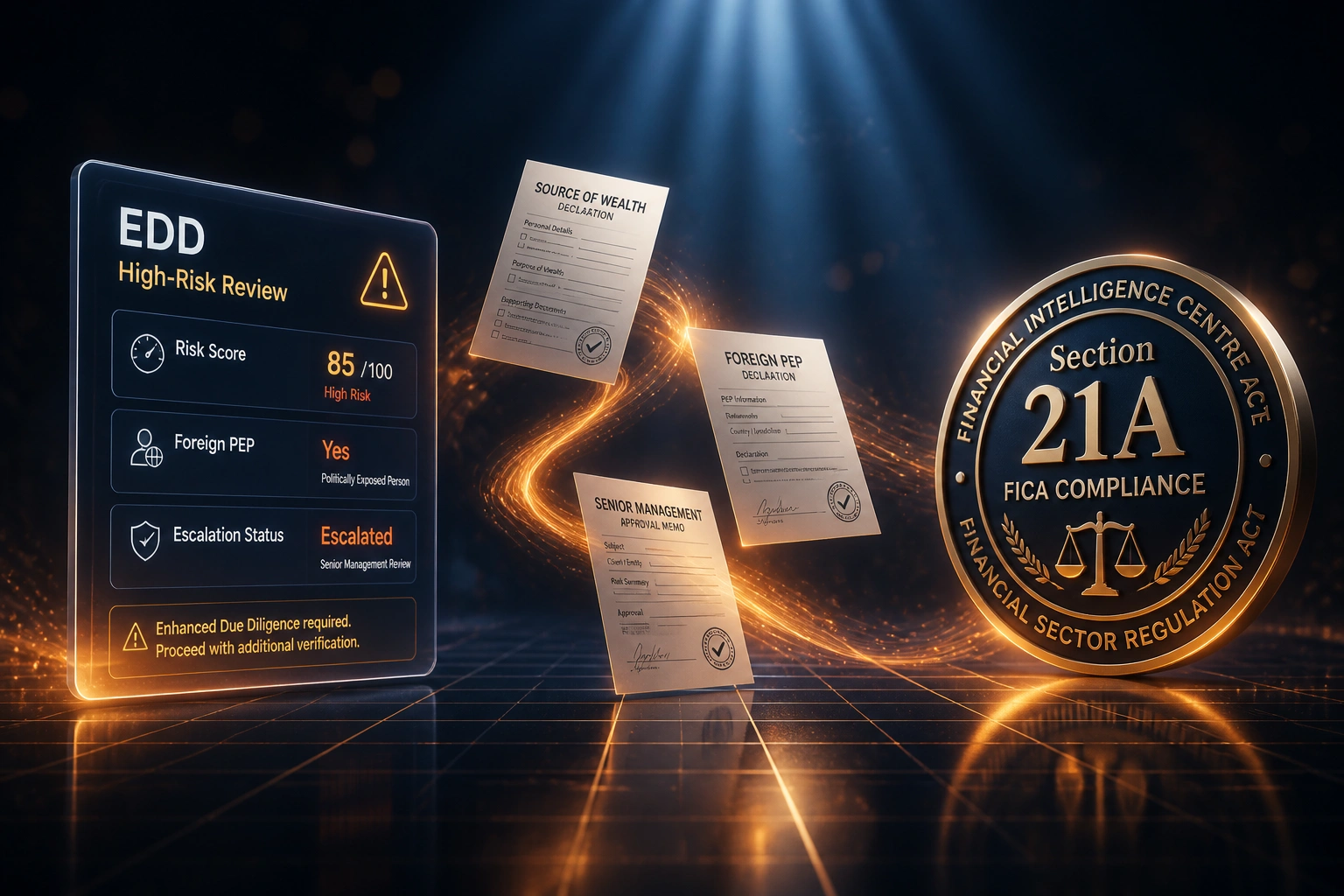
Section 21A enhanced verification is where exams fail and where manual escalation collapses under volume. Foreign PEPs and high-risk clients need source of wealth evidence, senior management approval, and a trail you can show an examiner.
We automate the triggers, evidence collection, and approval trail so those clients clear without auditor findings.
Sound Familiar?
These are the exact issues Compliance Officers and MLROs faced before we automated enhanced verification:
- Foreign PEP and high-risk flags sit in screening tools, while source-of-wealth files live in email and shared drives
- Senior management approval is verbal or buried in Outlook, so examiners cannot prove Section 21A escalation happened
- Compliance officers spend hours rebuilding who escalated what before a FIC or Prudential Authority sample
- High-risk clients clear onboarding without documented source of funds or enhanced ongoing monitoring schedules
- Volume spikes collapse the manual escalation queue, and incomplete EDD packs reach the book unchecked
South Africa exited the FATF grey list in October 2025, and the next mutual evaluation will test effectiveness. Supervisors expect documented, defensible enhanced verification for foreign PEPs and high-risk clients, not reconstructed email threads.
What Section 21A Enhanced Verification Automation Does
High-risk or foreign PEP flag → EDD case opens → evidence and approval captured → examiner-ready pack filed.
Escalation Trigger Fires
Screening or risk scoring flags a foreign PEP, high-risk jurisdiction, or RMCP threshold
EDD Evidence Collected
Source of wealth, source of funds, and foreign PEP declarations requested and filed automatically
Senior Management Approves
Approval routes to the right role with a timestamped decision memo retained on the file
Monitoring Scheduled
Enhanced review cycles and alerts attach to the relationship so ongoing monitoring is not forgotten
Everything You Need for High-Risk Client Enhanced Verification
Automated Escalation Triggers
When screening or risk scoring flags a foreign PEP, high-risk jurisdiction, or RMCP threshold, the workflow escalates automatically and opens an EDD case.
Source of Wealth & Funds Capture
Structured prompts collect and file source of wealth and source of funds evidence against the client record before the relationship can proceed.
Senior Management Approval Trail
Approval requests route to the right role with timestamps, decision notes, and a retained memo so examiners see the sign-off, not a verbal claim.
Foreign PEP Declaration Packs
Foreign prominent public official status, family members, and known close associates are evidenced in a single examiner-ready pack with screening outcomes attached.
Enhanced Monitoring Schedules
High-risk and foreign PEP relationships land on shorter review cycles with alerts when monitoring windows are missed or risk scores change.
Inspection-Ready EDD Evidence
One exportable file per client: escalation log, SoW/SoF documents, approval memo, risk rationale, and retention metadata ready for sampling.
Systems We've Wired for Enhanced Verification
From 3.5 Hours per EDD Pack to 40 Minutes
How a mid-size FSP cut high-risk and foreign PEP pack time, closed missing approval gaps, and recovered R155,000 in year one.
The Manual Escalation
- Compliance rebuilt foreign PEP and high-risk packs from email, shared drives, and screening screenshots
- Average 3.5 hours per pack: SoW chase, adverse media notes, and chasing a director for verbal approval
- Roughly one in four sampled high-risk files lacked a retained senior management memo
- Average 6 business days from flag to cleared relationship during volume spikes
- MLRO spent inspection week reconstructing escalation timelines instead of running the desk
The Automated Escalation
- Foreign PEP or high-risk flag opens an EDD case with required evidence prompts attached
- Compliance reviews a structured pack and routes senior management approval in one click
- Every cleared high-risk file carries a timestamped approval memo and SoW/SoF evidence
- Same-day clearance for complete packs, with monitoring schedules set automatically
- Inspection samples pull examiner-ready EDD packs without reconstructing email threads
Before vs After Enhanced Verification Automation
How It Works
From first conversation to live enhanced verification in 3–6 weeks.
Map Section 21A Escalations
Which foreign PEP, high-risk, and SoW/SoF triggers your RMCP requires, and where approvals currently go missing.
Free Scoping Call
30-minute call to design enhanced verification automation around your MLRO workflow and inspection readiness.
Build & Parallel Test
We wire escalation triggers, evidence capture, approval routing, and EDD packs, then run parallel against live high-risk files.
Go Live & Monitor
Incomplete enhanced verification stops clearing unchecked. Monitoring flags missed approvals and review cycles before examiners do.
Frequently Asked Questions
What does FICA Section 21A require for enhanced verification?
Section 21A requires accountable institutions to obtain information that reasonably enables them to understand the nature and purpose of a prospective business relationship. For foreign politically exposed persons (foreign PEPs / former FPPOs) and other high-risk clients, that understanding feeds enhanced measures: senior management approval, reasonable steps to establish source of wealth and source of funds, and enhanced ongoing monitoring under sections 21F and 21G and your RMCP. FIC guidance treats foreign PEPs as inherently high-risk, so enhanced verification is not optional once they are identified.
How is this different from standard Section 21 CDD automation?
Baseline Section 21 CDD covers identity, address, and examiner-ready packs for ordinary clients. This build focuses on the enhanced layer: automated escalation when foreign PEP or high-risk triggers fire, source of wealth and funds evidence, senior management approval trails, and enhanced monitoring schedules. If you need both layers, we usually wire standard CDD first and add Section 21A escalations on top.
What inspection findings does enhanced verification automation help prevent?
Recent enforcement shows CDD and enhanced due diligence failures are among the largest sanction components. Capitec Bank was sanctioned R56.25 million in December 2024, with CDD and EDD shortfalls among the headline findings. Examiners look for missing SoW/SoF evidence, absent senior management approval, and relationships that cleared without a documented escalation. Automated triggers and timestamped packs close those gaps.
Can you connect our existing PEP screening tools?
Yes. We connect screening and risk systems such as LSEG World-Check, ComplyAdvantage, and CRM or onboarding portals so a foreign PEP or high-risk hit opens an EDD case automatically, rather than relying on someone to notice the flag and start a manual pack.
How long does a typical enhanced verification build take?
Most mid-size FSP and accountable-institution builds take 3 to 6 weeks from scoping to go-live, depending on how many systems hold screening results, documents, and approvals. Parallel testing against real high-risk files usually runs for one to two weeks before manual escalation is switched off.
How much does Section 21A enhanced verification automation cost?
Typical builds that automate escalation triggers, SoW/SoF capture, senior management approval trails, and examiner-ready EDD packs run from about R45,000 to R95,000 depending on systems and RMCP complexity. Against R26,500 to R53,000 per corporate KYC review in industry research, and administrative sanctions of up to R50 million for legal persons, most mid-size desks see payback within a few months of live high-risk volume.
Stop Losing Exams on Incomplete Enhanced Verification
If foreign PEP and high-risk packs still depend on email escalations and reconstructed folders, you are carrying avoidable inspection risk.
Tell us which screening and CRM systems you use, how your RMCP defines high-risk triggers, and where approvals currently go missing. We will show you exactly how Section 21A enhanced verification automation would work for your desk.