Financial Ledger Reconciliation: Fixing Discrepancies Between Accounting Systems
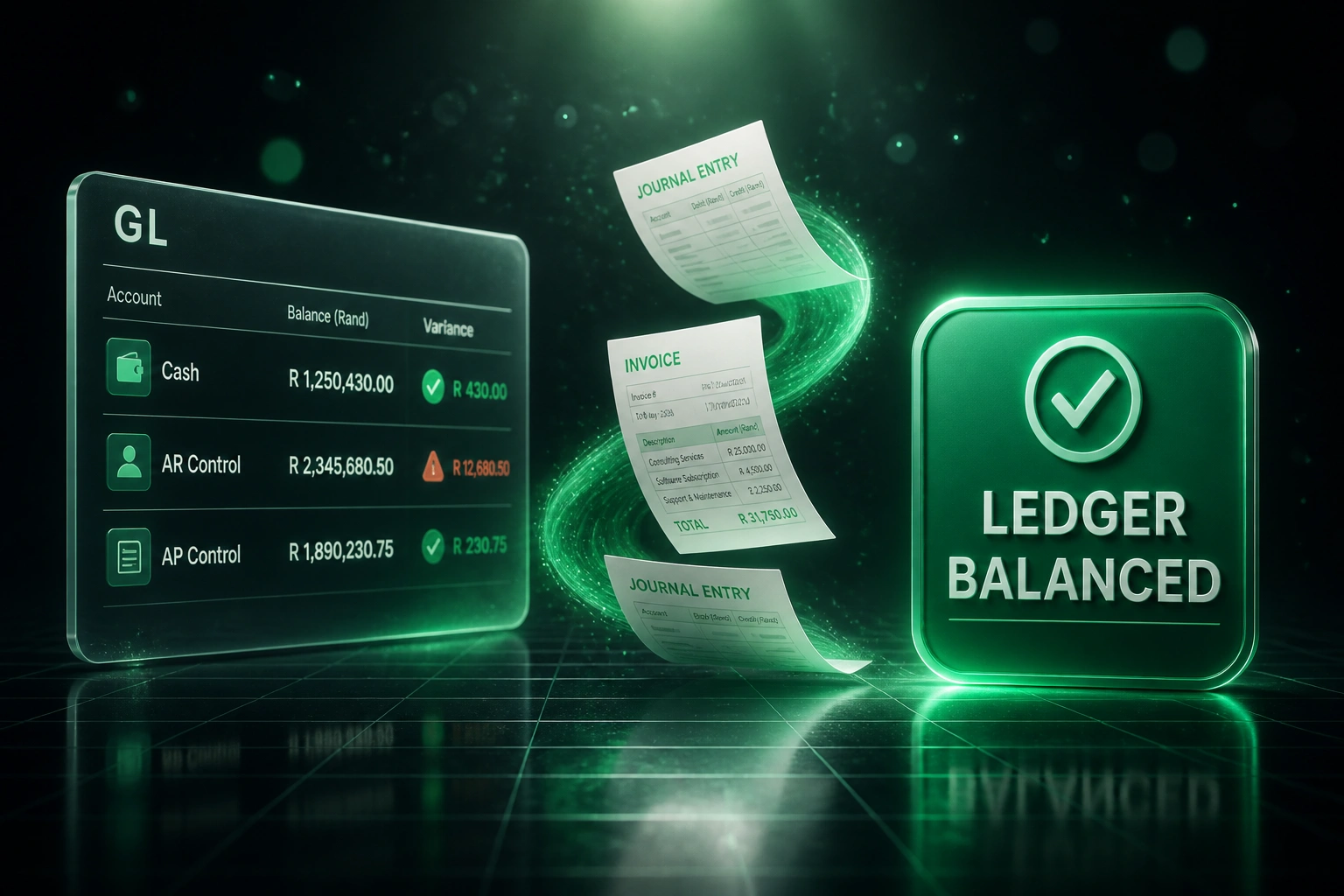
Month-end never closes cleanly because the general ledger, AR and AP sub-ledgers, and bank records disagree. Patch journals buy one more week, then the same accounting discrepancy returns.
We trace GL mismatches to root cause and repair the ledgers so close becomes predictable.
Sound Familiar?
These are the exact issues CFOs and finance controllers bring us before a ledger repair:
- General ledger control accounts disagree with AR and AP sub-ledgers, so every close starts with a variance hunt
- Bank records, cash book, and GL cash never land on the same figure without a week of detective work
- Finance posts correcting journals by hand each month, then the same mismatches return the next cycle
- Management packs slip by days while the team explains reconciling items instead of fixing root causes
- Auditors flag incomplete ledger ties and demand evidence packs that take nights of spreadsheet archaeology
Audit findings, delayed management packs, and cash visibility gaps compound every month you close late. Only 18% of teams hit a 1–3 day close. When GL, sub-ledgers, and bank refuse to tie, overtime and stale board packs become the operating model.
What Financial Data Repair Actually Does
Extract balances → find mismatches → correct root cause → close on a tied ledger.
Extract the Ledgers
Pull GL control accounts, AR/AP sub-ledgers, and bank records for the same period
Surface Every Variance
Flag GL vs sub-ledger and cash book gaps with the transactions that broke the tie
Repair the Root Cause
Fix failed postings, duplicates, cut-off errors, and broken feeds, then post evidenced corrections
Close on Tied Books
Month-end becomes a review of exceptions, not a forensic dig through every control account
Everything You Need for a Reliable Ledger Tie
GL to Sub-Ledger Variance Mapping
We compare control accounts to AR, AP, inventory, and fixed-asset sub-ledgers, then surface every out-of-balance account with the transactions that caused it.
Bank and Cash Book Tie-Out
Cash GL, bank statements, and clearing accounts are matched so unexplained cash gaps stop blocking month-end and cash visibility.
Root-Cause Trace, Not Patch Journals
Mismatches are traced to failed postings, duplicate journals, cut-off errors, or broken integrations. We repair the cause, not paper over the symptom.
Correcting Entries with Evidence
Approved corrections post with source documents, account codes, and VAT treatment attached so every adjustment is audit-ready.
Recurring Drift Prevention
After the repair, scheduled ledger checks catch new GL vs sub-ledger and bank variances before the next close window opens.
Close-Ready Exception Queues
Only genuine exceptions reach finance. The rest of the ledger ties automatically so controllers spend time on judgement, not matching.
Systems We've Tied Across Ledgers
From 65 Hours/Month to 10 Hours/Month
How a mid-market manufacturer stopped patching journals by hand, closed six days faster, and recovered R720,000 in year one.
The Manual Process
- Controllers spent nights matching AR control to the debtor sub-ledger and AP control to creditors
- Cash GL, bank statement, and clearing accounts rarely agreed without a spreadsheet war room
- Correcting journals cleared the variance for one close, then the same GL mismatch returned
- Management packs landed mid-month; cash visibility lagged the real bank position
- External auditors raised findings on incomplete ledger ties and thin evidence packs
The Repaired Process
- Root failed postings and cut-off errors fixed at source across GL, sub-ledgers, and bank
- Control accounts tie before the close window opens; finance reviews exceptions only
- Evidenced correcting entries replace ad-hoc patch journals
- Close moved from 11 business days to 5, with management packs on a fixed cadence
- Audit queries on ledger mismatches dropped; evidence trails sit with each balance
Before vs After Ledger Repair
How It Works
From first conversation to a validated parallel close in 3–6 weeks for most mid-market ledgers.
Show Us the Variances
Which control accounts break every month, which systems feed them, and where cash, AR, or AP refuse to agree.
Free Scoping Call
30-minute call to map GL, sub-ledgers, and bank sources, then prioritise the accounts that delay close the most.
Trace, Repair, Parallel Close
We find root mismatches, post correcting entries with evidence, and validate against your next month-end pack.
Go Live and Monitor
Manual patch journals drop away. Ongoing checks flag new ledger drift before the following close.
Frequently Asked Questions
How is ledger reconciliation repair different from bank statement matching?
Bank matching lines up statements to the cash book. Ledger reconciliation repair goes further: it resolves disagreements between the general ledger, AR and AP sub-ledgers, and bank records when control accounts will not tie. We find why the systems disagree and correct the ledgers so close stops depending on ad-hoc journals.
Which accounting systems can you repair?
We routinely work across Xero, Sage, Pastel, QuickBooks, SAP, NetSuite, and custom ERPs, plus bank feeds and sub-ledger extracts. If the GL, sub-ledgers, and bank files can be exported or queried, we can reconcile and repair them.
Will this disrupt our current month-end?
No. We run diagnosis and corrections in parallel with your existing close, then switch once the next pack proves the ledgers tie. Your team keeps the same tools; the firefighting drops.
What about audit findings and SARS reviews?
Incomplete GL to sub-ledger ties are a common audit finding and a drag on evidence packs. Every correction we post carries source documents and an audit trail, so reviewers can follow the balance from control account to transaction.
How long does a financial ledger reconciliation project take?
A focused repair across GL, core sub-ledgers, and bank for a mid-market close typically takes 3 to 6 weeks from scoping to a validated parallel close. Multi-entity or heavily customised ERP environments usually take 6 to 10 weeks.
How much does ledger reconciliation repair cost?
Focused GL, sub-ledger, and bank repair programmes typically start around R45,000. Broader multi-entity or multi-ERP forensic repairs usually land between R60,000 and R120,000. Most clients recover that inside 2 to 4 months against the hours currently spent explaining mismatches by hand.
Stop Patching Journals. Repair the Ledgers.
If GL, sub-ledgers, and bank records still disagree every month, you are paying for a problem that financial data repair already solves.
Tell us which control accounts break, which systems feed them, and how late the management pack lands. We will show you exactly how a root-cause ledger reconciliation would work for your close.