GDPR Compliance for CRM Systems: Prove Lawful Basis Before EU Buyers Walk
You are closing EU customers, but your CRM cannot show a lawful basis, answer a data subject access request in 30 days, or erase on demand. Procurement flags the gap, or a DPA enquiry turns into a scramble across inboxes and spreadsheets.
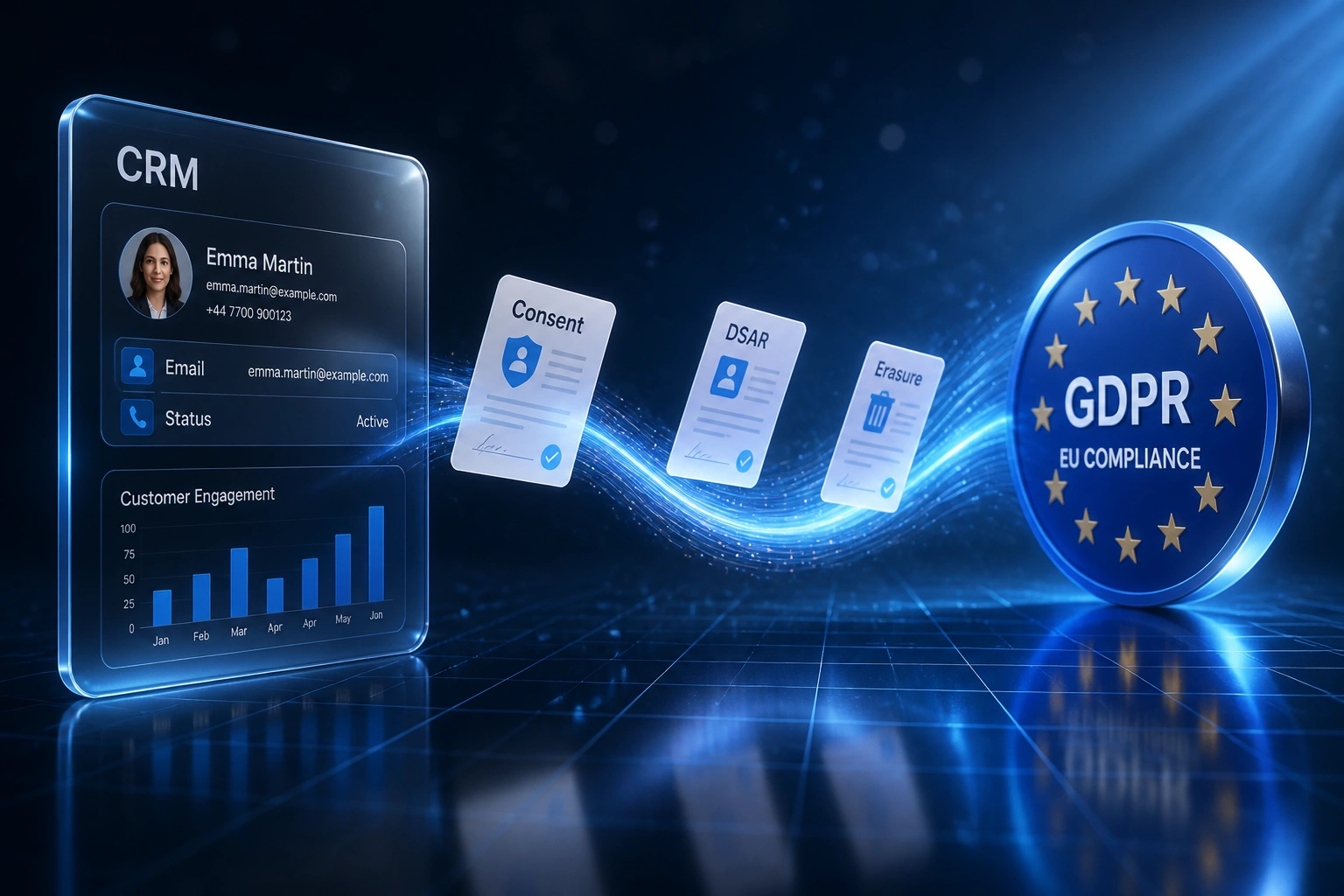
We wire consent, lawful-basis flags, and subject-request workflows into the CRM so GDPR compliance is operational, not a PDF on a share drive.
Sound Familiar?
These are the exact issues our clients faced before their CRM could prove GDPR data protection readiness:
- EU prospects ask for a lawful-basis record and the CRM only shows a silent checkbox
- A data subject access request takes weeks of hunting across CRM, email, and shared drives
- Nobody can prove consent purpose, timestamp, or channel when a DPA or buyer asks
- Erasure requests stall because connected marketing and billing tools still hold copies
- South African exporters lose EU deals when procurement flags GDPR gaps in the stack
South Africa has no EU adequacy decision. Transfers of EU personal data into SA systems need Chapter V safeguards such as Standard Contractual Clauses. Meta was fined €1.2 billion (about R24 billion) for unlawful EU-to-US transfers. Amazon's €746 million penalty (about R14.9 billion) showed how expensive processing without a solid basis can become. EU buyers increasingly treat CRM gaps as deal blockers.
What GDPR Compliance Looks Like in the CRM
Lawful basis recorded → DSAR answered → erasure proven. Your team stops rebuilding the trail by hand.
Basis Captured
Lead or deal stage records lawful basis, purpose, channel, and policy version
DSAR Queued
Access request opens a tracked workflow with identity check and one-month SLA
Records Packaged
CRM and connected systems assemble the response pack without inbox archaeology
Erasure Proven
Delete or restrict, cascade copies, and log the outcome for Article 17 accountability
Everything You Need for GDPR-Ready CRM Data Protection
Lawful-Basis Flags
Every EU contact carries a recorded basis (consent, contract, legitimate interest) with purpose and timestamp so sales never processes data they cannot justify.
Consent Ledger in the CRM
Opt-ins store channel, purpose, policy version, and source. Marketing cannot reuse a sales consent for a newsletter without a fresh, auditable record.
DSAR Fulfilment Workflow
An access request opens a tracked queue: verify identity, locate CRM and connected records, package the response, and hit the one-month GDPR deadline.
Erasure and Restriction
Delete or restrict on request, respect legal holds, cascade to email and billing tools, and write an immutable outcome log for Article 17 accountability.
72-Hour Breach Readiness
Affected-contact lists, categories of data, and notification drafts pull from the CRM so you can notify a supervisory authority within the GDPR 72-hour window.
Transfer Documentation
Flag EU-origin records, document SCC or other Chapter V safeguards, and give procurement the evidence pack EU buyers expect before they sign.
CRMs We've Configured for GDPR Compliance
From 18-Day DSARs to Under 48 Hours
How a Cape Town SaaS exporter stopped losing EU procurement reviews and made GDPR subject requests routine instead of crises.
The Manual Process
- EU buyers asked for a lawful-basis and consent evidence pack; sales rebuilt it from emails
- Each DSAR took 12 to 18 calendar days of CRM, mailbox, and Drive searches
- Staff cost per request sat near the Gartner average of roughly R26,000
- Two enterprise EU deals stalled when procurement flagged missing transfer documentation
- Erasure requests left copies in Mailchimp and billing for weeks
The Wired Process
- Every EU contact carries a lawful-basis flag and consent history on the CRM record
- DSARs open a tracked queue; response packs assemble in under 48 hours
- Erasure cascades to marketing and billing with an outcome log
- Procurement receives an SCC and processing evidence pack in one export
- Breach-ready contact lists pull from the CRM inside the 72-hour window
Before vs After GDPR CRM Integration
How It Works
From first conversation to live GDPR workflows in 3 to 6 weeks.
Map Your GDPR Gaps
Where EU customer data lives, which records lack a lawful basis, and how DSARs and erasure requests currently move (or stall).
Free Scoping Call
30-minute call with your CEO or marketing lead to prioritise lawful-basis fields, DSAR workflows, and transfer evidence.
Build and Test
We wire flags, consent history, and subject-request workflows into your CRM, then run sample DSARs and erasure drills with your team.
Go Live and Monitor
Staff keep the same CRM. Compliance gets SLA clocks, evidence packs, and alerts. Manual hunts across inboxes stop.
Frequently Asked Questions
Does GDPR apply if we are based in South Africa?
Yes, when you offer goods or services to people in the EU or monitor their behaviour. Extra-territorial reach under Article 3 means SA exporters and global firms serving EU customers must honour lawful processing, DSARs, and erasure even without an EU office. Your CRM is usually where that proof lives or fails.
What is the maximum GDPR fine in Rand terms?
Article 83 sets two caps. Serious infringements (unlawful processing, data subject rights, international transfers) reach up to €20 million or 4% of worldwide annual turnover, whichever is higher: about R400 million at roughly R20 per euro. Lower-tier breaches reach €10 million or 2% (about R200 million). Meta's €1.2 billion transfer fine alone was about R24 billion. Caps are maxima, not typical mid-market fines, but EU buyers treat them as real procurement risk.
How fast must we answer a DSAR?
GDPR requires a response within one month of receipt (commonly tracked as 30 days), with a possible two-month extension for complex requests if you notify the requester in time. Gartner research cited by EY found manual DSARs average about US$1,400 each (roughly R26,000) and often take more than two weeks. Wiring discovery into the CRM is how teams hit the deadline without burning a week of staff time.
How does this differ from POPIA CRM work?
POPIA is South Africa's domestic regime. GDPR is the EU rulebook for EU data subjects. Dual-facing exporters often need both, but the field sets differ: GDPR stresses lawful-basis categories, 72-hour breach notification, and Chapter V transfer tools such as Standard Contractual Clauses, because South Africa has no EU adequacy decision. We configure the CRM for the EU obligations here; POPIA-specific builds are a separate engagement when you need both.
Will we keep HubSpot, Pipedrive, or Salesforce?
Almost always. We add lawful-basis fields, consent history, DSAR and erasure workflows, and reporting on the CRM you already run. A platform change only makes sense when the tool cannot store consent history or run an auditable subject-request trail.
How much does GDPR CRM compliance work cost?
Focused lawful-basis flags, consent ledger, and DSAR workflows on an existing CRM typically start around R35,000. Full erasure cascades, breach-readiness lists, and transfer evidence packs usually land between R55,000 and R95,000. Against roughly R26,000 per manual DSAR and the risk of lost EU contracts, most mid-market exporters see payback inside a few closed deals or avoided fire drills.
Stop Gambling EU Revenue on an Unprovable CRM
If your team still rebuilds consent and DSAR evidence from inboxes, you are spending money and losing deals on a problem that is already solvable.
Tell us which CRM you run, how many EU contacts you hold, and where subject requests currently stall. We will show you exactly how GDPR compliance would work as a systems integration on the stack you already use.