Integration Error Recovery Patterns: Replay, Compensation, and Intervention Queues
An order sync fails halfway: stock is deducted, the invoice is half-created, and the CRM stage is wrong. Someone in operations or finance cleans it up by hand. Without designed error recovery and failure handling, every mid-process break becomes permanent data loss.
We build the recovery patterns that turn catastrophic mid-flight failures into recoverable exceptions.
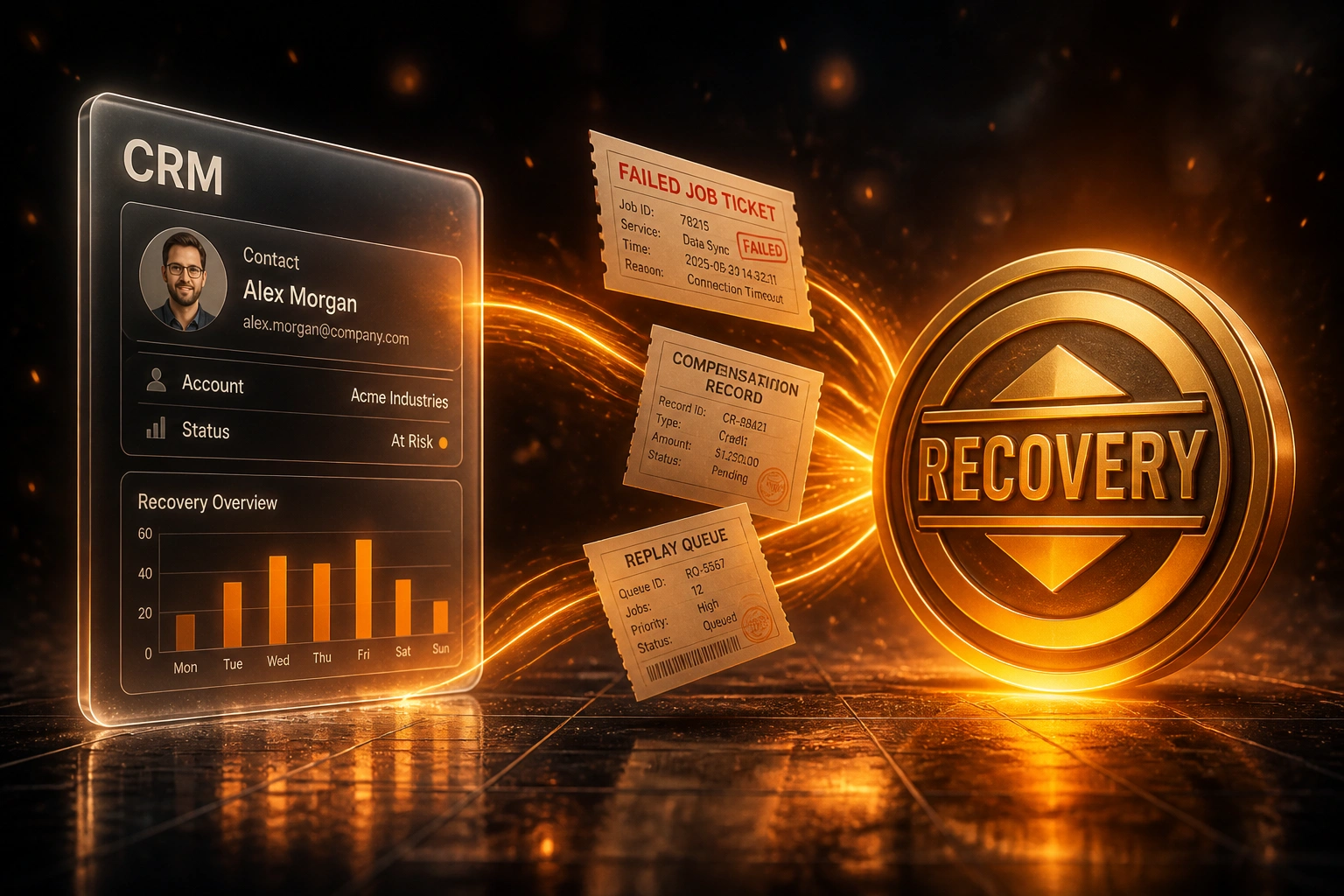
Sound Familiar?
These are the exact issues our clients faced before designed recovery patterns:
- An order sync fails halfway: stock is already deducted, the invoice is half-written, and the CRM stage is wrong
- Ops and finance spend evenings reconstructing what each system did, then fixing it by hand
- There is no checkpoint, so a failed job can only be re-run from the start and risk double writes
- Partial updates have no compensating path, so orphan invoices and phantom stock linger until month-end
- Failed mid-process jobs pile up with no intervention queue, so the mess only surfaces when an audit or close hits
Audit findings and month-end close blockers are the usual wake-up call. Seventy-one percent of organisations name bank reconciliation as their most time-consuming close activity, and forty-three percent regularly miss target close dates. Half-written invoices and stock mismatches from mid-process failures sit on that critical path until someone untangles them by hand.
What Error Recovery Actually Does Mid-Process
Failure detected → decide replay, compensate, or escalate → systems converge. No permanent half-written state.
Mid-Process Break
Stock deducts, then invoice create fails, or CRM updates while accounting never finishes
Checkpoint Replay
Job resumes from the last confirmed step so completed writes are not duplicated
Compensate or Escalate
Clear undo paths reverse earlier steps; ambiguous cases land in an intervention queue
Consistent Again
CRM, stock, and accounting agree, with an audit trail of what was recovered
Everything You Need for Mid-Process Failure Handling
Checkpoint Replay
Failed jobs resume from the last confirmed step, not from scratch. Stock, invoice, and CRM writes that already succeeded are not repeated.
Compensating Transactions
When a later step fails, defined undo actions reverse earlier work: release reserved stock, void draft invoices, or roll CRM stages back cleanly.
Manual Intervention Queues
Edge cases land in an ops or finance queue with full context: what succeeded, what failed, and which safe action is left. No more spreadsheet archaeology.
Durable Job State
Every mid-flight sync records step progress so a crash, timeout, or vendor outage never leaves silent half-written records across systems.
Recovery Playbooks
Replay, compensate, or escalate: each failure mode has a named recovery pattern your operations team can trust without calling a developer at midnight.
Audit-Ready Recovery Trails
Month-end and auditors see what failed, what was replayed, and what was compensated, with timestamps. Reconstruction from scattered logs is history.
Platforms We've Built Recovery Patterns Around
From 11 Hours/Week Cleanup to 1.5 Hours/Week
How a wholesale distributor stopped losing stock and invoice truth to mid-flight sync failures, and closed four days faster.
The Manual Recovery Mess
- Order sync failed after stock deduct: half-written Xero drafts and wrong CRM stages
- Ops manager spent 45–90 minutes reconstructing each mid-process failure by hand
- Re-running jobs from scratch created duplicate invoices and phantom stock moves
- Month-end close stalled while finance hunted orphan records across three systems
- Audit prep meant rebuilding timelines from email threads and export files
Designed Recovery Patterns
- Checkpoint replay resumes from the last confirmed step without double writes
- Compensating transactions release stock and void drafts when a later step fails
- Ambiguous cases land in a finance intervention queue with full step context
- Most mid-process failures recover the same day without spreadsheet archaeology
- Close and audit trails show what was replayed or compensated, with timestamps
Before vs After Recovery Patterns
How It Works
From first conversation to live recovery patterns in 2–4 weeks.
Map Mid-Flight Failure Paths
Where order, stock, invoice, and CRM updates can each succeed alone today, and what half-written mess that leaves.
Design Recovery Patterns
Checkpoint replay, compensating transactions, and intervention queues sized to your real multi-step syncs.
Prove Mid-Process Recovery
We deliberately fail jobs halfway and prove replay, compensation, or escalation restores consistency without data loss.
Go Live & Monitor
Production ships with recovery dashboards and intervention queues so ops clears exceptions before finance notices.
Frequently Asked Questions
What are integration error recovery patterns, in plain English?
They are the playbooks for what happens after a sync fails mid-process. Retry alone is not enough when stock is already deducted and the invoice never finished. Recovery patterns mean replay from a checkpoint, compensating transactions that undo completed steps, and manual intervention queues when a person must decide. Designed well, mid-flight failures become recoverable exceptions instead of permanent data loss.
How is this different from retries or distributed error detection?
Retries try the same call again when a vendor blips. Detection and reconciliation tell you systems disagree. Recovery patterns decide how to finish or unwind work that already partially succeeded: resume from the last safe step, reverse earlier side effects, or escalate with enough context for ops and finance to act. Most stacks need all three layers; this page is about the recovery layer after the mid-process break.
What does a mid-process failure actually cost us?
Published case studies put three mid-process payment workflow incidents in ninety days at about R776,000 in combined remediation once converted from USD benchmarks. A single partial-failure cleanup often takes thirty minutes or more of senior time. Teams without recovery patterns also burn twenty to fifty hours a month on cash reconciliation that blocks the close. The visible ticket is usually only one-third to one-fifth of the real cost.
Will recovery patterns disrupt our current CRM and accounting tools?
No. We wrap checkpoint state, compensation rules, and intervention queues around the order-to-cash paths you already run. Your team keeps using HubSpot, Pipedrive, Shopify, Xero, Sage, and your payment gateway. The recovery discipline sits underneath so half-written invoices and wrong CRM stages no longer become permanent.
When do we need a human intervention queue versus automatic compensation?
Automatic compensation suits clear undo paths: release reserved stock, void a draft invoice, reopen a deal stage. Intervention queues handle ambiguous or high-value cases where finance must choose complete versus reverse, or where both the forward step and the compensation failed. The design mistake is having neither.
How much does an integration recovery layer cost?
Focused recovery for one critical multi-step path (checkpoint replay, compensation, and an intervention queue) typically starts around R25,000. Broader order-to-cash recovery across CRM, stock, payments, and accounting usually sits between R40,000 and R70,000. Teams burning ten or more ops hours a week on mid-flight cleanup usually see payback within two to four months.
Stop Treating Mid-Process Failures as Permanent
If operations or finance is still untangling half-written invoices, wrong CRM stages, and phantom stock by hand, you are paying for a recovery problem that already has a playbook.
Tell us which multi-step syncs break mid-flight today, how long cleanup takes, and where month-end or audits get blocked. We will show you exactly how checkpoint replay, compensating transactions, and intervention queues would work for your stack.