Integration Monitoring and Alerting Setup: Catch Silent Failures Before Month-End
Silent CRM-to-accounting and payment sync failures corrupt data for days before anyone notices. You find out when a customer complains or month-end close will not balance, and by then failure detection has already cost you hours of forensic reconciliation.
We build the monitoring and alerting that pays for itself in the first avoided silent outage.
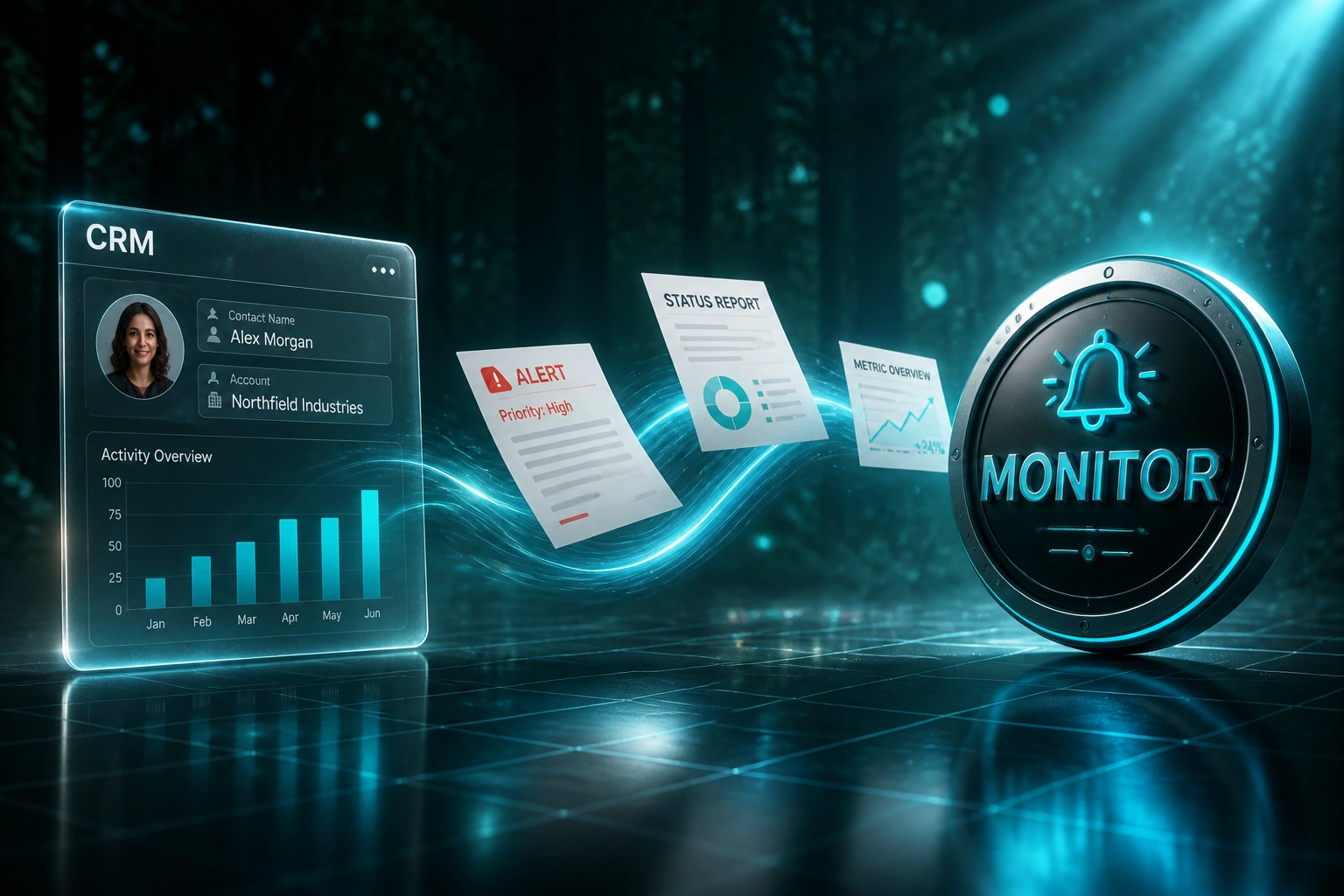
Sound Familiar?
These are the exact issues our clients faced before proactive failure detection:
- CRM-to-accounting sync looks green for days while invoices silently stop landing in Xero or Sage
- Payment confirmations never reach the CRM, so sales keeps chasing clients who already paid
- Month-end close fails first: finance discovers the gap when the books will not reconcile
- Customers complain before your team does, because no alert fired on lag or missing rows
- After each silent outage, ops spends a full day reconstructing which records need manual repair
SOC 2 CC7.2 expects continuous monitoring with alert ownership and triage evidence. Auditors sample acknowledgement timestamps and runbook responses across the observation period. A green dashboard nobody checked is not enough when integrations sit in scope.
What Integration Monitoring Actually Does
Signal → threshold → page the right person → contain the blast radius. Failure detection becomes minutes, not days.
Watch Critical Paths
Health checks and lag metrics run on CRM, accounting, and payment syncs
Cross a Meaningful Threshold
Silence, lag, or row-count shortfalls trip an alert: not every single blip
Reach On-Call Fast
WhatsApp, SMS, or pager routes to the owner with severity and blast radius
Contain Before Close
Fix the sync while the window is minutes, not after month-end fails
Everything You Need for Proactive Failure Detection
Health Checks on Every Sync
Heartbeat and completion signals on CRM, accounting, and payment paths. If a job that should run every five minutes goes quiet, you know before customers do.
Lag and Freshness Metrics
Track how old the newest synced record is. When CRM-to-Xero lag crosses your threshold, an alert fires while the window is still measured in minutes, not days.
Meaningful Alert Thresholds
One failed webhook is noise. Twenty failures across fifteen tenants in ten minutes is an incident. Thresholds are tuned so on-call only wakes for patterns that matter.
Row-Count and Completeness Checks
Compare expected vs delivered record counts after each sync. A pipeline that wrote zero rows where it normally writes thousands surfaces within minutes, not at month-end.
On-Call Routing That Reaches People
Alerts route to WhatsApp, SMS, email, or your existing pager with clear ownership and severity. Acknowledgement timestamps become the audit trail your SOC 2 programme needs.
Blast Radius and Runbooks
When an alert opens, you see which customers and flows are affected, plus the first steps to contain damage. Investigation stops being a two-hour grepping exercise.
Systems We Monitor Across
From Days of Silence to an Eight-Minute Alert
How a mid-size wholesale distributor stopped discovering CRM-to-Xero and payment sync failures at month-end, and recovered R280,000 in year one.
The Silent Failure Cycle
- CRM invoices and payment webhooks looked healthy while syncs quietly stopped
- Ops learned about gaps when a customer chased a missing credit note, or month-end would not close
- One four-day silent window needed 22 hours of forensic matching across CRM and Xero
- Finance burned roughly 18 hours a month reconciling sync discrepancies
- No on-call path: the first alert was always a person complaining
Proactive Monitoring Live
- Health checks and lag metrics on CRM-to-Xero and payment confirmation paths
- Threshold alerts route to WhatsApp on-call with severity and affected record counts
- Mean time to detect dropped to eight minutes on the first silent-failure drill
- Monthly reconciliation after incidents fell from 18 hours to about one
- Month-end close stopped being the de facto monitoring system
Before vs After Integration Monitoring
How It Works
From first conversation to live alerting in 2 to 4 weeks.
Map What Must Not Go Silent
We list every CRM, accounting, and payment sync that would hurt month-end or customers if it failed without anyone noticing.
Define Signals and Thresholds
Health checks, lag windows, row-count baselines, and alert severity are agreed with ops and finance so noise stays out of the pager.
Wire Monitoring and On-Call
We instrument the live paths, route alerts to the right owners, and prove detection with a deliberate silent-failure drill.
Go Live and Tune
Monitoring ships with a first-week review. Thresholds tighten, false positives drop, and MTTD settles into minutes.
Frequently Asked Questions
What is integration monitoring, in plain English?
It is continuous watching of the handoffs between your systems: CRM to accounting, payments to CRM, warehouse to ecommerce. Instead of waiting for a customer complaint or a failed month-end close, you get an alert when a sync goes quiet, lag grows, or record counts fall short of what normally arrives.
How is this different from uptime monitoring or retries?
Uptime checks tell you a server is reachable. Retries try again when a call fails loudly. Silent failures look healthy on both: the API returns 200, the dashboard stays green, and data simply stops moving. Integration monitoring watches outcomes and freshness, not just whether an endpoint answered.
How quickly should we detect a silent sync failure?
Industry guidance for critical user journeys targets a mean time to detect of 5 to 15 minutes. Without targeted monitoring, median discovery for silent failures is typically 6 to 18 hours, and the first signal is often a customer or a month-end reconciliation miss. We design thresholds so your team hears first.
Will this flood us with false alarms?
Not if thresholds are designed properly. We separate single blips from patterns, set lag and volume baselines from your real traffic, and route only actionable severities to on-call. The first week after go-live is spent tuning so the pager stays quiet unless something business-critical is wrong.
Does this help with SOC 2 or audit evidence?
Yes. SOC 2 CC7.2 expects continuous monitoring of system components, alert ownership, and evidence that anomalies were triaged. Alert history, acknowledgement timestamps, and runbook responses become the operating evidence auditors sample, rather than a dashboard nobody checked.
How much does an integration monitoring and alerting setup cost?
Focused monitoring on two or three critical sync paths typically starts around R25,000. Broader coverage across CRM, accounting, and payments with lag metrics, row-count checks, and on-call routing usually sits between R40,000 and R75,000. Most clients recover the build cost from the first avoided silent outage and the reconciliation hours that follow it.
Find Silent Sync Failures Before Your Customers Do
If CRM-to-accounting or payment syncs can fail without anyone knowing until month-end, you are paying for a monitoring gap every quiet hour that passes.
Tell us which integrations matter most, how you hear about problems today, and who should get the first alert. We will show you what proactive integration monitoring would look like for your stack, and how quickly it pays back.