Inventory to Accounting Integration: Reliable COGS Automation
Every month-end, your warehouse system and your ledger tell different stories about stock. Finance rebuilds COGS by hand, auditors question valuations, and the P&L you present is already stale.
We build the inventory accounting sync that makes stock financial integration automatic.
Sound Familiar?
These are the exact issues our clients faced before inventory accounting sync:
- Warehouse on-hand and the accounting inventory asset disagree every month-end
- Finance rebuilds COGS from stock exports, invoices, and spreadsheets for 3 to 5 days
- Stock journals land late, so gross margin in the P&L is already a week stale
- Auditors query valuation method, write-offs, and cut-off because the trail is manual
- Ecommerce growth multiplies SKU movements until manual journals are impossible
IFRS inventory disclosure and SARS audit findings put stock valuations under a microscope. When ecommerce growth multiplies SKU movements, month-end journal rework cannot keep up, and carrying costs of 20–30% of inventory value punish every valuation error.
What Inventory Accounting Sync Actually Does
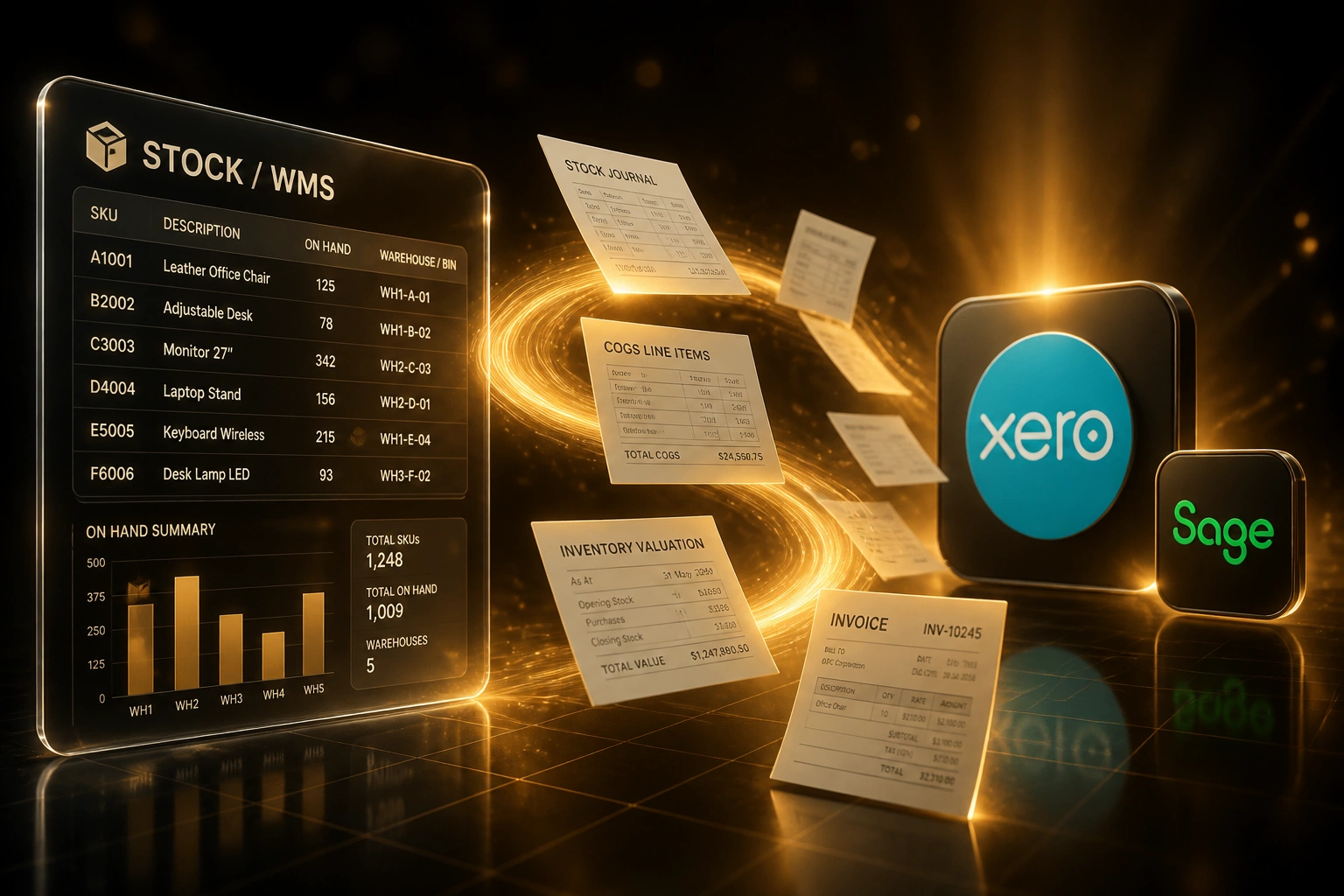
Stock moves in the warehouse → journals post in the ledger → COGS and inventory asset stay honest. No human rebuilding the month-end file.
Stock Moves in WMS
Receipt, pick, transfer, adjustment, or write-off lands in the warehouse system
Journal Posted to Ledger
Quantity, unit cost, and account codes map into Xero, Sage, or Pastel automatically
COGS and Asset Updated
Inventory asset and cost of goods sold move with the physical stock event
Month-End Already Matches
Finance reviews exceptions instead of rebuilding COGS from scratch
Everything You Need for Stock Financial Integration
Stock Movement Journals
Receipts, issues, transfers, adjustments, and write-offs from the WMS post as inventory and COGS journals in Xero, Sage, or Pastel automatically.
COGS Automation
Each fulfilment or issue posts cost of goods sold at the correct unit cost, so gross margin tracks reality instead of a month-end estimate.
Inventory Asset Sync
The ledger inventory balance moves with warehouse quantity and value, so stock on the balance sheet matches what operations can actually ship.
Valuation Method Mapping
Weighted average, FIFO, or standard cost in the inventory system maps to the accounting treatment your auditor and IFRS disclosures expect.
Cut-Off and Exception Alerts
Failed posts, negative stock, and period-lock conflicts retry or escalate. Finance only touches the exceptions, not every journal.
Audit-Ready Trail
Every stock financial entry links back to the warehouse movement, SKU, and timestamp, so SARS and external audit can follow the chain.
Systems We've Connected for Stock Financial Sync
From 5 Days of COGS Close to 4 Hours
How a Gauteng wholesale distributor stopped rebuilding stock journals by hand and made inventory asset and COGS match the warehouse every month.
The Manual Process
- Finance exported WMS movements and rebuilt COGS in a master spreadsheet
- 3 to 5 days each month chasing SKU discrepancies before journals could post
- Inventory asset on the balance sheet drifted from warehouse on-hand by mid-month
- External auditors queried write-offs and valuation cut-off every year-end
- Ecommerce channel growth made the spreadsheet file unmanageable
The Automated Process
- Every WMS receipt, issue, and write-off posts a journal into Xero within minutes
- Finance reviews exception alerts instead of rebuilding the full COGS file
- Inventory asset and warehouse on-hand stay within a narrow tolerance band
- Audit trail links each ledger line to the warehouse movement and SKU
- Month-end COGS close is a review, not a construction project
Before vs After Inventory Accounting Sync
How It Works
From first conversation to live stock financial sync in 3–5 weeks.
Map Stock Truth
Which system owns quantity and cost, how valuation works, and which movements must hit the ledger.
Free Scoping Call
30-minute call to design COGS posting rules, account codes, and what happens on write-offs and transfers.
Build & Parallel Test
We wire the sync, run parallel against your current month-end journals, and prove inventory asset and COGS match.
Go Live & Monitor
Switch off spreadsheet COGS rebuilds. Monitoring catches exceptions before auditors do.
Frequently Asked Questions
What is inventory accounting sync?
It is the continuous posting of warehouse stock movements into your accounting ledger so inventory asset, COGS, and stock valuations stay accurate without month-end spreadsheet rebuilds. Receipts, issues, transfers, and write-offs from the WMS or inventory system become financial journals in Xero, Sage, or Pastel. It is about stock financial integration and COGS automation, not about CRM deals creating invoices.
How is this different from inventory-aware invoicing?
Inventory-aware invoicing checks available stock before a CRM deal confirms and deducts quantity when an invoice posts, so sales cannot oversell. Inventory accounting sync answers a different question: when stock physically moves, do the inventory asset and COGS in the ledger move with it? You can stop overselling and still have unreliable COGS if warehouse journals never reach accounting.
Why not rely on Xero or Sage inventory alone?
Native Xero inventory is accounting-first: single-location quantity, weighted average cost by default, and a practical limit around 4,000 tracked items. It is not a warehouse system for multi-site stock, barcode picking, or batch tracking. Growing wholesalers and retailers usually keep a separate WMS as the operational source of truth and push financial journals into Xero, Sage, or Pastel. That handoff is what we automate.
Which inventory and accounting systems can you connect?
We have built stock financial integrations into Xero, Sage Business Cloud, Sage Pastel, Sage Evolution, and QuickBooks from Cin7, DEAR / Cin7 Core, Shopify inventory exports, and custom or on-premise WMS platforms. If your inventory system exposes movements with quantity, cost, and SKU, and your ledger accepts journals or inventory transactions, we can sync them.
Will this disrupt month-end close while we go live?
No. We run parallel for at least one full close cycle so finance can compare automated journals against the current spreadsheet process before switching off the manual rebuild. Your team keeps the same accounting system; the change is that stock movements already sit in the ledger when close starts.
How much does inventory accounting integration cost?
A focused one-way stock-to-ledger sync starts from around R25,000. Bidirectional setups with multi-warehouse valuation, write-off workflows, and exception alerting typically range from R40,000 to R75,000. Finance teams reclaiming even one full-time week of month-end COGS rework usually see payback within two to four months.
Stop Rebuilding Stock Journals Every Month-End
If warehouse on-hand and your ledger inventory asset still disagree at close, you are paying for a problem that inventory accounting sync already solves.
Tell us which WMS or inventory system you run, which ledger you close in, and where COGS rework hurts most. We will show you exactly how stock financial integration would work for your business.