Match Invoices to Purchase Orders Automatically
Your AP team still opens every supplier invoice, hunts for the PO, then cross-checks the delivery note by hand. Price and quantity variances slip through until payment has already gone, and early payment discounts expire while matching waits in a queue.
We build automated three-way matching that flags discrepancies before you pay.
Sound Familiar?
These are the exact issues our clients faced before purchase order matching automation:
- AP clerks open the invoice, hunt for the PO, then chase the goods receipt note across email and the warehouse system
- Price and quantity variances only surface after payment has already left the bank
- Roughly one in six invoices becomes an exception that sits for days while finance and procurement argue over tolerances
- Duplicate supplier invoices slip through when PO numbers are mistyped or GRNs are late
- Early payment discounts expire because matching still takes more than a week
Best-in-class AP teams process invoices at roughly R51 each versus R174–R238 for the average, a gap Ardent Partners puts near 70–78% lower cost. Most of that gap is matching, exceptions, and rework your team still does by hand.
What Automated Three-Way Matching Actually Does
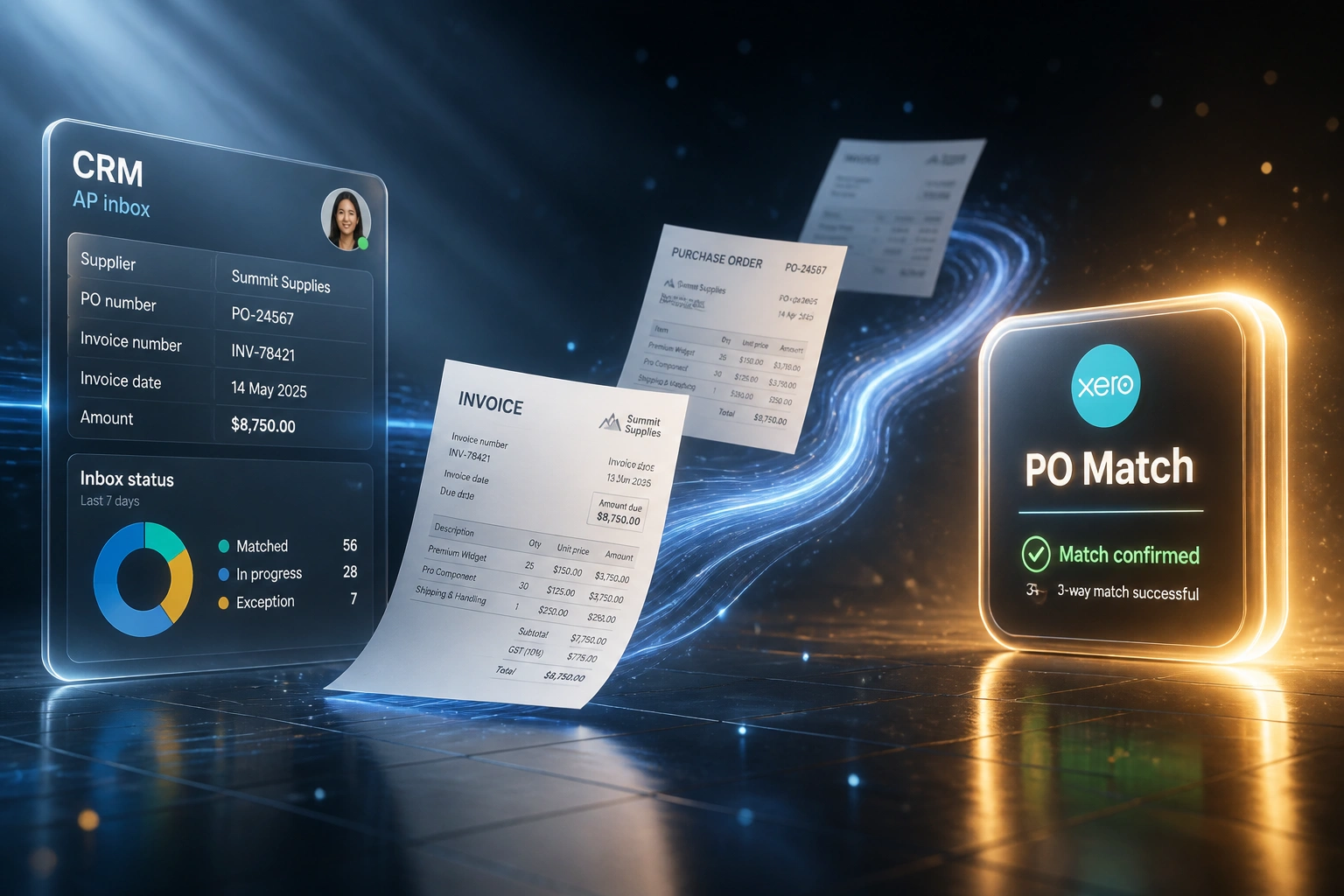
Invoice arrives → matched to PO and GRN → exceptions flagged → payment only when the three documents agree.
Invoice Captured
Supplier PDF, email, or EDI bill lands in the AP inbox with lines extracted
PO & GRN Matched
Quantity, unit price, VAT, and PO number checked against open purchase order and goods receipt
Exceptions Queued
Only variances outside tolerance go to AP or procurement with the failing line highlighted
Payment Cleared
Matched bills post to the ledger; payment runs only against confirmed three-way matches
Everything You Need for Reliable PO Matching
Automated Three-Way Match
Supplier invoice lines are checked against the purchase order and goods receipt note for quantity, unit price, VAT, and PO number before payment is released.
Tolerance & Exception Queues
Within-tolerance matches post straight through. Real variances (price, qty, missing GRN) land in an exception queue with the exact line that failed.
Duplicate Invoice Detection
The same supplier, amount, and invoice number combination is blocked before a second payment run, even when the PO reference looks slightly different.
Ledger Write-Back
Matched bills post into Xero, Sage, or your ERP with the PO link, tax codes, and approval trail already attached for audit.
Approval Routing on Exceptions
Only genuine mismatches need a human. Approvers get Slack, Teams, email, or WhatsApp with one-click accept, reject, or short-pay.
Audit Trail for Finance
Every match, override, and short payment is logged with who decided what and when, so month-end and external audit stop rebuilding evidence packs.
Ledgers & ERPs We've Matched Against
From 12 Minutes per Invoice to Exception-Only Review
How a mid-market distributor stopped overpaying on price and quantity variances and freed AP from line-by-line PO matching.
The Manual Process
- AP opened each PDF invoice and searched for the PO in Sage, then emailed the warehouse for the GRN
- About 12 minutes per invoice on a clean match; exceptions stretched into multi-day email threads
- Roughly 16% of invoices needed investigation for price, qty, or missing delivery notes
- Average invoice cycle sat near 10 days, so 2/10 early payment discounts were routinely missed
- Two duplicate payments in a quarter were only found when suppliers offered credit notes
The Automated Process
- Invoices auto-match to open POs and GRNs; clean matches post for payment without a second look
- AP reviews only the exception queue, typically under 2 hours a week
- Price and quantity variances are blocked before the payment run leaves the bank
- Cycle time dropped toward the best-in-class 3-day band, unlocking early payment discounts again
- Duplicate detection stopped a second payment on the same supplier invoice number
Before vs After Purchase Order Matching
How It Works
From first conversation to live three-way matching in 2–4 weeks.
Tell Us Your Setup
Which ledger and purchasing systems, how invoices arrive today, and where PO and GRN data lives.
Free Scoping Call
30-minute call to map match rules, tolerance bands, exception owners, and payment hold behaviour.
Build & Test
We wire invoice capture to PO and GRN matching, run parallel for a week, and validate exception queues against real supplier bills.
Go Live & Monitor
Switch off the manual line-by-line match. Monitoring keeps tolerances honest as suppliers and catalogues change.
Frequently Asked Questions
How long does three-way matching automation take to set up?
A focused pilot on PO-backed supplier invoices with Xero or Sage write-back usually takes 2–4 weeks from scoping to go-live. Multi-entity rules, OCR capture, EDI GRNs, and complex tolerance matrices typically take 4–6 weeks.
Which systems can you match invoices against?
We have built purchase order matching against Xero, Sage, NetSuite, SAP Business One, Syspro, QuickBooks, and custom ERP or WMS databases. If supplier invoices, open POs, and goods receipt notes are accessible, we can automate the three-way match.
Will AP still approve every supplier invoice?
Clean matches within your tolerance bands can post for payment without a second look. Everything outside tolerance (price, quantity, missing GRN, VAT mismatch) still needs a human. The default is straight-through for matches and a clear exception queue for the rest.
How is this different from purchase order automation?
Purchase order automation generates and releases POs when stock hits reorder points. Invoice-to-PO matching sits on the AP side after the goods arrive: it compares the supplier invoice to the PO and delivery note before you pay. Many finance teams need both.
How do you handle partial deliveries and price variances?
During setup we encode quantity and price tolerances by supplier or category. Partial GRNs match the received lines only. Over-deliveries and unit-price drifts outside tolerance become exceptions with the exact line highlighted for procurement or AP to resolve.
How much does invoice-to-PO matching cost?
PO-backed three-way matching into a single ledger starts from around R15,000. Full AP matching with OCR capture, tolerance rules, exception routing, duplicate detection, and ERP write-back typically ranges from R25,000 to R60,000. Teams processing 200+ supplier invoices a month usually see payback within 1–3 months from staff time and stopped overpayments alone.
Stop Matching Invoices to POs by Hand
If your AP team is still line-checking supplier invoices against purchase orders and delivery notes, you are paying for control that automation already delivers faster and with fewer overpayments.
Tell us which ledger you run, how invoices arrive, and where POs and GRNs live. We will show you exactly how automated three-way matching would work for your volumes and tolerances.