Build an Invoicing Workflow Designed for Agency Operations
Agencies juggling retainers, projects, and ad-hoc work lose cashflow when billing models collide and finance rebuilds invoices from three systems every month. Clients wait, disputes rise, and money that should already be in the bank is still WIP.
We build the agency invoicing workflow that bills all three models in one run.
Sound Familiar?
These are the exact issues agency owners and ops leads faced before a purpose-built agency billing workflow:
- Finance rebuilds invoices every month from the CRM, the project tool, and a media spend spreadsheet
- Retainer renewals slip while milestone invoices and ad-hoc T&M lines wait in a separate queue
- Pass-through media and production costs land on the wrong invoice, or never get billed at all
- Clients query line items because retainers, projects, and extras were pasted together by hand
- Billing closes late, so cash that should already be in AR is still stuck as WIP across three models
39% of small-agency invoices are paid late, and slow payment commonly ties up 8–12% of annual revenue as working capital. When billing models collide and invoices go out late or wrong, the cash crunch shows up weeks before payroll feels it.
What an Agency Invoicing Workflow Actually Does
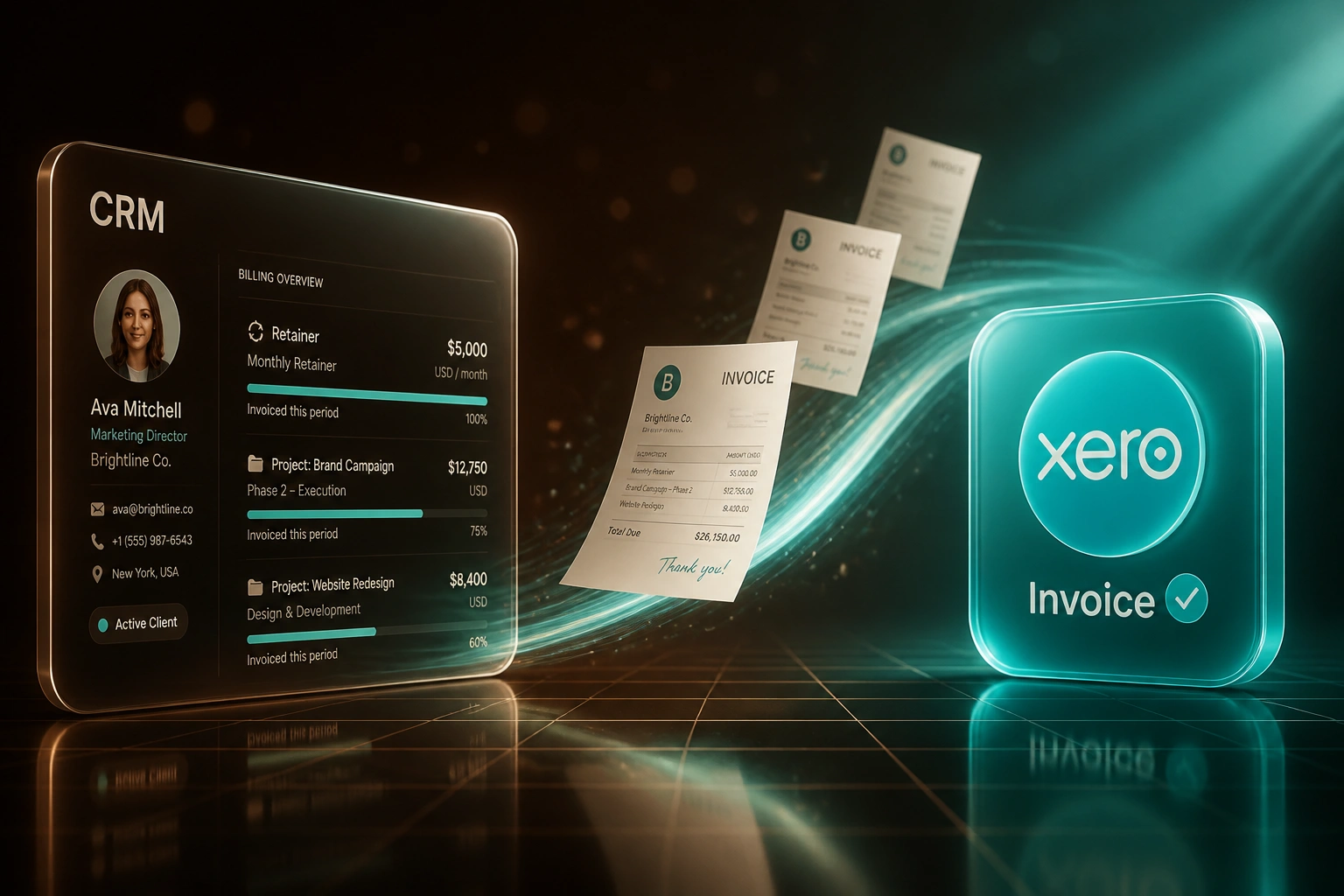
Retainers renew, milestones hit, ad-hoc work closes. One invoice run. No human rebuilding from three systems.
Billing Events Fire
Retainer date, project milestone, or approved ad-hoc work triggers from CRM and project tools
Lines Compose Correctly
Retainers, milestones, T&M, and media pass-throughs map to the right client, tax, and account codes
Draft Hits Accounting
Invoice appears in Xero, Sage, or QuickBooks for review and send, same day the cycle closes
Cash Status Syncs Back
Payment updates flow to the CRM so ops and account leads see what is still outstanding
Everything You Need for Agency Billing That Holds Together
Retainer Renewals on Schedule
Day-1 monthly retainers raise from CRM agreements with balance tracking, renewals, and overage lines when scope runs hot.
Milestone & Project Billing
Fixed-fee projects invoice on deposit, progress, and completion triggers from the project tool, not a Friday spreadsheet.
Ad-Hoc & T&M Capture
Time-and-materials and one-off work become invoice lines alongside retainers, so nothing waits for a separate billing run.
Media & Pass-Through Costs
Media buy, production, and vendor costs map to the right client invoice with markup rules and account codes already set.
CRM & Project Tool Sync
Contacts, agreements, and deliverables stay aligned with Xero, Sage, or QuickBooks so finance stops re-keying client detail.
Payment Visibility Back
When a client pays in accounting, status syncs back to the CRM or ops view so account leads know what is still outstanding.
Systems We've Wired Into Agency Billing Workflows
From 22 Hours/Month to 3.5 Hours/Month
How an 18-person digital agency stopped rebuilding mixed-model invoices by hand and cut DSO by 24 days.
The Manual Process
- Ops pulled retainer amounts from HubSpot, milestones from Asana, and media lines from a shared sheet
- Finance rebuilt each client invoice in Xero: roughly 22 hours every month across the team
- About one in five invoices needed correction after a client query on wrong lines or missing pass-throughs
- Billing often closed 4–6 days after month-end, stretching DSO past 50 days
- Account leads had no live view of what was paid without chasing finance
The Automated Process
- Retainers, milestones, and ad-hoc lines draft into Xero from CRM and project events
- Finance reviews a composed invoice instead of building it; media markups apply automatically
- Correction rate dropped below 4%, with exceptions flagged before send
- Same-week close every cycle; DSO moved from 52 days to 28
- Payment status visible in HubSpot without asking anyone
Before vs After an Agency Billing Workflow
How It Works
From first conversation to live agency billing workflow in 2–4 weeks.
Tell Us Your Setup
Which CRM and project tools you run, how retainers, projects, and ad-hoc work are billed today, and where month-end breaks.
Free Scoping Call
30-minute call to map billing models, VAT treatment, media pass-through rules, and the systems that must stay in sync.
Build & Test
We build the workflow, test with real retainers and project milestones, and run a parallel billing cycle for finance to compare.
Go Live & Monitor
Switch off the three-system rebuild. Monitoring catches exceptions early so the monthly invoice run still closes on time.
Frequently Asked Questions
How is this different from timesheet-to-invoice automation?
Timesheet pipelines solve hourly billing. An agency invoicing workflow handles the full mix: recurring retainers, fixed-fee milestone projects, ad-hoc T&M, and media or production pass-throughs, synced from CRM and project tools into accounting as one coherent run.
How long does an agency billing workflow take to set up?
A focused retainer-plus-project setup usually takes 2–4 weeks from scoping to go-live. Agencies with multiple entities, complex media markups, or dual ledgers typically sit closer to 4–6 weeks.
Which CRMs, project tools, and accounting systems can you connect?
We regularly connect HubSpot, Pipedrive, Salesforce, Asana, Monday.com, and ClickUp into Xero, Sage Business Cloud, Sage Evolution, and QuickBooks Online. If your stack has an API, we can usually bridge it.
Will account managers still need to rebuild invoices at month-end?
No. Retainers, milestones, and ad-hoc lines draft automatically from the rules we set with you. Finance reviews and approves; account managers stop pasting from three systems into one invoice.
How do you handle media spend and pass-through costs?
During setup we map vendor costs, markup percentages, and account codes so pass-through lines land on the correct client invoice with the right VAT treatment. Exceptions pause for review instead of posting a wrong bill.
How much does an agency invoicing workflow cost?
Simple retainer-to-ledger syncs start from around R15,000. Mixed-model workflows with milestone billing, media pass-through, and payment status sync typically range from R25,000 to R60,000. Most agencies with 15+ active clients recover that within one to three billing cycles.
Stop Rebuilding Invoices From Three Systems
If your agency still pastes retainers, project milestones, and ad-hoc lines into accounting by hand, you are paying for a problem that a purpose-built agency invoicing workflow already solves.
Tell us which CRM and project tools you run, how retainers and projects are structured, and where month-end hurts most. We will show you exactly how a unified billing workflow would work for your book.