KYB Beneficial Ownership: Verify Ultimate Owners Behind Corporate Clients
Layered companies, trusts, and nominee arrangements hide the people who actually control the risk. Manual UBO tracing takes days, misses indirect owners, and leaves your MLRO without an inspection-ready ownership trail.
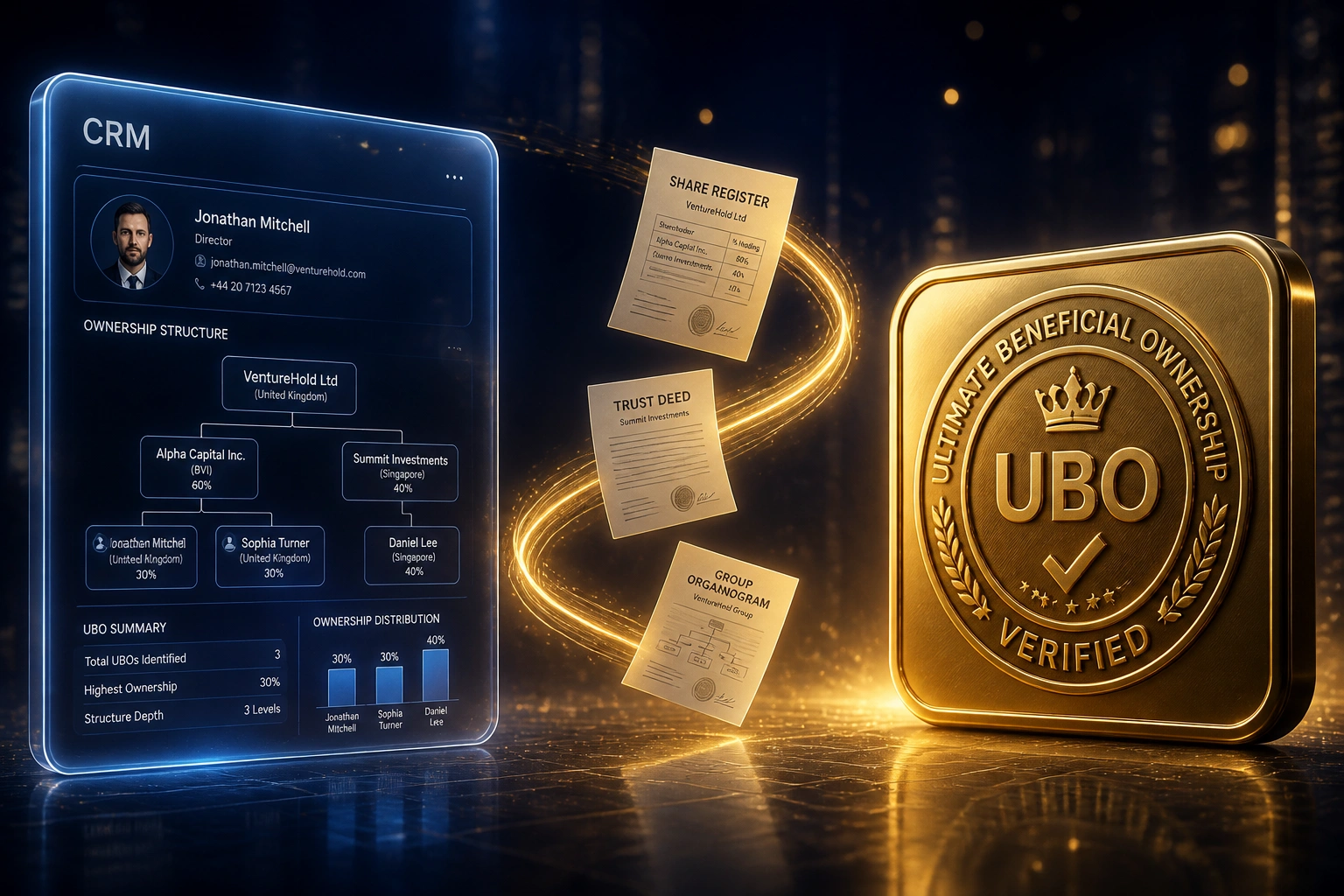
We automate beneficial ownership verification so the ownership tree, the flags, and the evidence arrive before the deal committee meets.
Sound Familiar?
These are the ownership headaches compliance leads and MLROs bring to us:
- Analysts spend a full day pulling CIPC extracts, share registers, and trust deeds for one layered client
- Nominee directors and offshore holding companies hide the natural person who actually controls the deal
- Self-declared UBOs on the application form are accepted because the ownership tree is too hard to rebuild by hand
- One in five complex structures misses an indirect owner on the first manual pass
- FIC inspections ask for the ownership trail and the file has screenshots, not a source-attributed organogram
South Africa exited the FATF grey list in October 2025, but the next mutual evaluation is already on the calendar for 2026–2027. CIPC beneficial ownership filings and FICA Section 21B juristic CDD remain fully in force. Supervisors now expect sustainable UBO verification, not a temporary paper trail built for delisting.
What Beneficial Ownership Verification Actually Does
Corporate client arrives → ownership tree resolved → opaque layers flagged → UBOs screened. Analysts review exceptions, not blank spreadsheets.
Client Declares Structure
Juristic onboarding starts in your CRM or core with the stated shareholders, trustees, and controllers
Tree Mapped Automatically
Registry and commercial data walk every layer until natural-person UBOs are identified
Opaque Paths Flagged
Nominee layers, circular holdings, and declaration mismatches escalate for analyst review
UBOs Screened & Filed
Verified owners enter sanctions/PEP screening and an audit-ready ownership pack lands on the case
Everything You Need for Reliable UBO Screening
Ownership Tree Mapping
Walk every shareholding layer, trust, and nominee arrangement until the natural person UBO is identified, with percentages aggregated to your FICA threshold.
Registry Cross-Checks
Compare client declarations against CIPC beneficial ownership filings, Masters' Office trust registers, and commercial corporate data so discrepancies surface automatically.
Opaque Structure Flags
Flag circular holdings, unexplained nominee layers, missing jurisdiction data, and control paths that stop before a natural person.
UBO Screening Handoff
Push verified ultimate beneficial owners into your sanctions and PEP workflow so ownership discovery and screening share one audit trail.
CRM & Case Write-Back
Store the resolved organogram, evidence links, and UBO identities on the deal or client record. Your MLRO reviews one pack, not a folder of PDFs.
Inspection-Ready Evidence
Every node carries a timestamp, source citation, and percentage so Section 21B juristic CDD survives FIC scrutiny without rebuilding the file.
Systems We've Connected for Ownership Workflows
From 8 Hours a File to 45 Minutes
How a mid-size corporate lender cleared a 60-deal UBO backlog and recovered over R628,000 in analyst time in year one.
The Manual Process
- Compliance analysts rebuilt organograms in spreadsheets from CIPC extracts and emailed share registers
- Complex files with trusts and offshore holdings took 6–8 hours each
- Indirect controllers were often missed until a second reviewer challenged the tree
- Deal committees waited while ownership packs were still incomplete
- Evidence for FIC reviews was a folder of screenshots without source attribution
The Automated Process
- Ownership tree maps automatically when a juristic deal enters onboarding
- Analysts validate flagged layers and opaque paths in about 45 minutes
- Declaration mismatches against CIPC BO filings surface before credit approval
- Verified UBOs hand off into sanctions and PEP screening with one audit trail
- Every node carries a timestamp and source citation for Section 21B evidence
Before vs After Beneficial Ownership Automation
How It Works
From first conversation to live beneficial ownership verification in 3–6 weeks.
Map Your Ownership Risk
Which products onboard juristic clients, where UBO files stall, and which registries you already subscribe to.
Free Scoping Call
30-minute call to design the ownership thresholds, escalation rules, and how results land in your CRM or case system.
Build & Parallel Test
We wire registry lookups, structure mapping, and opaque-structure flags, then run parallel on live deals for a week.
Go Live & Monitor
Switch off spreadsheet organograms. Monitoring catches ownership changes and keeps evidence packs current.
Frequently Asked Questions
How is beneficial ownership verification different from company registration checks?
Registration confirms the entity exists and is in good standing. Beneficial ownership verification traces who ultimately owns or controls it through layered companies, trusts, and nominees, then screens those natural persons. Both matter under FICA; they answer different questions.
Can we rely on the CIPC beneficial ownership register alone?
No. The CIPC filing is the company's duty under the Companies Act. FICA still requires accountable institutions to run independent Section 21B customer due diligence on juristic clients. We use the register as one verification source and flag mismatches against what the client declared.
What ownership threshold do you apply?
We configure the threshold to your RMCP. South African practice commonly uses 5% for CIPC filing and FIC guidance, while many international products default to 25%. Your programme decides; the integration enforces it consistently.
How long does a UBO verification integration take to deliver?
Most builds take 3–6 weeks from scoping to go-live. Simple one-way mapping into a case queue can be live in about two weeks. Multi-registry feeds with CRM write-back, opaque-structure scoring, and sanctions handoff usually sit closer to 4–6 weeks.
Will this replace our analysts?
No. Automation gathers the tree and flags opaque paths. Your analysts validate exceptions, escalate high-risk control arrangements, and sign off. The goal is to stop burning days on data gathering so the MLRO team spends time on judgement.
How much does beneficial ownership automation cost?
Scoped integrations typically range from R45,000 to R95,000 depending on registry coverage, CRM write-back, and screening handoff. Teams processing 20+ complex juristic onboardings a month usually recover that in analyst time within one to two quarters.
Stop Tracing Ownership Structures by Hand
If your compliance team is still rebuilding organograms from PDFs while deals wait, you are spending money on a risk that automation already solves.
Tell us how many juristic clients you onboard, where ownership files stall, and which registries you already use. We will show you how automated KYB beneficial ownership verification would work for your bank, wealth desk, or corporate lending book.