KYC Remediation: Clear Your Client Review Backlog with Automation
Your periodic KYC review backlog is a regulatory risk and a cost centre. Compliance officers drown in overdue re-verifications, FICA review deadlines, and manual chase emails while high-risk files wait in the same pile as everyone else.
We automate outreach, document collection, and risk-prioritised re-verification so months of backlog clear in weeks.
Sound Familiar?
These are the exact issues compliance officers and MLROs describe before remediation automation:
- Periodic KYC reviews sit overdue for months while high-risk clients wait in the same FIFO pile as low-risk files
- Compliance officers spend evenings sending chase emails and logging who replied, who ignored, and who needs a second nudge
- Document packs arrive incomplete, land in shared inboxes, and get re-requested weeks later with no single status view
- MLRO and board packs show backlog totals, not risk-tier exposure or days past the RMCP review deadline
- Inspection findings cite outdated client particulars and incomplete ongoing due diligence, even when onboarding looked fine years ago
South African supervisors are already fining ongoing due diligence failures. The Prudential Authority imposed R56.25 million on Capitec for CDD and ongoing due diligence gaps, including annual high-risk reviews. The FSCA fined Ninety One Fund Managers R3 million after finding inadequate ongoing due diligence across sampled clients. An overdue KYC remediation backlog is inspection risk, not just operational debt.
What Re-Verification Automation Actually Does
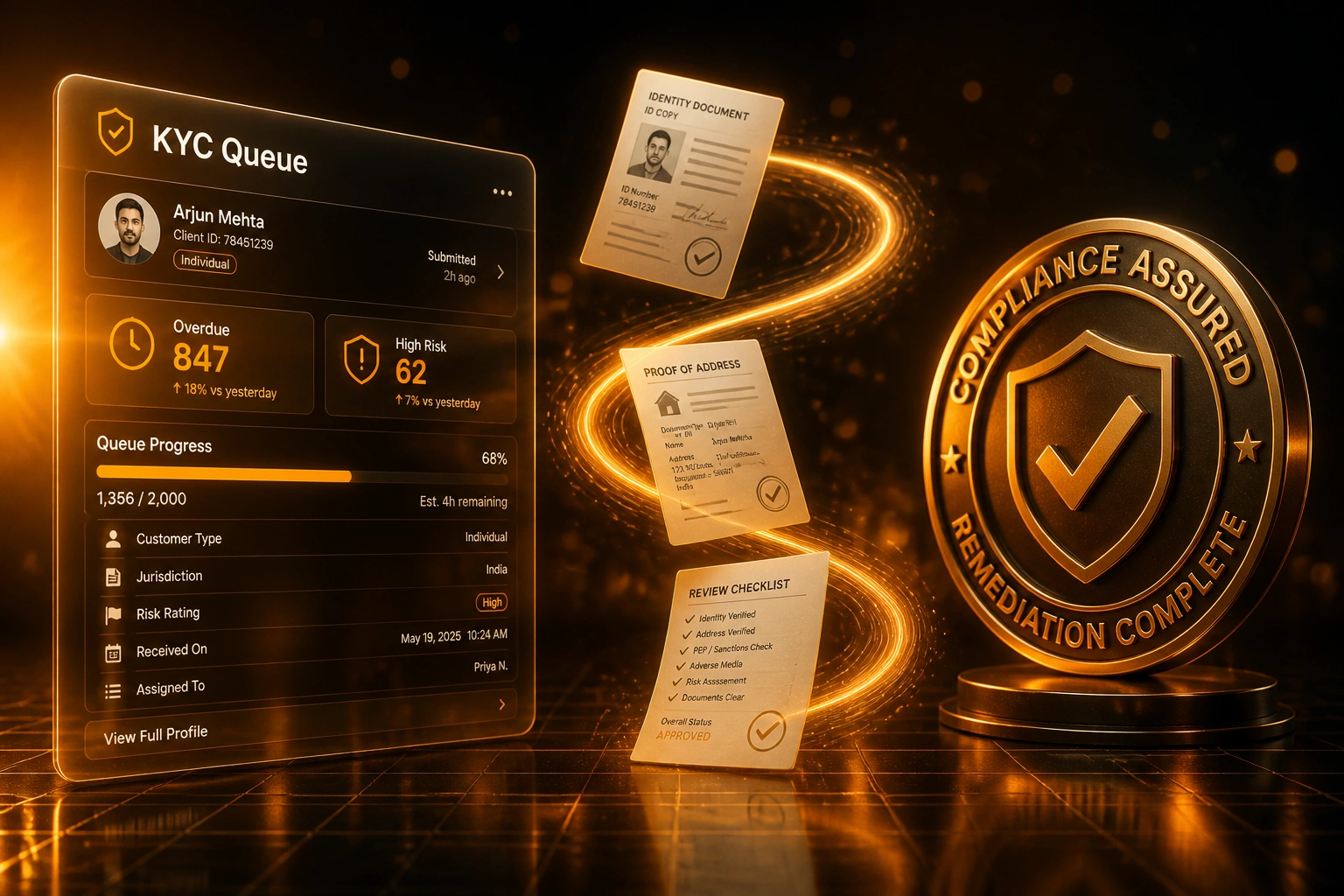
Overdue review flagged → client chased → documents verified → file closed with audit trail. No spreadsheet status theatre.
Review Hits the Queue
RMCP deadlines and risk tiers push overdue files into a prioritised KYC Queue
Automated Outreach
Clients receive document requests with reminders; compliance stops writing chase emails by hand
Collect & Re-Verify
Packs land in the portal, quality-checked, screened, and risk re-scored before close
Close & Report
Case system updates, next review date set, MLRO sees backlog burn-down by risk tier
Everything You Need to Clear a Compliance Backlog
Risk-Prioritised Remediation Queue
Overdue reviews surface by risk tier and days past deadline. High-risk and PEP files move to the front so regulatory exposure shrinks first.
Automated Multi-Channel Outreach
Email, SMS, and portal reminders fire on a defined cadence with clear document lists and consequence language. First-pass response stops depending on who remembers to chase.
Document Collection Portal
Clients upload refreshed IDs, proof of address, and ownership packs into a branded portal. Incomplete submissions get immediate prompts instead of silent email loops.
Re-Verification & Screening Refresh
Submitted documents run through quality and authenticity checks, then PEP, sanctions, and risk re-score before the file can close.
CRM & Case System Write-Back
Review status, new document links, updated risk rating, and next review date sync back to your CRM or case system so relationship managers see the same truth.
Escalation & Restriction Workflows
Non-responders escalate to relationship managers, then to restriction or exit workflows with a full audit trail for FIC and FSCA examiners.
Systems We Connect for Remediation Programmes
From 14 Weeks of Manual Chase to an 8-Week Clearance
How a Johannesburg FSP cleared 4,200 overdue periodic KYC reviews, put high-risk clients first, and recovered R2.1 million in year-one analyst time.
The Manual Remediation
- Three compliance analysts chased refreshes from Excel lists and shared inboxes
- Low-risk and high-risk files sat in the same FIFO pile with no deadline heat map
- First-pass document response hovered around 35%, with weeks of silent non-replies
- Management projected 14 weeks to clear the book at current capacity
- Board packs showed a single overdue total, not exposure by risk tier
The Automated Programme
- Risk-prioritised KYC Queue pushed 180 high-risk files to the front in week one
- Automated outreach and portal uploads replaced most chase emails
- First-pass document response rose to 72% with a defined reminder cadence
- High-risk exposure closed in 21 days; full backlog cleared in eight weeks
- MLRO dashboard tracked burn-down, response rates, and restriction escalations
Before vs After Client Review Backlog Automation
How It Works
From first conversation to a live remediation programme in 4–8 weeks for focused builds.
Tell Us Your Setup
Backlog size, risk tiers, RMCP review cadence, and which systems hold the client file today.
Free Scoping Call
30-minute call to map outreach rules, document checklists, escalation paths, and MLRO reporting needs.
Build & Test
We wire the queue, outreach, portal, and write-back, then pilot on a high-risk segment before full rollout.
Go Live & Monitor
Backlog clears by risk priority. Dashboards keep completion rates, chase response, and overdue exposure visible.
Frequently Asked Questions
How is KYC remediation different from onboarding automation?
Onboarding clears new clients. Remediation clears the existing book: overdue periodic reviews, refreshed documents, re-verification, and risk re-rating under your RMCP. The backlog is the problem, not first-time applications.
How long does a remediation backlog automation project take?
A focused queue-plus-outreach build typically takes 4–8 weeks from scoping to go-live. Full programmes with portal, screening refresh, CRM write-back, and restriction workflows usually land in 8–12 weeks. Targeted high-risk pilots can start clearing files within the first month.
Does this satisfy FICA ongoing due diligence requirements?
The FIC Act (section 21C) requires ongoing due diligence and up-to-date client particulars under your RMCP. We automate the operational work: prioritised queues, documented outreach, evidence collection, re-verification, and audit trails. Your RMCP still sets review triggers and risk tiers; we make those schedules executable at scale.
What happens when clients ignore outreach?
Industry first-pass response often sits between 20% and 60%. Our cadence includes second and third touches, relationship-manager escalation, and pre-defined restriction or exit paths so non-response does not stall the programme indefinitely.
Will this disrupt our compliance team or clients?
No. Examiners keep deciding exceptions in the same case system. Automation removes the chase admin, status tracking, and low-risk file handling. Clients get a clear portal request instead of ad hoc emails. We run a parallel pilot before switching off the manual path.
How much does KYC remediation backlog automation cost?
Focused backlog queue and outreach builds typically start from around R45,000. Full programmes with portal, re-verification, screening refresh, and CRM write-back usually sit in the R75,000–R180,000 range depending on volume and systems. Firms clearing thousands of overdue reviews often recover the build cost within one to two quarters from analyst time alone.
Stop Letting Overdue KYC Reviews Become Audit Findings
If your periodic review queue is growing faster than your team can chase documents, you are carrying regulatory exposure that automation already solves for other accountable institutions.
Tell us how large the backlog is, how your RMCP sets review cadence, and which systems hold the client file. We will show you a risk-prioritised clearance plan with realistic weeks-to-clear numbers.